
ChatGPT Enterprise is OpenAI’s sales-led version of ChatGPT for organizations. Instead of letting employees buy personal subscriptions, a company signs an agreement, receives a dedicated workspace, and decides centrally who can use which models and connected apps, how long content is stored, and how much usage each team may consume. OpenAI does not publish a price for the plan, which is why many buyers research it long before they ever speak to a salesperson.
This guide explains what the plan includes as of October 29, 2026, what is and is not public about its cost, how its data commitments work in practice, and when the cheaper self-serve Business plan is the smarter pick. Anything OpenAI has not disclosed is labeled as undisclosed.
Table of Contents
ChatGPT Enterprise at a Glance
| Question | Short answer |
|---|---|
| What is it? | A contract-based ChatGPT workspace for organizations, bought through OpenAI’s sales team |
| Who is it for? | Larger or more regulated organizations that need central governance |
| What does it cost? | Custom pricing; OpenAI publishes no list price |
| Is company data used for training? | Not by default, according to OpenAI’s Enterprise privacy commitments |
| Notable controls | SSO, SCIM, role-based access, key management, analytics, data residency options |
What Is ChatGPT Enterprise?
OpenAI announced ChatGPT Enterprise on August 28, 2023. Since when ChatGPT was released, the platform has grown from a faster, privacy-minded edition of the chatbot into a managed workspace with identity integration, audit tooling, spend controls, and agent features. OpenAI, which owns and operates ChatGPT, sells it through its sales team.
Who it is built for
OpenAI’s own Business help page tells organizations that need more than 200 paid seats to consider Enterprise. In practice the plan targets organizations where security, legal, and procurement teams all have a say, rather than a manager with a company card.
How it differs from a personal subscription
A personal plan belongs to one person and follows consumer settings. A workspace belongs to the organization: admins assign roles, switch features on or off, and can review activity. The commitments on OpenAI’s Enterprise privacy page cover business offerings, not personal plans. For a plain-English look at the individual tiers, see our guide on whether ChatGPT Plus is worth it, or start with how ChatGPT works.
ChatGPT Enterprise Features That Matter in 2026
Models and everyday tools
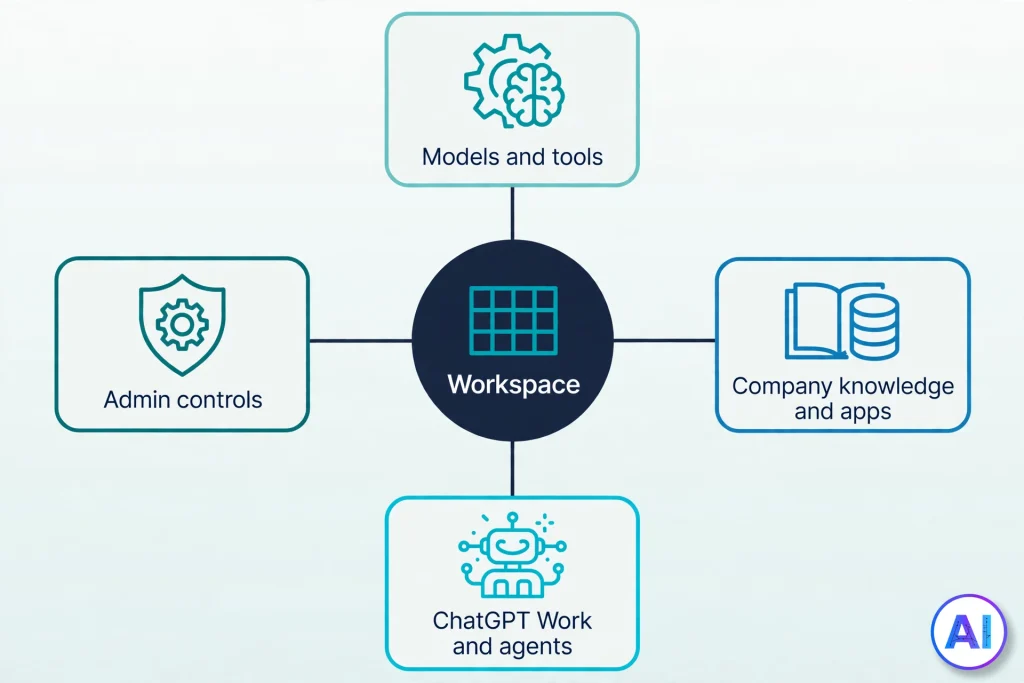
Members use the GPT models their admins enable. Access is governed by workspace settings and role-based permissions, and admins may see automatic-routing controls under Workspace settings. OpenAI describes message volume on eligible base models as virtually unlimited, subject to guardrails against misuse.
Built-in tools include apps, deep research, data analysis, file uploads, canvas, projects, search, advanced voice, and ChatGPT image generation. The model lineup moves quickly. OpenAI retired several older models from ChatGPT on February 13, 2026, so confirm what your workspace actually offers before promising a team a specific model.
Company knowledge and connected apps
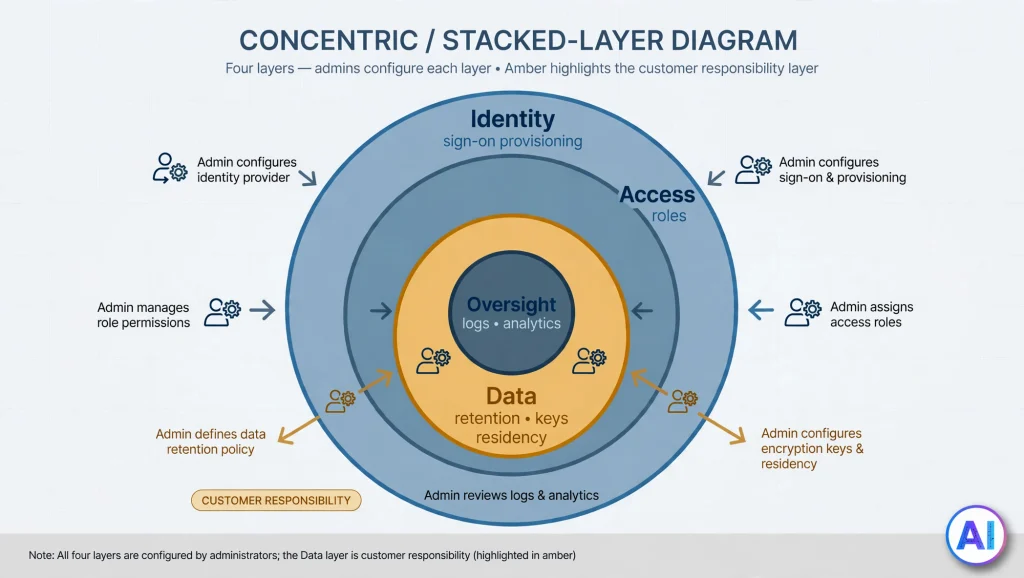
Company knowledge lets ChatGPT draw on internal sources such as documents, messages, tickets, and email through connected apps. In Enterprise workspaces those apps start switched off until an admin enables them. Admins can then limit individual apps with role-based controls and require SSO and SCIM for provisioning.
ChatGPT Work and workspace agents
In July 2026 OpenAI launched ChatGPT Work, an agent that acts across connected apps and files to produce sheets, slides, documents, and web apps, and can run scheduled tasks. Enterprise, Edu, and Pro users received it first.
Usage here behaves differently from chat. Heavier tasks consume more of a plan’s included usage, and Enterprise admins can set spend controls through workspace defaults, group limits, and individual overrides. Workspace agents are in research preview for Business, Enterprise, Edu, and Teachers plans; Enterprise admins decide which tools and actions each group may use, and the Compliance API exposes agent runs for review. Because agents touch real systems, treat them as pilot material, where approvals and access rules matter more than speed.
Administration and identity
OpenAI’s pricing page lists SCIM, Enterprise Key Management (EKM), user analytics, domain verification, and role-based access controls for the Enterprise tier. OpenAI has also announced custom roles with group-level permissions, OIDC alongside SAML for single sign-on, IP allowlisting, and a Compliance API that provides conversation logs for reporting. Listed support terms include 24/7 priority support, SLAs, custom legal terms, and AI advisors for eligible customers.
ChatGPT Enterprise Pricing: What Is Public and What Is Not
What OpenAI publishes
No per-seat figure. OpenAI’s pricing page lists the plan as custom pricing, points buyers to its sales team, and mentions invoicing and volume discounts. OpenAI publishes no minimum seat count or contract length for the plan.
Credit-based and token-based billing
Agreements come in two billing shapes. Credit-based agreements draw down a workspace balance bought up front for metered usage. Token-based agreements, offered on eligible agreements, add usage to a monthly invoice. OpenAI maintains a rate card for each, and an agreement can include a spending commitment covering both the plan and the API. Ask your account team which model applies, because it changes how you budget for heavy agent use.
What unofficial reports say
Several price-comparison sites (for example CloudZero) claim contracts cluster around $45 to $75 per user per month, with a seat minimum near 150 and annual prepayment. OpenAI has not confirmed those numbers. Treat them as a sanity check against a real quote, never as a price list.
ChatGPT Enterprise Security, Privacy and Data Residency
Data handling commitments
OpenAI states that it does not train its models on business data by default, that customers own their inputs and outputs where the law allows, and that Enterprise customers control how long data is retained. Custom models are described as exclusive to the customer that built them.
Certifications and encryption
OpenAI reports a completed SOC 2 audit, AES-256 encryption at rest, TLS 1.2 or higher in transit, and a Trust Portal with further detail. In a separate announcement it said its information security management system is certified by Schellman to ISO/IEC 27001, 27017, 27018, and 27701. These describe OpenAI’s controls. They do not make your own use of the product compliant automatically.
Data residency and inference residency
New Enterprise and Edu customers can store in-scope content at rest in ten regions: Australia, Canada, Europe (EEA plus Switzerland), India, Japan, Singapore, South Korea, the UAE, the UK, and the US. OpenAI includes this at no extra cost. Inference residency, which keeps model execution on in-region GPUs, is currently offered for Europe, the US, and the UAE, and requires data residency in the same region.
The limits matter. Workspace metadata, billing details, and logins can sit outside the region. Data passed to external integrations such as apps, MCP servers, or web search follows those providers’ rules. Beta features, third-party GPTs, and Codex web are excluded, and residency workspaces cannot share GPTs with “Anyone.” The UAE inference option also supports a narrower set of models and features.
What stays your responsibility
Your team configures SSO, SCIM, retention, and app access, and decides what staff may upload. People still need to review outputs, and teams that publish AI-assisted text may also want to understand how a ChatGPT detector works. Duties under GDPR, HIPAA, or sector rules require legal review and the right contract terms; no product removes risk entirely.
ChatGPT Enterprise vs Business, Plus and Edu
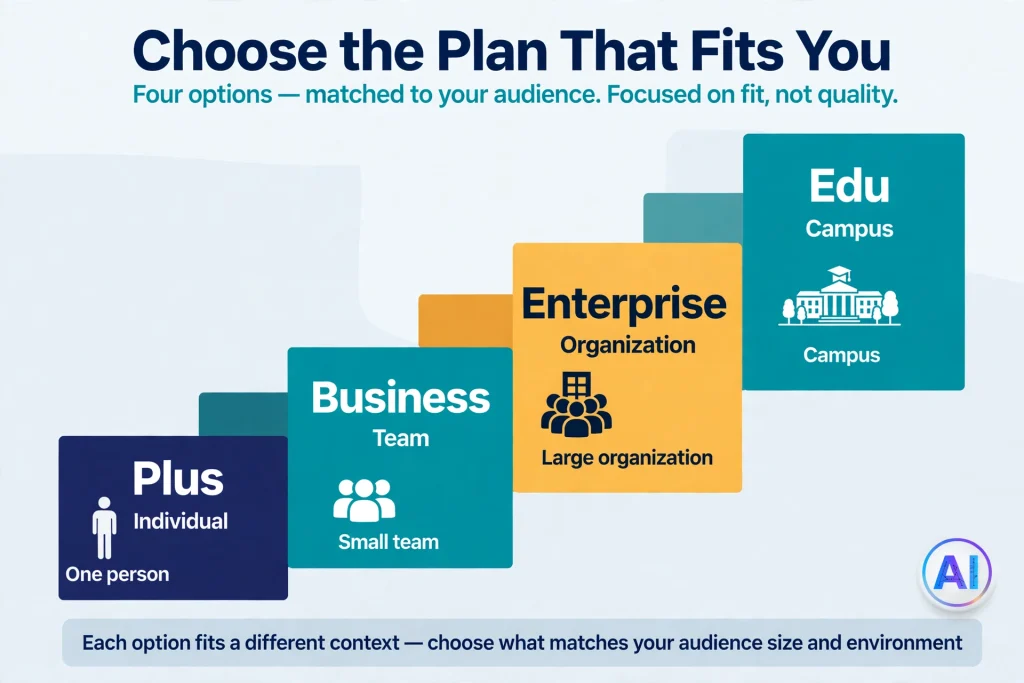
Organizations often compare ChatGPT Enterprise with OpenAI’s other plans, and sometimes with competitors such as Gemini. The right choice depends mainly on seat count, governance needs, and procurement requirements.
| Plus | Business | Enterprise | Edu | |
|---|---|---|---|---|
| Intended audience | Individuals | Startups and growing teams | Larger or regulated organizations | Universities |
| How you buy | Self-serve | Self-serve | Contact OpenAI sales | Contact OpenAI |
| Published price | Consumer price on ChatGPT.com | $20 per user monthly (annual) or $25 (monthly) | Not published | Not published |
| Seats | One user | 2 to 200 paid seats | Set by contract | Set by institution |
| Admin and identity | Personal settings | SAML SSO, MFA, admin console | Adds SCIM, EKM, RBAC, analytics, residency | SSO, SCIM, group permissions, GPT management |
| Training on your data | Not covered by business commitments | Not by default | Not by default | Not by default |
| Support terms | Not disclosed | No enhanced support or dedicated onboarding listed | 24/7 priority, SLAs, custom legal terms | Not disclosed |
When Business is enough
If you have fewer than 200 people and do not need SCIM provisioning, customer-managed keys, region-locked storage, or negotiated legal terms, ChatGPT Business gives you a dedicated workspace, single sign-on, and the same no-training default at a public price. ChatGPT Enterprise earns its place when governance, residency, or contract terms drive the decision. Individuals weighing the personal tiers can read our breakdown of whether ChatGPT Pro is worth it.
Practical Business Uses for ChatGPT Enterprise
These are potential applications, not guaranteed results, and each needs human review.
- Reporting and analysis. A finance team could upload trial balances and ask for variance explanations. OpenAI says its own finance team cut month-end close from days to hours with ChatGPT Work, but that is a vendor claim, not a benchmark.
- Document review. A procurement group might compare vendor contracts against a checklist, with a lawyer approving anything that matters.
- Internal knowledge. With company knowledge connected, staff can ask policy questions and receive cited answers. Quality depends on how clean and well-permissioned the source documents are.
- Customer support. Agents can draft replies from internal articles, then edit before sending.
- Engineering. OpenAI’s pricing page lists Codex, its coding agent, alongside ChatGPT for Enterprise, so technical teams can evaluate it for tasks such as code review.
- Marketing. Teams can turn research into campaign briefs and adapt copy for different markets, keeping brand approval with people.
Is ChatGPT Enterprise Right for Your Organization?
Ask these before requesting a quote:
- Will you exceed 200 paid seats?
- Do you need SCIM provisioning or customer-managed encryption keys?
- Must content stay in a specific region?
- Does legal require custom terms or service-level commitments?
- Who will own administration, approvals, and spend limits for agents?
Two or more yeses point toward ChatGPT Enterprise. Mostly noes suggest piloting Business first.
How to Get Started
- List requirements from security, legal, and IT, using the questions above.
- Contact OpenAI’s sales team through the Enterprise section of the business pricing page.
- Review security documents in OpenAI’s Trust Portal before signing.
- Confirm the billing model, credit-based or token-based, and request the matching rate card.
- Configure the workspace: SSO, SCIM, roles, retention, and app access.
- Pilot with one or two groups and measure real outcomes before scaling.
Frequently Asked Questions
What is ChatGPT Enterprise?
It is OpenAI’s managed, contract-based ChatGPT plan for organizations, with a dedicated workspace, central administration, and data commitments that personal plans do not carry.
How much does ChatGPT Enterprise cost?
OpenAI does not publish a price. Cost is negotiated with sales and depends on the agreement, including its billing model. Figures from third-party sites are unconfirmed.
Is ChatGPT Enterprise different from ChatGPT Business?
Yes. Business is self-serve with public pricing and a 200-seat cap. Enterprise is sales-led and adds SCIM, key management, role-based access, analytics, residency options, and contract-level support terms.
Is enterprise data used to train OpenAI models by default?
No, according to OpenAI. Its Enterprise privacy page says models are not trained on business data by default.
What security features does ChatGPT Enterprise offer?
OpenAI lists SSO, SCIM, role-based access, EKM, encryption at rest and in transit, a Compliance API, and certifications including SOC 2 and ISO standards. Customers still configure and govern their own use.
Does ChatGPT Enterprise support integrations?
Yes, through connected apps for tools such as Slack, Google Drive, and SharePoint. On Enterprise, admins must enable apps first.
Is ChatGPT Enterprise suitable for small businesses?
Usually not. Small teams generally fit Business better, with no sales process and a public price.
How can an organization evaluate or purchase ChatGPT Enterprise?
Contact OpenAI’s sales team, share your requirements, review security documentation, and pilot a limited group before wider rollout. If you are new to the platform, our guide on when ChatGPT came out provides useful background on its evolution.
Conclusion
ChatGPT Enterprise is best understood as a governance decision as much as a software purchase. The model and tools matter, but identity management, retention, residency, spend controls, and contract terms decide whether it fits. Because OpenAI keeps pricing private, bring clear requirements to the first sales conversation, verify every claim against current documentation, and pilot before you commit.
Sources and References
Last verified October 29, 2026. Plans, models, and prices change often, so confirm details on OpenAI’s pages before relying on them.
OpenAI pages
- OpenAI: Pricing for business and enterprise plans
- OpenAI: Enterprise privacy at OpenAI
- OpenAI Help Center: Data residency and inference residency for ChatGPT
- OpenAI Help Center: ChatGPT Enterprise and Edu – Models & Limits
- OpenAI Help Center: Token-based billing for ChatGPT Enterprise
- OpenAI Help Center: ChatGPT Business General FAQ
- OpenAI Help Center: Company knowledge in ChatGPT (Business, Enterprise, and Edu)
- OpenAI Help Center: Managing GPT access in Enterprise and Edu workspaces
- OpenAI: ChatGPT is now a partner for your most ambitious work (July 9, 2026)
- OpenAI: Introducing workspace agents in ChatGPT
- OpenAI: More ways to work with your team
- OpenAI: Work smarter with your company knowledge in ChatGPT
- OpenAI: Introducing ChatGPT Enterprise
- OpenAI: Introducing ChatGPT Edu
Secondary and unofficial sources (not OpenAI statements)
- Shacknews: OpenAI launches ChatGPT Enterprise service (launch date)
- CloudZero: ChatGPT Enterprise pricing in 2026 (reported figures, unconfirmed by OpenAI)