
So, who created ChatGPT? OpenAI did. The artificial intelligence company developed ChatGPT and released it to the public on November 30, 2022. It was built by OpenAI’s research, engineering, and product teams rather than by one inventor, and it grew out of the company’s earlier GPT language models.
That short answer is accurate, but the question of who created ChatGPT often gets tangled up with other questions. Who founded OpenAI? Who led the company? Who actually trained the model? Did Elon Musk or Sam Altman build it? This guide separates those threads using OpenAI’s own announcements and other published sources, so you can see which claims hold up and which are myths.
Table of Contents
What Is OpenAI, and Where Does ChatGPT Fit?
To understand who created ChatGPT, it helps to know the organization behind it. OpenAI is an artificial intelligence research and product company. When it announced itself on December 11, 2015, it described itself as “a non-profit artificial intelligence research company” whose goal was to advance digital intelligence for the benefit of humanity.
Over time, OpenAI moved from pure research toward building products. Its GPT language models powered the OpenAI API, and ChatGPT became its best-known consumer product. In other words, ChatGPT is one product from a larger organization, not the whole of what OpenAI does. OpenAI’s work spans research publications, models offered to developers through its API, and consumer products. OpenAI’s own InstructGPT post notes that the API was already running GPT-3 models before ChatGPT existed, which shows the order of events: the models came first, and the chat product followed.
OpenAI’s corporate structure has changed since 2015. We cover the current setup in the ownership section below.
Who Founded OpenAI?
OpenAI was founded in 2015 by a group, not a single person. The December 2015 announcement named Ilya Sutskever as research director, Greg Brockman as chief technology officer, and Sam Altman and Elon Musk as co-chairs, alongside a team of researchers and engineers.
The Names in the December 2015 Announcement
According to OpenAI’s launch announcement and a reproduction of the press release, the early group looked like this:
- Ilya Sutskever: research director.
- Greg Brockman: chief technology officer, a role he had previously held at Stripe, according to TechCrunch’s launch coverage.
- Sam Altman and Elon Musk: co-chairs.
- Other founding members: Trevor Blackwell, Vicki Cheung, Andrej Karpathy, Durk Kingma, John Schulman, Pamela Vagata, and Wojciech Zaremba.
- Early supporters: Altman, Brockman, Musk, Reid Hoffman, Jessica Livingston, Peter Thiel, Amazon Web Services, Infosys, and YC Research were listed as donors.
Donors and founders are not always the same group, and published lists of “OpenAI co-founders” vary slightly. Some name only a handful of people; others name everyone on the founding roster.
Founders Are Not the Same as ChatGPT’s Builders
When people ask who created ChatGPT, they sometimes mean who founded OpenAI. Those are different questions. Founding OpenAI in 2015 is a different accomplishment from building ChatGPT seven years later. Founders created the organization, raised money, recruited researchers, and set its mission. ChatGPT came from model-training and product work that happened mostly afterward, involving a much larger group.
Some people overlap. Brockman, Schulman, and Zaremba all appear in the acknowledgments of OpenAI’s ChatGPT launch post. But that list does not include every founder, and it names dozens of people who were not founders.
Founders, Leaders, Builders, and Owners: Who Is Who?
Four different groups tend to get blended into one “creator.” Separating them makes it much easier to evaluate any claim about who was behind ChatGPT.
| Group | Who it refers to | Relationship to ChatGPT |
|---|---|---|
| Founders | The people who started OpenAI in 2015, including those named in the December 2015 announcement | Set up the organization and its mission; not all of them worked on ChatGPT |
| Leaders | Executives and board members who run or oversee OpenAI, including CEO Sam Altman | Direct strategy and resources; leading a company is not the same as building its product |
| Builders | Researchers, engineers, human trainers, and safety and product staff, including the 87 people thanked in the launch post | Trained, tested, and shipped ChatGPT |
| Owners | The OpenAI Foundation, Microsoft, and other stakeholders in OpenAI Group PBC | Hold equity and governance rights; ownership is not authorship |
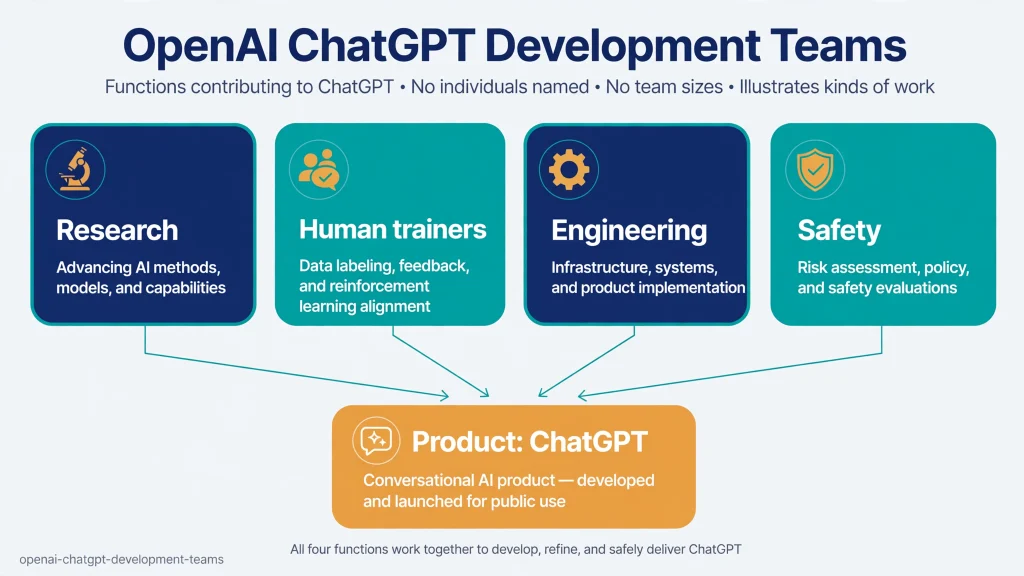
Who Developed ChatGPT? A Team Effort
OpenAI developed ChatGPT. Its launch post lists “OpenAI” as the author and thanks 87 named contributors in an acknowledgments section. That list does not break down who did what, so it cannot be used to assign specific credit.
What the launch post does describe is the kind of work involved:
- Research: training the underlying model and developing the human-feedback methods used to make it conversational.
- Data and human trainers: AI trainers wrote example conversations, playing both the user and the assistant, and ranked alternative responses.
- Engineering: OpenAI says ChatGPT and its GPT-3.5 base models were trained on Azure AI supercomputing infrastructure.
- Safety and product: the team added content moderation tools and a feedback system, then released the chatbot through a public web interface.
How to Read the Acknowledgments List
The list in the launch post is useful, but it is easy to over-read. It is not alphabetical, and OpenAI does not explain its order, so you should not treat position as rank. It thanks people without describing what each one did. And it reflects the 2022 launch, so it does not cover the work that has gone into ChatGPT since. Treat it as evidence that many people contributed, not as a leaderboard.
Who Invented ChatGPT? Why No Single Person Gets the Credit
The word “invented” suggests a lone inventor, and asking who created ChatGPT in those terms points to a single name that does not exist. That is not how large AI products get built. ChatGPT is the output of an organization: researchers, engineers, trainers, safety staff, and product teams, working on top of years of earlier research, much of it OpenAI’s own.
Prominent leaders and researchers contributed to OpenAI and its products, but that does not make any one of them the sole creator of ChatGPT. Two names come up most often.
Did Elon Musk Create ChatGPT?
No. Musk was a co-chair and early donor named in the 2015 announcement. He left OpenAI’s board in February 2018 to avoid a potential conflict with Tesla’s growing AI work, as Fortune reported at the time. That was more than four years before ChatGPT launched.
Did Sam Altman Personally Create ChatGPT?
There is no evidence for that. Altman co-founded OpenAI and, based on the sources checked for this article, is its CEO. But OpenAI’s launch post does not credit any single person with building ChatGPT, and it does not name Altman in its acknowledgments. Leading a company is not the same as personally building its products.
How Was ChatGPT Developed? A Beginner’s Walkthrough
OpenAI explained its method in the launch post. Here is a plain-language version, with the caveat that this is OpenAI’s public description, not a full account of its internal process.
GPT Models: The Foundation
GPT stands for generative pre-trained transformer. OpenAI introduced the approach in a June 2018 research post, and the term is explained on Wikipedia’s GPT-1 page. ChatGPT was fine-tuned from a model in the GPT-3.5 series, which finished training in early 2022.
Human Feedback: Teaching the Model to Chat
A raw language model predicts text. It is not automatically good at following instructions or holding a conversation. OpenAI used a technique called reinforcement learning from human feedback (RLHF). Trainers wrote model conversations, then ranked several candidate responses. Those rankings trained a reward model, which was used to fine-tune ChatGPT over several rounds.
OpenAI calls ChatGPT a sibling to InstructGPT, a model family it described in January 2022 using the same human-feedback approach.
Testing and a Public Research Preview
OpenAI released ChatGPT as a free research preview to gather feedback. It openly listed weaknesses, including answers that sound plausible but are wrong, and said it expected its moderation tools to make mistakes. That feedback-driven rollout is what OpenAI calls iterative deployment.
When Was ChatGPT Created? Development vs. Public Release
ChatGPT was released to the public on November 30, 2022. The work behind it started earlier. The GPT approach dates to 2018, OpenAI itself dates to 2015, and the base model finished training in early 2022.
Dates get mixed up because three different clocks are running at once: the organization (2015), the GPT approach (2018), and the ChatGPT product (2022). An answer that gives only one date without saying which clock it uses can be technically correct and still misleading.
OpenAI has not published an exact date for when work on ChatGPT specifically began, so for anyone asking who created ChatGPT and when, any “creation date” other than the launch date is an estimate. It is also wrong to say that ChatGPT and the GPT family began on the same date.
For what happened after launch, including Plus, GPT-4, and later models, see our full guide on when ChatGPT came out.
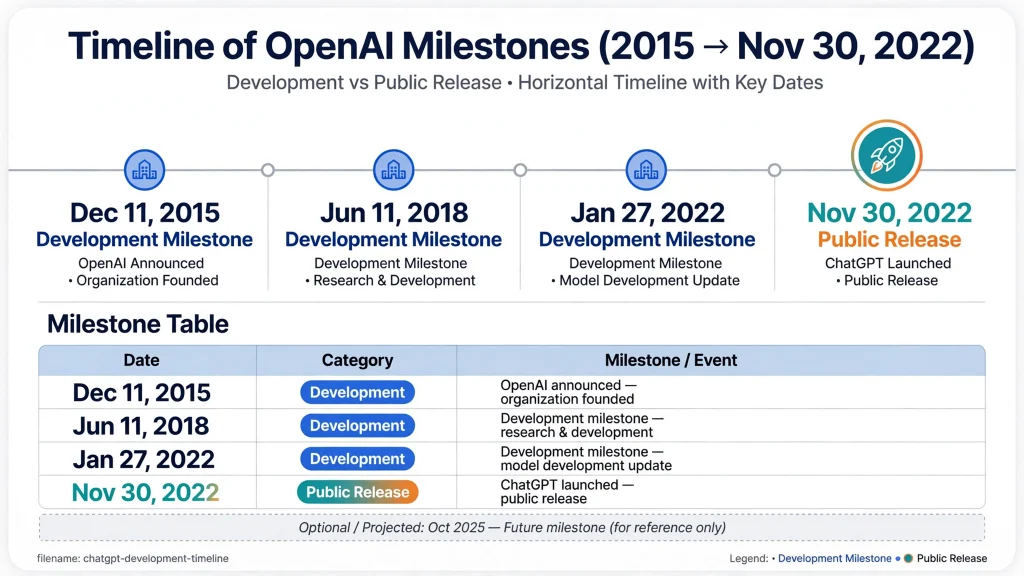
| Date | Milestone |
|---|---|
| December 11, 2015 | OpenAI announces itself as a nonprofit AI research company |
| February 2018 | Elon Musk leaves OpenAI’s board |
| June 11, 2018 | OpenAI publishes its GPT research |
| January 27, 2022 | OpenAI describes InstructGPT and human-feedback training |
| Early 2022 | The GPT-3.5 series finishes training |
| November 30, 2022 | ChatGPT launches as a free research preview |
| October 2025 | OpenAI completes a restructuring into a foundation and a public benefit corporation |
GPT vs. ChatGPT: What’s the Difference?
GPT is a family of language models. ChatGPT is a conversational product that uses those models along with other tools and systems. People often use the names interchangeably, but they describe different things.
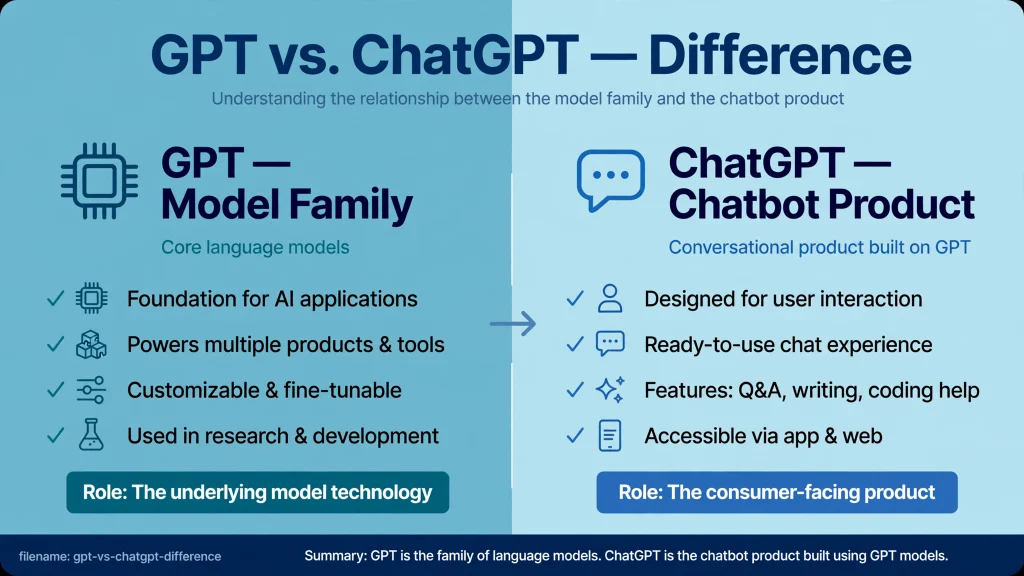
| GPT | ChatGPT | |
|---|---|---|
| What it is | A family of generative language models | A chatbot product built on those models |
| Who developed it | OpenAI | OpenAI |
| Where it first appeared | June 2018 research | November 30, 2022 |
| How people reach it | Mostly through developer tools and products | A web interface and apps |
OpenAI itself notes that ChatGPT has evolved substantially since its 2022 introduction, so the product today is far more than the original release.
If you are thinking about a paid plan, see whether ChatGPT Plus is worth it or whether ChatGPT Pro is worth it.
Who Owns ChatGPT Today?
ChatGPT is an OpenAI product, so OpenAI owns and operates it. Who owns OpenAI is a separate question, and the answer changed in October 2025.
At that point, OpenAI completed a restructuring. Its for-profit business became OpenAI Group PBC, a public benefit corporation controlled by the nonprofit OpenAI Foundation, according to NBC News. The Foundation held roughly 26% of the for-profit at announcement, and Microsoft held about 27%, per The Decoder. These figures came from the 2025 announcement and may have changed since.
Ownership and governance are not the same as creation. Shareholders and board members do not become the people who built a product. For the full breakdown of shareholders and structure, see our guide on who owns ChatGPT.
Why Did ChatGPT Become So Significant?
ChatGPT’s free, conversational format made generative AI easy to try. UBS analysts estimated it reached 100 million monthly active users by January 2023, two months after launch, calling it “the fastest-growing consumer application in history,” as Reuters reported. That figure is an analyst estimate based on web-traffic data, not an official OpenAI number.
Still, ChatGPT did not invent modern AI. It built on decades of machine-learning research, including earlier GPT models, and it arrived alongside work at many other labs. Its significance lies in bringing conversational AI to a mass audience.
Common Myths About Who Created ChatGPT
Most wrong answers come from blending the four groups above. These are the myths that come up most often, with what the sources actually support.
- Myth: One person invented ChatGPT. OpenAI’s launch post credits the organization and thanks 87 named contributors. It does not credit a single inventor.
- Myth: Elon Musk built ChatGPT. Musk was a co-chair and early donor in 2015 and left the board in February 2018, more than four years before launch.
- Myth: Every OpenAI founder worked on ChatGPT. Only some founders appear in the launch post’s acknowledgments, and the list includes many people who were not founders.
- Myth: GPT and ChatGPT are the same thing. GPT is a model family. ChatGPT is a chatbot product built on those models.
- Myth: ChatGPT was created on November 30, 2022. That is the public release date. The base model finished training in early 2022, and GPT research dates to 2018.
- Myth: Whoever owns OpenAI created ChatGPT. Ownership and governance describe who holds equity and control, not who did the research and engineering.
Frequently Asked Questions About Who Created ChatGPT
Who created ChatGPT?
OpenAI developed ChatGPT through the collective work of its research, engineering, and product teams. It launched publicly on November 30, 2022. No single person is credited as its sole creator.
Who invented ChatGPT?
There is no single inventor. ChatGPT is the product of an organization and builds on earlier GPT models and human-feedback research from OpenAI and the wider field.
Was ChatGPT created by OpenAI?
Yes. OpenAI’s own launch post introduces ChatGPT as a model the company trained.
Who founded OpenAI?
A group founded it in 2015. The December 2015 announcement named Sutskever, Brockman, Blackwell, Cheung, Karpathy, Kingma, Schulman, Vagata, and Zaremba as the research and engineering team, with Altman and Musk as co-chairs.
Did Elon Musk create ChatGPT?
No. Musk was an early co-chair and donor who left the board in 2018, years before ChatGPT existed.
Did Sam Altman personally create ChatGPT?
No source supports that claim. Altman is a co-founder and the CEO, but OpenAI credits ChatGPT to its teams, not to one person.
When was ChatGPT created?
Development happened before launch, building on GPT research from 2018 and a base model that finished training in early 2022. OpenAI has not published an exact start date for the project.
When was ChatGPT released to the public?
November 30, 2022, as a free research preview.
Is GPT the same as ChatGPT?
No. GPT refers to a family of language models. ChatGPT is a chatbot product that uses them.
Who owns ChatGPT?
OpenAI. Since the October 2025 restructuring, OpenAI Group PBC operates the business and is controlled by the nonprofit OpenAI Foundation.
Conclusion
OpenAI developed ChatGPT, and that is the core answer to who created ChatGPT. It did so through the combined work of researchers, engineers, trainers, and product teams, building on its own earlier GPT models. OpenAI’s founders, its current leaders, its owners, and the people who built ChatGPT are overlapping but different groups, and treating them as one is where most myths begin.
So the next time someone asks who created ChatGPT, the best answer is simple: OpenAI, through teamwork, with the credit shared across many people.
If you remember one thing, remember that “creator” can mean founder, leader, builder, or owner. The people who built ChatGPT itself are the researchers, engineers, trainers, and product staff at OpenAI.
Sources & References
- Introducing ChatGPT — OpenAI, November 30, 2022. https://openai.com/index/chatgpt/ — Supports the launch date, free research preview, RLHF method, GPT-3.5 base model, Azure infrastructure, limitations, and acknowledgments list.
- Aligning language models to follow instructions — OpenAI, January 27, 2022. https://openai.com/index/instruction-following/ — Supports InstructGPT, human-feedback training, and GPT-3 powering the OpenAI API.
- Introducing OpenAI — OpenAI, December 11, 2015. https://openai.com/index/introducing-openai/ — Supports the announcement date, nonprofit description, research director, and co-chairs.
- OpenAI Announced — Future of Life Institute, December 11, 2015. https://futureoflife.org/2015/12/11/openai-announced/ — Reproduces OpenAI’s press release, including the list of other founding members.
- Non-profit OpenAI launches with backing from Elon Musk and Sam Altman — TechCrunch, December 11, 2015. https://techcrunch.com/2015/12/11/non-profit-openai-launches-with-backing-from-elon-musk-and-sam-altman — Supports Brockman’s CTO role, the co-chairs, and the funders.
- Improving language understanding with unsupervised learning — OpenAI, June 11, 2018. https://openai.com/index/language-unsupervised/ — Supports the date of OpenAI’s GPT research.
- GPT-1 — Wikipedia. https://en.wikipedia.org/wiki/GPT-1 — Supports the meaning of “generative pre-trained transformer” (secondary source).
- Elon Musk Is Leaving the Board of an AI Safety Group He Co-Founded — Fortune, February 21, 2018. https://www.fortune.com/2018/02/21/elon-musk-leaving-board-openai — Supports Musk’s 2018 board departure and the stated reason.
- ChatGPT sets record for fastest-growing user base — analyst note — Reuters, via Euronews, February 2, 2023. https://www.euronews.com/2023/02/02/openai-chatgpt — Supports the UBS estimate of 100 million monthly active users.
- A nonprofit on top, billions below: Inside OpenAI’s new corporate balancing act — NBC News. https://www.nbcnews.com/tech/tech-news/openai-restructuring-company-structure-chatgpt-invest-own-rcna240138 — Supports the OpenAI Foundation / OpenAI Group PBC structure and the Foundation’s 26% stake.
- OpenAI restructures under new foundation, Microsoft takes 27 percent stake — The Decoder. https://the-decoder.com/openai-restructures-under-new-foundation-microsoft-takes-27-percent-stake/ — Supports the restructuring and Microsoft’s roughly 27% stake.
- Inside OpenAI’s Reboot (as summarized by Gigazine, August 27, 2026). https://gigazine.net/gsc_news/en/20260827-openai-agi/ — Secondary source referring to Sam Altman as CEO in 2026.