
When was ChatGPT released? OpenAI released ChatGPT to the public on November 30, 2022, introducing it as a free research preview. That date marks the launch of the ChatGPT product. It does not mark the start of GPT technology, which OpenAI had been building and releasing in earlier models for years.
You may have searched this as “when did ChatGPT come out,” “ChatGPT release date,” or “ChatGPT launch date.” All of them lead to the same answer. This guide explains what OpenAI launched that day, how ChatGPT differs from the GPT models that came before it, and which milestones followed through October 2026. Dates were checked against OpenAI’s own pages where possible, and against reliable reporting where noted.
Table of Contents
When Was ChatGPT Released? The Quick Facts
ChatGPT was publicly released on November 30, 2022. OpenAI introduced it as a free research preview so people could try a conversational AI and give feedback. ChatGPT was fine-tuned from a GPT-3.5 series model, so the underlying GPT technology predates the ChatGPT product.
| Question | Verified answer |
|---|---|
| ChatGPT public release date | November 30, 2022 |
| Who released it | OpenAI |
| How it launched | As a free research preview |
| Underlying model | Fine-tuned from a model in the GPT-3.5 series |
| First paid plan announced | February 1, 2023 (ChatGPT Plus pilot) |
| Earlier GPT technology | GPT-3 research paper dated May 28, 2020 |
What Happened When ChatGPT First Launched?
What OpenAI Released on November 30, 2022
OpenAI announced the OpenAI ChatGPT launch in a post titled “Introducing ChatGPT”. The company described a model trained to interact in a conversational way. According to OpenAI, the dialogue format lets ChatGPT answer follow-up questions, admit mistakes, challenge incorrect premises, and reject inappropriate requests. OpenAI also called it a sibling model to InstructGPT, which is trained to follow instructions in a prompt and give detailed responses.
Training used a method called reinforcement learning from human feedback, or RLHF. In plain terms, human AI trainers wrote example conversations playing both the user and the assistant. They then ranked alternative model answers by quality, and OpenAI used those rankings to fine-tune the model.
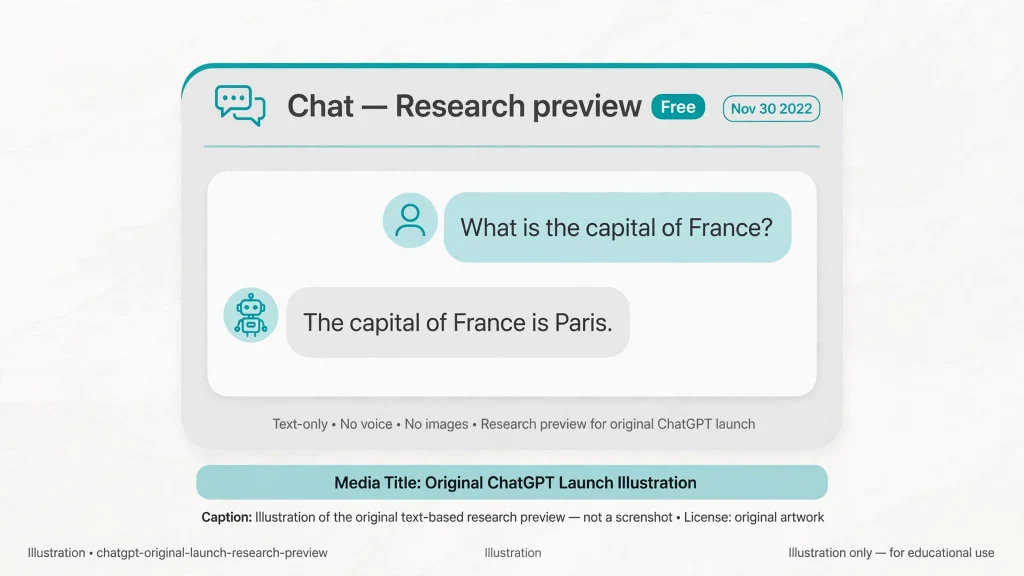
Why ChatGPT Began as a Research Preview
OpenAI said it introduced ChatGPT to collect user feedback and learn about the system’s strengths and weaknesses. Usage was free during the ChatGPT research preview. The company also encouraged people to report problematic outputs through the interface, and it ran a feedback contest with API credits as prizes. A research preview is an early public release meant for testing and learning, not a finished product.
What the Original Version Could and Could Not Do
The launch post showed sample conversations, including help fixing code and an explanation of a math theorem. OpenAI was also direct about limitations. ChatGPT sometimes wrote plausible-sounding but incorrect answers. It reacted differently to small changes in phrasing, tended to be wordy, and often guessed what users meant instead of asking clarifying questions. OpenAI added that it would sometimes respond to harmful instructions despite its safeguards.
The announcement describes a text conversation. It does not mention voice chat or image generation, which appear in OpenAI’s later release notes. So it would be inaccurate to describe the original release as if it had today’s features.
Was ChatGPT the First GPT Model?
No. GPT models existed years before ChatGPT’s public release. GPT stands for Generative Pre-trained Transformer, a term we unpack in our guide to what GPT stands for. OpenAI researchers published the paper introducing the first GPT model in June 2018. OpenAI’s GPT-3 paper, dated May 28, 2020, described a 175-billion-parameter language model. OpenAI began offering GPT-3 to developers through an API on June 11, 2020. GPT-3 +2
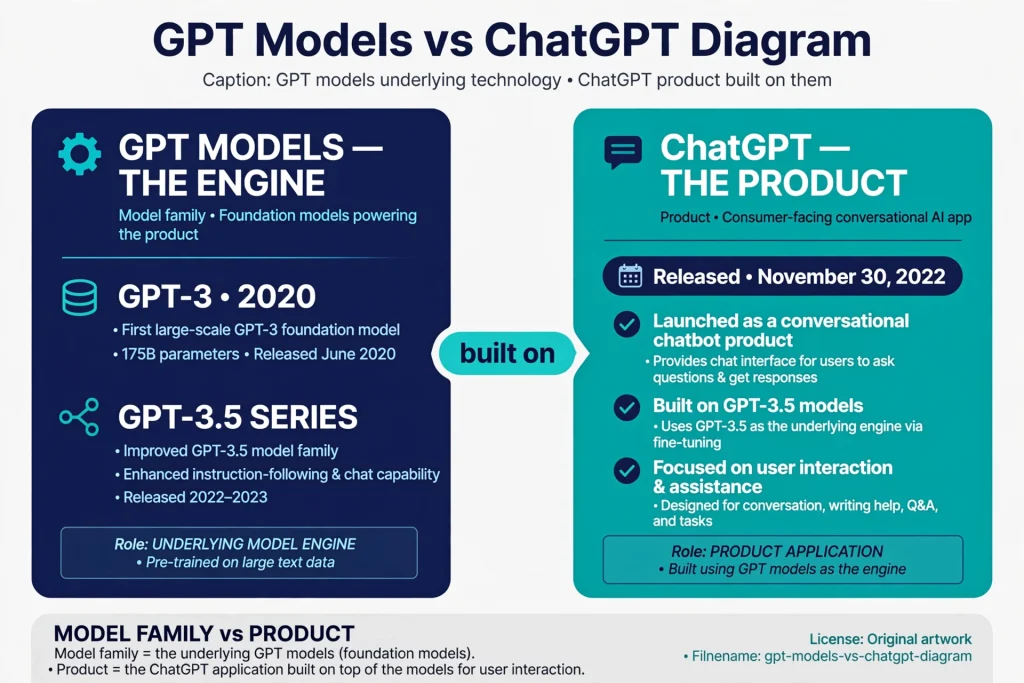
ChatGPT came later. OpenAI’s launch post says it was fine-tuned from a model in the GPT-3.5 series, which finished training in early 2022. The same post says lessons from earlier deployments such as GPT-3 and Codex informed ChatGPT’s safety work.
GPT Is the Engine, ChatGPT Is the Product
Think of a GPT model as the engine and ChatGPT as the car built around it. The model generates text. ChatGPT adds the chat interface, safety systems, and feedback tools that people actually use. That is why release dates get mixed up. When was ChatGPT released? November 30, 2022. When was GPT-3 introduced? 2020. These are separate events, and later GPT models have their own dates.
Why Did OpenAI Release ChatGPT?
OpenAI’s own announcement points to a few documented reasons:
- Feedback: It wanted users’ input to learn about ChatGPT’s strengths and weaknesses.
- Iterative deployment: It described the release as the latest step in gradually deploying increasingly safe and useful AI systems.
- Learning from real use: It hoped an accessible interface would surface problems it was not already aware of, and it said it planned regular model updates.
OpenAI’s public posts do not spell out private business motives, so this guide sticks to what the company documented. For the corporate side of the story, see our explainer on who owns ChatGPT.
ChatGPT Release Timeline: Key Milestones From 2022 to 2026
The answer to when was ChatGPT released is one date, but the story did not stop there. This ChatGPT timeline separates product and plan changes from GPT model releases. It is selective, not exhaustive. OpenAI’s ChatGPT release notes track the rest.
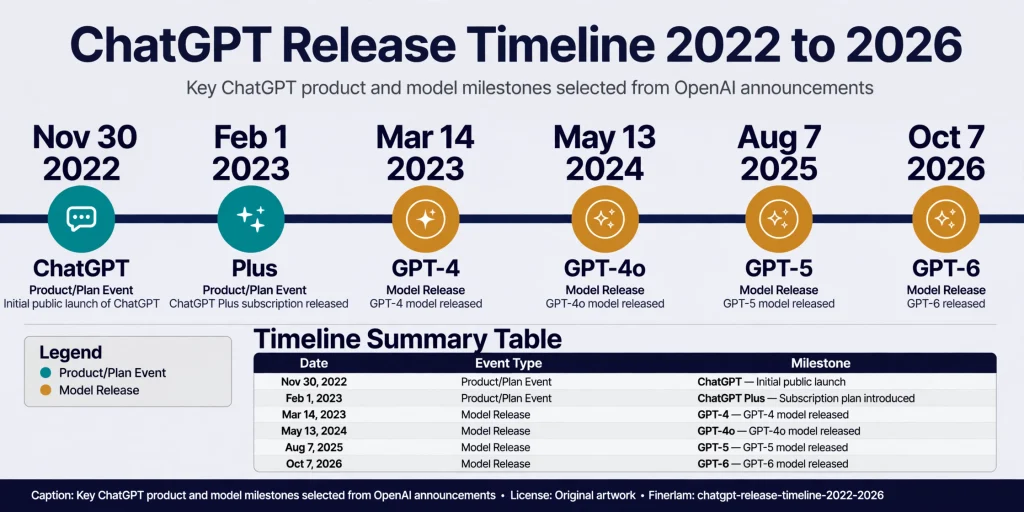
| Date | What happened | Type | Why it mattered | Source |
|---|---|---|---|---|
| Nov 30, 2022 | OpenAI released ChatGPT as a free research preview | ChatGPT product launch | The public could chat with the system directly | OpenAI, “Introducing ChatGPT” |
| Feb 1, 2023 | OpenAI announced a pilot subscription, ChatGPT Plus, at $20 per month; access expanded beyond the United States on February 10, 2023 | Plan change | First paid tier, with OpenAI saying free access would continue | OpenAI, “Introducing ChatGPT Plus” |
| Mar 14, 2023 | OpenAI announced GPT-4 and released its text-input capability through ChatGPT and a waitlisted API | Model release | A newer GPT model reached ChatGPT users | Lenz.io fact-check citing OpenAI and Reuters |
| May 13, 2024 | OpenAI introduced GPT-4o at its Spring Update and made more capabilities available to free ChatGPT users | Model and product update | Wider access to newer capabilities | OpenAI, “Spring Update” |
| Aug 7, 2025 | GPT-5 launched, rolling out in ChatGPT to Free, Plus, Pro and Team users | Model release | Next-generation model across plans | Wikipedia: GPT-5; press coverage |
| Oct 7, 2026 | OpenAI began rolling out GPT-6 with Intelligent UI in ChatGPT’s Chat tab for Plus, Pro, Business and Enterprise, expanding to Free and Go the next day. OpenAI said it introduced the first GPT-6 models for paid customers the month before | Model and product update | Answers can include interactive visuals and tools | OpenAI, “GPT-6 and Intelligent UI for everyone” chatgpt plus +6 |
A model release, such as GPT-4, is not the same as a plan change, such as ChatGPT Plus. If you are weighing a paid plan today, our guides on whether ChatGPT Plus is worth it and whether ChatGPT Pro is worth it cover current choices.
How Has ChatGPT Changed Since Its Release?
The evolution of ChatGPT is easiest to see side by side. At launch, it was a free, text-based research preview built on a GPT-3.5 series model. By October 2026, OpenAI’s materials describe a much broader product.
| Aspect | At launch (Nov 2022) | Recent (Oct 2026) |
|---|---|---|
| Access | Free during the research preview | Several plans, including Free, Go, Plus, Pro, Business, Enterprise and Edu; availability varies by plan, region and workspace settings |
| Ways to interact | Text conversation | Text, plus voice, image creation, file and audio uploads, and connected apps and plugins, per OpenAI’s release notes |
| Models in Chat | GPT-3.5 series fine-tune | GPT-6 family: GPT-6 Sol for Plus, Pro, Business and Enterprise; GPT-6 Luna for Free and Go |
| Scale | Early research preview | OpenAI says more than 1.2 billion people use ChatGPT each week |
Not every user gets the same features. Access can depend on the model, subscription, region, and workspace settings. OpenAI’s release notes also show that ChatGPT now covers longer, multi-step work. In July 2026, for example, OpenAI introduced ChatGPT Work, an agent for longer, more involved tasks. Features change often, so check the release notes for what your account has.
Why Was ChatGPT’s Release Important?
That is why the question of when was ChatGPT released matters beyond trivia. The November 2022 launch put conversational generative AI in front of a broad public audience. Before then, GPT-3 was offered to developers through an API. ChatGPT gave anyone with a browser a chat window.
Adoption was fast. UBS analysts estimated that ChatGPT reached 100 million monthly active users in January 2023, about two months after launch, and Reuters reported it as the fastest-growing consumer application in history at that point. That is an analyst estimate based on third-party traffic data, not a figure reported by OpenAI, and later comparisons with other apps have been debated. More recently, OpenAI said that more than 1.2 billion people use ChatGPT every week. euronewslenz
ChatGPT did not invent artificial intelligence, and it was not the first AI chatbot ever built. It is better understood as a major step in bringing conversational generative AI to everyday users.
Frequently Asked Questions About the ChatGPT Release Date
When was ChatGPT released?
OpenAI released ChatGPT to the public on November 30, 2022, as a free research preview.
When did ChatGPT first become available to the public, and was it in 2022?
Yes. The public release was on November 30, 2022. The first paid plan, ChatGPT Plus, was announced on February 1, 2023.
When Was ChatGPT Launched, and Is That the Same as Released?
Yes. “Launched,” “released,” and “came out” all refer to the public debut on November 30, 2022. Do not confuse that date with the release of GPT-3, GPT-4, or later models.
Who released ChatGPT?
OpenAI released ChatGPT.
Was ChatGPT initially free?
Yes. OpenAI said usage was free during the research preview. When it later introduced a paid plan, OpenAI said it would keep offering free access. openai
What was ChatGPT originally released for?
OpenAI said it released ChatGPT to gather feedback and learn about the system’s strengths and weaknesses.
Did GPT exist before ChatGPT?
Yes. The first GPT paper dates to 2018, and OpenAI’s GPT-3 paper is dated May 28, 2020. ChatGPT itself was fine-tuned from a GPT-3.5 series model. Wikipediaopenai
When was GPT-4 released?
OpenAI announced GPT-4 on March 14, 2023. lenz
How has ChatGPT changed since its launch?
It grew from a free, text-only research preview into a product with multiple plans, newer GPT models, and features such as voice, images, and file uploads. Availability depends on plan, region, and workspace settings.
Conclusion
So, when was ChatGPT released? OpenAI made ChatGPT public on November 30, 2022, as a free research preview built on a GPT-3.5 series model. GPT technology is older: the first GPT paper dates to 2018, and GPT-3 arrived in 2020. The launch is the date of a product, not of the underlying technology.
Since then, ChatGPT Plus (February 1, 2023), GPT-4 (March 14, 2023), GPT-5 (August 7, 2025), and GPT-6 in Chat (October 7, 2026) have reshaped what ChatGPT can do. Because features and plans change often, check OpenAI’s release notes for current details.
Sources & References
- “Introducing ChatGPT”, OpenAI, Nov 30, 2022. https://openai.com/index/chatgpt/ — Supports: release date, research preview, free usage, GPT-3.5 series fine-tune, RLHF method, limitations, feedback goals, iterative deployment.
- “ChatGPT release notes”, OpenAI Help Center. https://help.openai.com/en/articles/6825453-chatgpt-release-notes — Supports: current plans, voice/images/uploads, ChatGPT Work (July 9, 2026), GPT-6 rollout details.
- “GPT-6 and Intelligent UI for everyone”, OpenAI, Oct 7, 2026. https://openai.com/index/gpt-6-for-everyone/ — Supports: GPT-6 rollout, GPT-6 Sol/Luna, 1.2 billion weekly users.
- “Introducing ChatGPT Plus”, OpenAI, Feb 1, 2023. https://openai.com/index/chatgpt-plus/ — Supports: Plus pilot, $20/month, Feb 10, 2023 expansion, free access continuing.
- “Spring Update”, OpenAI, May 13, 2024. https://openai.com/index/spring-update/ — Supports: GPT-4o introduction and expanded free-user capabilities.
- “Language models are few-shot learners”, OpenAI, May 28, 2020. https://openai.com/index/language-models-are-few-shot-learners — Supports: GPT-3 paper date and 175 billion parameters.
- “ChatGPT sets record for fastest-growing user base – analyst note”, Reuters (Krystal Hu), via Euronews. https://www.euronews.com/2023/02/02/openai-chatgpt — Supports: UBS estimate of 100 million monthly users in January 2023.
- “Claim analyzed: OpenAI released GPT-4 on March 14, 2023”, Lenz.io. https://lenz.io/c/526541bd — Supports: GPT-4 date, citing OpenAI’s page and Reuters.
- “GPT-5”, Wikipedia. https://en.wikipedia.org/wiki/GPT-5 — Supports: GPT-5 launch date.
- “GPT-3”, Wikipedia. https://en.wikipedia.org/wiki/GPT-3 — Supports: first GPT paper (2018) and GPT-3 API beta (June 11, 2020).
- “ChatGPT growth claim analysis”, Lenz.io. https://lenz.io/c/e297e1e3 — Supports: caveat that “fastest in history” comparisons are debated.
- aivibesofficial.com homepage. https://aivibesofficial.com/ — Supports: existence of the internal links used above.