
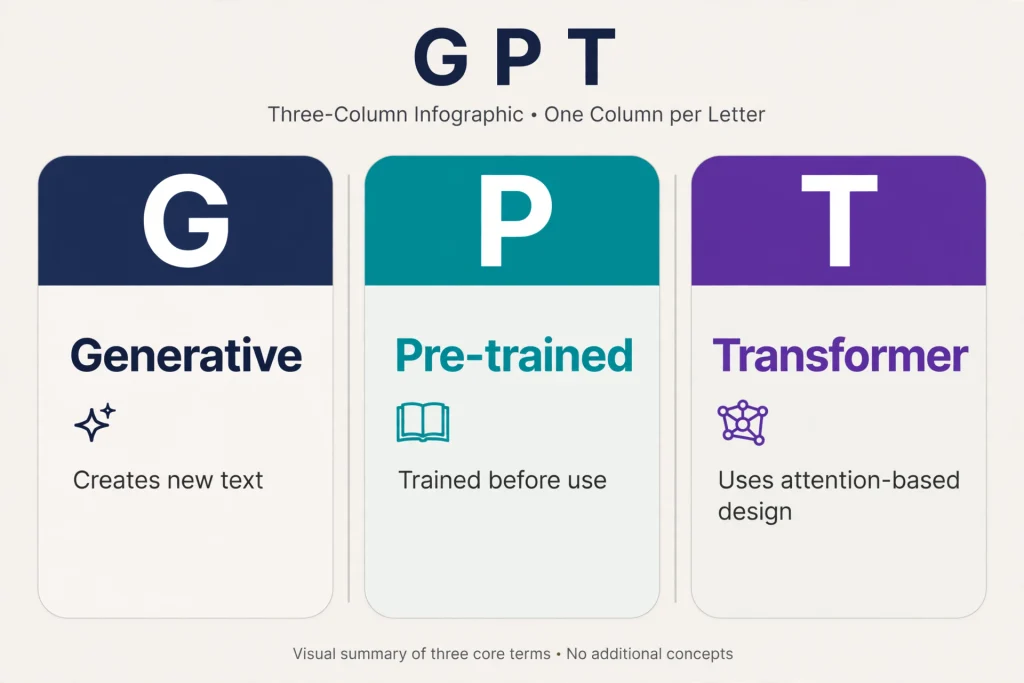
So, what does GPT stand for? It stands for Generative Pre-trained Transformer, the name of a family of AI language models that OpenAI first introduced in 2018. Each word describes something real: the model generates new text, it is pre-trained on large amounts of data before you ever use it, and it is built on a design called a transformer.
This guide explains each word in plain English, shows how GPT works at a high level, and clears up the most common mix-up: GPT and ChatGPT are not the same thing.
Table of Contents
What Does GPT Stand For in AI?
GPT stands for Generative Pre-trained Transformer. It is a type of AI language model that is first trained on large amounts of text, built on a neural-network design called a transformer, and able to generate new text by predicting what should come next. OpenAI introduced the approach in 2018.
Search engines often show this same answer when people type what does GPT stand for, because the full name is short and fixed. What changes over time is the technology behind the name, not the three words.
In OpenAI’s 2018 research announcement, the company described its approach as a combination of two existing ideas: transformers and unsupervised pre-training. The research paper behind it was titled “Improving Language Understanding by Generative Pre-Training,” which is where the “G” and “P” come from. The “T” comes from the transformer design the model is built on.
The GPT meaning in AI is really about a method, not one product. Over time, “GPT” became the label for a whole series of OpenAI models, and many people now use it as shorthand for this style of technology. In this article, “GPT” refers to OpenAI’s GPT models unless we say otherwise.
If you are asking what does GPT mean in everyday terms, think of it as a text-generating engine that learned language patterns from a very large amount of writing.
What Does Each Letter in GPT Mean?
Back to the core question of what does GPT stand for: the three letters stand for three separate ideas. Together, they explain how these models are built and what they do.
What Does “Generative” Mean?
A generative model produces new output instead of looking up a stored answer. A search engine, for example, finds existing web pages. A generative model can write a fresh two-line poem about Paris, rewrite a paragraph in a friendlier tone, or draft an email from your notes.
The word “new” matters, but it comes with a warning. A generative model builds its answer from patterns it learned, so the result can sound confident and still be wrong. “Generative” describes how the text is produced, not whether it is correct.
What Does “Pre-trained” Mean?
Pre-trained means the model was trained before you started using it. In its 2018 announcement, OpenAI described a two-stage system. First, a transformer model is trained on a very large amount of data without human labels, using language modeling as the training signal. Then the model is fine-tuned on much smaller datasets to handle specific tasks.
In simple terms, language modeling means learning to predict what comes next in a piece of text. A useful comparison is a person who reads widely for years and then learns a specific job quickly, because they already understand how language works.
Training details differ from one GPT model to the next. This article does not claim to know details that OpenAI has not published, so treat this section as the general idea rather than a recipe for any single model.
What Does “Transformer” Mean?
A transformer is a neural-network design introduced in the 2017 research paper “Attention Is All You Need”. The authors described a network built solely on attention mechanisms, without the recurrent or convolutional designs that were common at the time. They first tested it on language translation.
Attention lets a model weigh how much each part of a text matters to every other part. Take this sentence: “The trophy didn’t fit in the suitcase because it was too big.” To work out what “it” refers to, a reader looks back at “trophy” and “suitcase.” Attention is a way for a model to make a similar kind of connection across the words around it.
That illustration is a simplification. Real transformers use many layers of mathematical operations, and the beginner version here leaves most of that out on purpose.
Once you understand the transformer part, you can explain what does GPT stand for to a friend without any jargon: it is a model that generates text, learned in advance, and uses attention to connect words.
What Is GPT and How Does It Work?
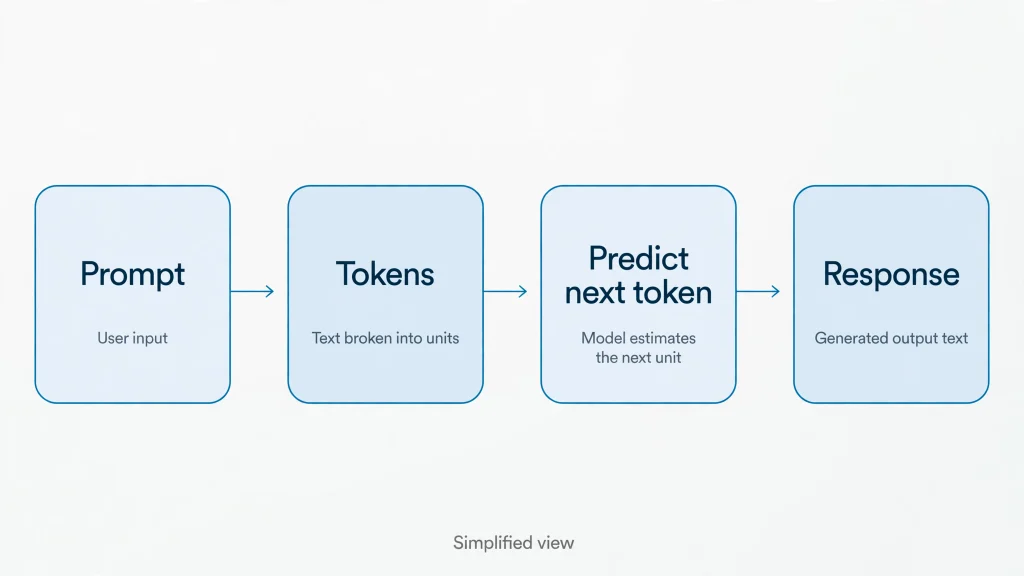
Here is how GPT works in a simplified, step-by-step view:
- You give the model an input. This is your prompt, such as a question or an instruction.
- The input is split into tokens. Tokens are small chunks of text, often pieces of words.
- The model uses learned patterns and the surrounding context. It estimates which token is most likely to come next.
- The answer is built one token at a time. Each new token becomes part of the context for the next one.
OpenAI’s GPT-4 Technical Report describes GPT-4 as a transformer-based model pre-trained to predict the next token in a document. The report also says a later alignment stage, called post-training, improved factuality and how well the model follows desired behavior.
This four-step view is a simplified explanation. It does not describe every GPT model or every product built on one, and real systems may add other steps and tools around the model.
Why Prompt Wording and Context Matter
Because the model works from the text it is given, small changes in wording can change the answer. A vague prompt like “Tell me about Paris” can lead to a general overview. A specific prompt like “List three free things to do in Paris for a student” gives the model more to work with. Adding context, such as your audience or the format you want, usually helps.
What Is the Difference Between GPT and ChatGPT?
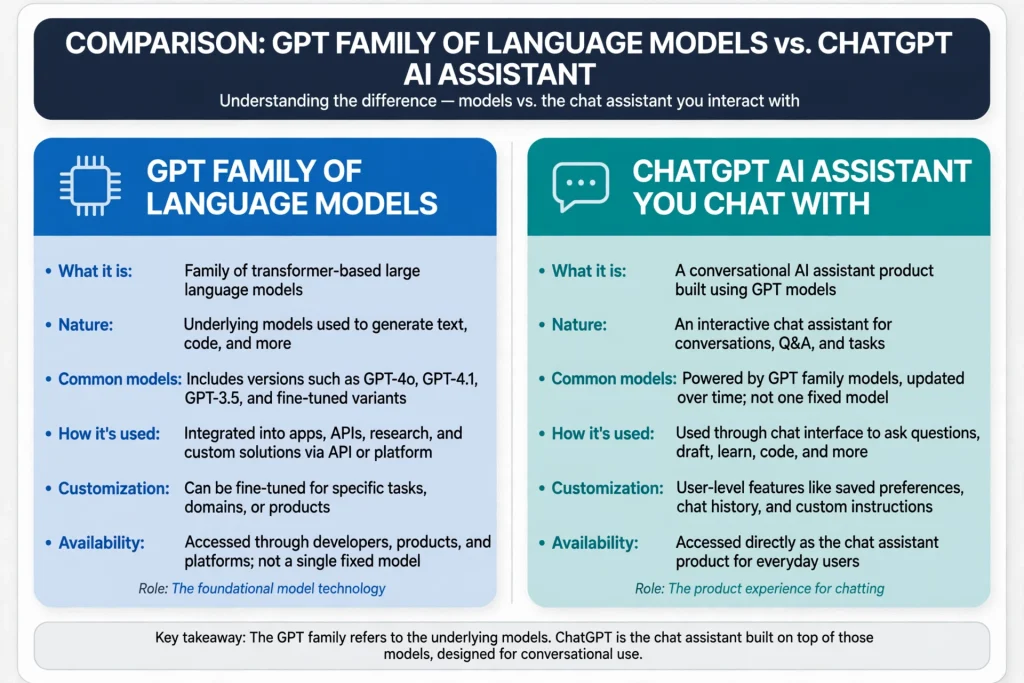
GPT generally refers to a family of language models. ChatGPT is a product you use to talk to an AI. OpenAI’s help center describes ChatGPT as an AI assistant for tasks like brainstorming, writing, studying, planning, math, and coding, trained to follow instructions in a conversation.
That answers what is GPT in ChatGPT: the “GPT” part points to the kind of model technology behind the assistant, while “Chat” points to the conversational product built around it.
Many people first see the letters in ChatGPT and then search what does GPT stand for, expecting a product name. It is actually the name of the model technology, and ChatGPT is only one place you can meet it.
| Term | What it refers to | Simple example |
|---|---|---|
| GPT | A family of generative pre-trained transformer language models | OpenAI’s GPT-4, described in its technical report |
| ChatGPT | OpenAI’s user-facing AI assistant, which can include extra tools and features | Chatting at chatgpt.com or in the mobile app |
| Generative AI | The broad category of AI that creates new content | A system that writes text or creates images |
It is not accurate to say ChatGPT is just another name for one specific model. The models available in ChatGPT change over time. OpenAI’s help center notes, for instance, that GPT-4o and some other models were deprecated in ChatGPT on February 13, 2026, while remaining available in the API. ChatGPT can also include features beyond the model itself, such as searching the web and citing sources when current information is needed.
One more wrinkle: OpenAI also uses the word “GPTs” for assistants that can be used inside ChatGPT, so context tells you which meaning is intended. To learn who runs the company behind both, see our explainer on who owns ChatGPT.
Is GPT the Same as AI?
Another common follow-up after what does GPT stand for is whether GPT and AI are the same thing. No. Artificial intelligence is the broad field of building systems that perform tasks associated with human intelligence. GPT is one particular kind of AI model within that field.
A helpful way to picture it: AI is the large category, large language models are one type of AI model, and GPT models are a well-known example of large language models. Other AI systems do very different jobs, such as recognizing objects in photos, recommending videos, or converting speech to text. So every GPT model is AI, but not all AI is a GPT.
What Can GPT Models Do?
GPT models are often used for language-related work. Depending on the model, product, plan, and tools available, people use them to:
- Generate and rewrite text, from emails to outlines.
- Summarize long documents or articles.
- Explain a concept at a beginner or advanced level.
- Brainstorm ideas, names, or angles for a project.
- Assist with certain coding and reasoning tasks.
- Support translation and other language tasks.
Features vary. A capability available in one model, plan, or country may not exist in another, and OpenAI’s help center says usage limits vary by plan and model and can change over time. Do not assume every GPT model can do everything on this list. If you are weighing paid plans because of those limits, our guide on whether ChatGPT Pro is worth it explains what the higher tiers add over Plus.
What Are the Limitations of GPT?
GPT-generated answers can be incorrect, incomplete, outdated, or misleading. This is not a minor footnote. OpenAI’s own 2018 announcement acknowledged that text from books and the internet does not contain complete or even accurate information about the world, and that models can learn biases from their data. The company also noted that these models can still behave in surprising ways when tested in unusual conditions.
The first letter of the answer to what does GPT stand for is a useful reminder here: “generative” means the model creates text instead of retrieving verified facts, which is exactly why checking matters.
The GPT-4 Technical Report similarly says the model is less capable than humans in many real-world scenarios. Newer models may be stronger, but the safe habit stays the same: a language model is not a person, not a guaranteed fact-checker, and not a source of perfect answers.
Verify important information before acting on it. That matters most for medical, legal, financial, and academic decisions, where a confident but wrong answer can cause real harm. Check claims against official or primary sources, and ask a qualified professional when the stakes are high.
A Simple Real-World Example of GPT
Here is an original example of how a GPT-style model might respond. We wrote it ourselves to illustrate the idea. It is not the output of a test we ran.
Prompt: “Explain what a transformer is to a ten-year-old in two sentences.”
Example response: “A transformer is a computer program design that reads a whole sentence and figures out which words are connected to each other. It is like reading ‘the dog chased the ball because it was fast’ and working out whether ‘it’ means the dog or the ball.”
What this shows: the model takes an input, uses context, and produces new wording instead of copying a stored answer.
What it does not prove: that the answer is correct every time, or that every GPT model would respond the same way. Run the same prompt twice, or on a different model, and the wording may change.
Frequently Asked Questions About GPT
These quick answers cover the questions people ask most after searching what does GPT stand for.
What does GPT stand for?
GPT stands for Generative Pre-trained Transformer. It names a family of AI language models first introduced by OpenAI in 2018.
What does GPT mean in ChatGPT?
In ChatGPT, “GPT” refers to the generative pre-trained transformer technology behind the assistant. “Chat” refers to the conversational product built around it.
Is GPT an acronym?
Yes. GPT is an acronym formed from the first letters of Generative Pre-trained Transformer.
Is GPT the same as ChatGPT?
No. GPT usually refers to a type of language model. ChatGPT is OpenAI’s AI assistant, which uses models and can include additional tools and features.
What does Generative Pre-trained Transformer mean?
It describes a model that generates new text, was trained on large amounts of data beforehand, and uses the transformer architecture introduced in 2017.
How does GPT work in simple terms?
You give it a prompt, it breaks the prompt into tokens, uses learned patterns and context to predict the next token, and builds a response one token at a time.
Is GPT a type of artificial intelligence?
Yes. GPT is a specific kind of AI model, but AI as a field is much broader than GPT.
Can GPT make mistakes?
Yes. Answers can be wrong, incomplete, outdated, or biased. Check important facts against reliable sources.
Who developed GPT models?
OpenAI developed the GPT series, starting with the 2018 research paper on generative pre-training. For background on the company’s structure, read who owns ChatGPT.
Is GPT free to use?
It depends on the product. OpenAI’s help center says ChatGPT is free to use, with free-tier users getting a range of chat capabilities, tools, and GPTs. It also says the default model and available limits can change over time, and paid plans offer higher limits. Products built on GPT models by other companies may be priced differently. For a plan comparison, see is ChatGPT Plus worth it and is ChatGPT Pro worth it.
Conclusion: What Does GPT Stand For?
So, what does GPT stand for? Generative Pre-trained Transformer: a model that generates text, is trained before use, and relies on the transformer design. ChatGPT is a different thing, a product that puts conversation, tools, and OpenAI models in one assistant.
Now that you know what does GPT stand for, the practical takeaway is simple. Use GPT-powered tools as a fast starting point for writing, learning, and brainstorming, and double-check anything that matters before you rely on it.
Sources & References
- Improving language understanding with unsupervised learning — OpenAI. https://openai.com/index/language-unsupervised/ — Supports the 2018 introduction of GPT, the two-stage approach (pre-training, then fine-tuning), the combination of transformers and unsupervised pre-training, and the stated limitations.
- Attention Is All You Need — Ashish Vaswani et al., arXiv. https://arxiv.org/abs/1706.03762 — Supports the description of the transformer as an attention-based architecture introduced in 2017.
- GPT-4 Technical Report — OpenAI, arXiv. https://arxiv.org/abs/2303.08774 — Supports the description of GPT-4 as a transformer-based model pre-trained to predict the next token, the role of post-training, and the statement that it is less capable than humans in many real-world scenarios.
- What is ChatGPT: FAQ — OpenAI Help Center. https://help.openai.com/en/articles/12677804-what-is-chatgpt-faq — Supports the description of ChatGPT as an AI assistant, web search with citations, available plans, and changing usage limits.
- ChatGPT (Help Center collection) — OpenAI Help Center. https://help.openai.com/en/collections/3742473-chatgpt — Supports the statements that ChatGPT is free to use, that default models and limits can change, and that GPT-4o and other models were deprecated in ChatGPT on February 13, 2026.