
How does ChatGPT work? ChatGPT works by running your message through a large language model, a neural network trained on huge amounts of text. Your input is split into tokens, the model uses the conversation’s context to estimate what should come next, and it builds a reply one token at a time. This is a simplified picture, not a full blueprint.
Real ChatGPT systems add layers on top of that core idea, including safety training and, in some cases, tools such as web search. This guide explains how ChatGPT works in plain English, moving from the basics to the more technical details, and it flags where public information runs out.
What Is ChatGPT?
ChatGPT is an AI chat product from OpenAI. You type a question or instruction, and it replies in a conversational format. Our guide on when ChatGPT was released covers the full timeline. In short, OpenAI introduced it in November 2022 as a research preview, describing it as a model trained to interact conversationally and fine-tuned from a model in the GPT-3.5 series.
Table of Contents
ChatGPT, AI, and GPT Models: What’s the Difference?
Artificial intelligence (AI) is the broad field of building systems that perform tasks we associate with human intelligence. Generative AI is the part that creates new content such as text, images, or code. GPT-style language models are one kind of generative AI, and ChatGPT is the app that lets you talk to them.
It helps to separate two things:
- The model: the trained neural network that produces text.
- The product: ChatGPT itself, including the chat window, settings, safety systems, and optional tools.
If you are curious about the company side, see who owns ChatGPT and who created ChatGPT.
OpenAI updates the models behind ChatGPT over time, and the options you see can vary by plan, so check the model picker in your own account instead of assuming every user has the same one. If you are comparing plans, our breakdown of whether ChatGPT Plus is worth it may help.
How Does ChatGPT Use AI?
Instead of following a hand-written rule for every possible question, ChatGPT uses machine learning. A neural network, a system of mathematical connections loosely inspired by the brain, adjusted itself during training until it became good at predicting language patterns. That learned ability is the “AI” part. The rest of the product wraps it in a usable, safer interface.
How Does ChatGPT Work Step by Step?
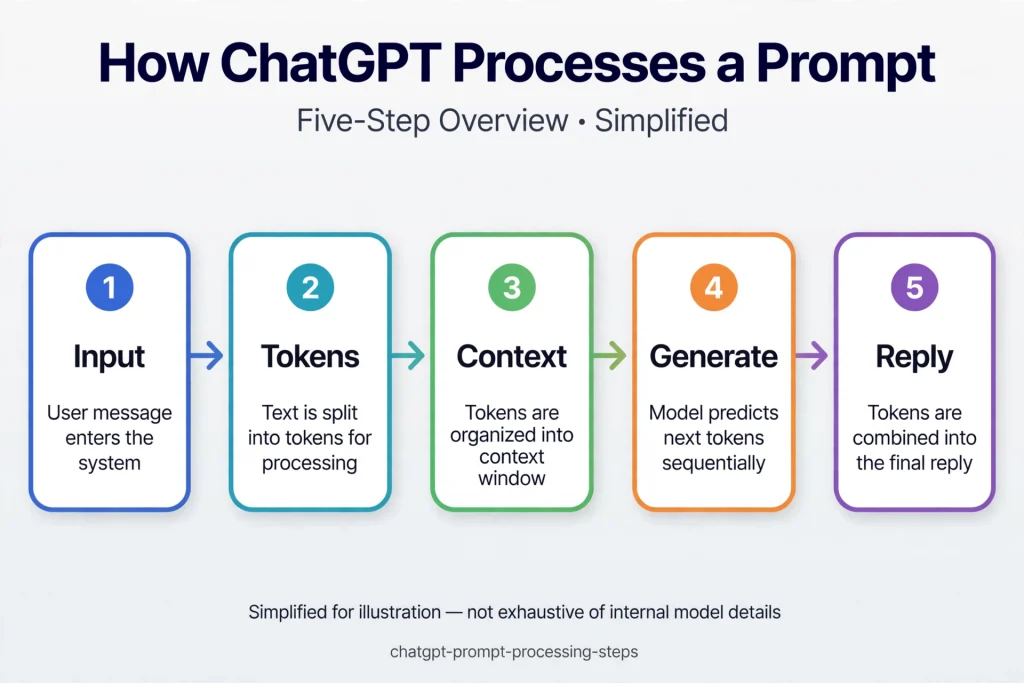
Here is a simplified view of how ChatGPT processes prompts, from the moment you press send:
- You enter input. This can be a question, an instruction, or, where supported, a file or image.
- The text becomes tokens. The system converts your words into tokens, small units the model can handle numerically.
- The model reads the context. It considers your message along with earlier parts of the conversation that fit inside its context window, the amount of text it can take into account at once.
- The model generates output step by step. It estimates likely next tokens and produces them in sequence.
- The reply is returned. The tokens are converted back into readable text, sometimes after extra steps such as safety checks or tool use.
This is a conceptual model, not an exact diagram of OpenAI’s systems. Details differ between models and features, and OpenAI does not publish every implementation detail. Some advanced models, for example, use extra “reasoning” tokens internally before showing a final answer.
How Does ChatGPT Work When You Ask a Follow-Up Question?
In a chat, your earlier messages stay part of the context the model can read, which is why you can say “make it shorter” without repeating everything. That context lives inside the conversation. It is different from the long-term memory features covered later.
What Is a Large Language Model?
A large language model (LLM) is a neural network trained on very large amounts of text to learn statistical patterns in language: which words, phrases, and ideas tend to go together, and how sentences are built. “Large” refers to the scale of the model and its training.
An LLM is not a giant database of prewritten answers. It does not look up a stored reply the way a search engine retrieves a page. It generates text from the patterns it learned during training and the context in front of it. So how does ChatGPT work when it has never seen your exact question? It applies learned patterns to your specific wording and context rather than matching it to a saved answer.
That also means it can combine ideas in new ways, and it can be wrong. Learning patterns is not the same as verifying facts.
What Does GPT Stand For?
GPT stands for Generative Pre-trained Transformer.
- Generative: the model produces new output, such as text, instead of only sorting or labeling existing text.
- Pre-trained: the model first learns general language patterns in an earlier training stage, before it is adapted for a specific use such as chatting.
- Transformer: a neural-network architecture introduced in the 2017 research paper “Attention Is All You Need.” It is built on attention mechanisms, which let the model weigh how different tokens in a sequence relate to one another.
Attention is what helps a model connect a word like “it” to the noun it refers to earlier in a passage, at least most of the time.
What Are Tokens and Tokenization?
Models do not read text the way you do. Text is first split into tokens, which OpenAI describes as the building blocks of text its models process. A token can be a whole word, part of a word, punctuation, or a space attached to a word, depending on the tokenizer.
As a simple illustration, a long word such as “unbelievable” might be split into a few pieces, while a short common word such as “cat” may be a single token. This is only an example; real splits depend on the tokenizer.
For English, OpenAI’s rule of thumb is that one token is roughly four characters, or about three-quarters of a word, though counts vary by model and language. Tokens matter because models can only handle so many at once, and both your prompt and the reply count toward that limit. To see real splits, try OpenAI’s Tokenizer tool.
How Does ChatGPT Generate Responses?
Next-token prediction is the best-known part of how ChatGPT generates responses. Given the tokens so far, the model estimates which tokens are likely to come next, picks one, adds it to the sequence, and repeats. Doing this many times produces sentences and paragraphs.
For example, after “The capital of France is,” a well-trained model assigns high probability to “Paris.” For open-ended prompts such as “write a short poem about autumn,” many continuations are plausible, so replies can differ from one attempt to the next.
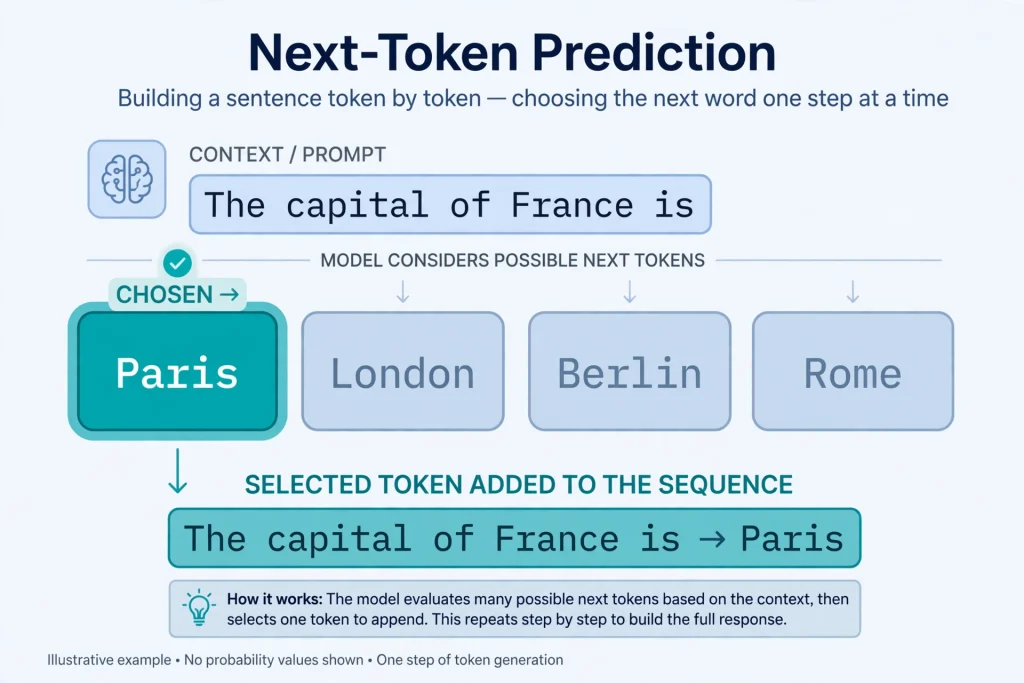
Next-token prediction is a useful simplification, not a complete description of modern ChatGPT systems. Training stages, safety systems, reasoning steps, and tools all shape what you see.
Why Does Changing Your Wording Change the Answer?
The model works from the exact tokens and context it receives, so small changes can shift what follows. OpenAI noted at launch that ChatGPT can be sensitive to tweaks in phrasing, sometimes answering one wording differently from a slight rephrase. Clear, specific prompts give the model better context to work with.
How Is ChatGPT Trained?
Training happens in stages, and the exact recipe differs between models. OpenAI’s public descriptions cover the general approach, not every internal detail or the contents of its datasets.
Pre-Training
In pre-training, a model learns from a very large collection of text by repeatedly predicting what comes next. This is where it picks up grammar, facts, writing styles, and many reasoning patterns. OpenAI describes pretraining as predicting the next word in huge amounts of text.
Fine-Tuning and Human Feedback
After pre-training, models are refined. For the original ChatGPT, OpenAI used Reinforcement Learning from Human Feedback (RLHF). Human AI trainers wrote example conversations for supervised fine-tuning. Trainers then ranked alternative model responses, those rankings were used to build a reward model, and the chat model was tuned further against it. Newer models involve more evaluation and safety work, but OpenAI does not detail every step publicly.
Training vs. Inference
| Training | Inference | |
|---|---|---|
| What happens | The model’s parameters are adjusted using data | A trained model generates a reply to your prompt |
| When | Before release and in later updates | Each time you send a message |
| Does your chat change the model right away? | No | No. Your message is used as context |
Chatting with ChatGPT is inference. Whether your conversations may later help improve OpenAI’s models depends on your account’s data controls, such as the “Improve the model for everyone” setting.
Does ChatGPT Search the Internet for Every Answer?
No. Generating a reply from a trained model is not the same as a live web search. ChatGPT can search the web for current information and show links to sources, and OpenAI says it may do this automatically when a question would benefit from up-to-date information. You can also choose Search yourself.
Availability and behavior can vary by plan, model, region, and settings, so do not assume every answer involved a search. OpenAI also cautions that search results and citations can be incomplete, outdated, or incorrect, so check important sources yourself.
Does ChatGPT Remember Previous Conversations?
Two different things are easy to confuse:
- Context within a conversation: earlier messages in the same chat that the model can read, within its context window.
- Memory features: optional personalization. OpenAI describes saved memories, which are details you ask ChatGPT to remember, and the ability to reference past chats, both managed in Settings.
ChatGPT does not remember everything forever, and memory is not identical for every user. The memory summary may not show everything ChatGPT can draw on, and Temporary Chats do not use or create memories. Availability depends on plan and rollout, so check your own Settings.
Why Does ChatGPT Make Mistakes?
ChatGPT can produce fluent answers that are wrong. These errors are often called AI hallucinations: plausible but false statements. OpenAI says hallucinations remain a challenge for all large language models, even as newer models reduce them.
Several factors contribute:
- Pattern-based generation: a model built to produce plausible language can produce plausible falsehoods, especially for obscure, one-off facts.
- Guessing incentives: OpenAI research argues that common training and evaluation setups can reward guessing over admitting uncertainty.
- Missing or outdated information: without search, a model may not know recent events.
- Ambiguous prompts: vague questions force the model to guess what you meant.
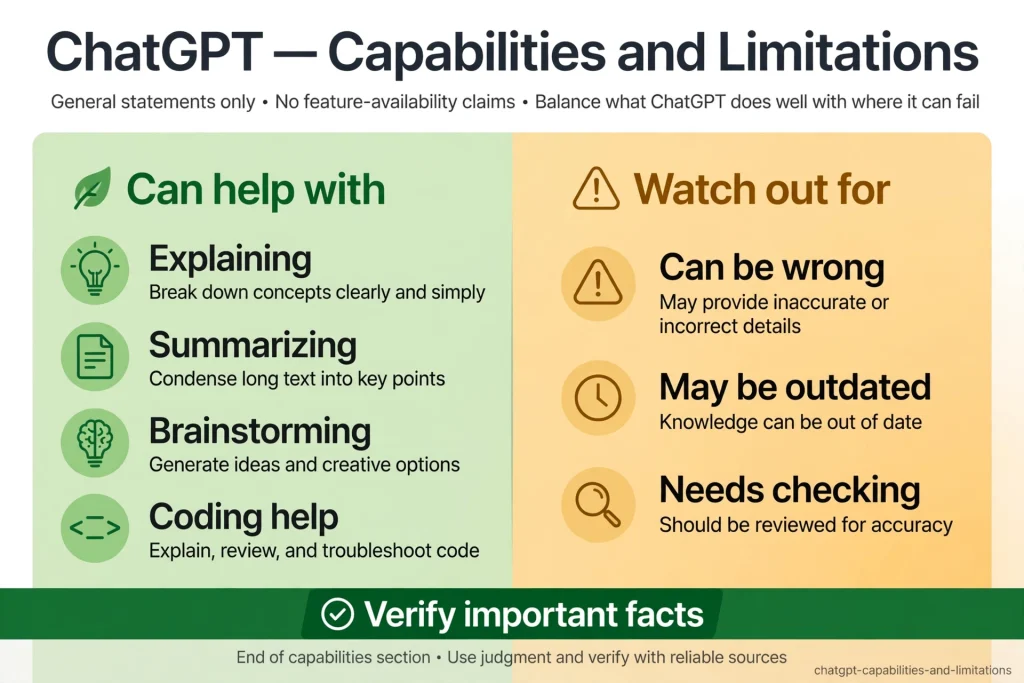
A confident tone does not guarantee accuracy. Verify anything important, especially medical, legal, or financial information, with qualified professionals and reliable primary sources. ChatGPT is neither fully reliable nor useless. It is a powerful tool that needs checking. If you are trying to tell whether a piece of text was written by AI, our guide to ChatGPT detector tools covers what those checks can and cannot show.
What Can ChatGPT Do?
Common uses include:
- Answering questions and explaining concepts
- Summarizing and rewriting text
- Brainstorming ideas
- Helping write and debug code
- Supporting research and analysis
- Working with files, images, or voice, where supported
How does ChatGPT work with files or images? In general, supported inputs are converted into a form the model can process alongside text, but features differ by model, plan, region, and settings, so not every user has every capability.
How Can You Get Better Answers From ChatGPT?
Better prompts give the model better context, though they never guarantee correctness. Try these habits:
- State the task clearly.
- Add relevant context.
- Name the audience and format.
- Break big tasks into steps.
- Ask follow-up questions.
- Verify key facts.
- Protect sensitive information. Avoid sharing private details unnecessarily.
| Vague prompt | Improved prompt |
|---|---|
| “Explain photosynthesis.” | “Explain photosynthesis to a 9th-grade student in about 150 words, using one everyday analogy.” |
| “Help with my resume.” | “Rewrite this resume summary for a marketing coordinator role in a friendly but professional tone, under 80 words.” |
| “Write about dogs.” | “Write a 300-word blog intro about adopting a rescue dog, aimed at first-time owners, with a warm tone.” |
Frequently Asked Questions
How does ChatGPT work in simple terms?
ChatGPT reads your message as tokens, uses a language model trained on large amounts of text to predict a fitting reply one token at a time, and returns the result as text. It generates responses from learned patterns, not by looking up stored answers.
How does ChatGPT generate answers?
It converts your input into tokens, considers the conversation context, and generates output incrementally, often by estimating likely next tokens. Training stages, safety systems, and tools can also influence the result.
Does ChatGPT understand what people say?
It processes language well enough to respond coherently and often usefully, but whether that equals human understanding is debated. It has no human experience behind its words, and it can misread a request or state something false with confidence.
Does ChatGPT predict the next word?
At a high level, yes. Language models are trained to predict the next token, which is often a word or part of one. That is a simplification, though, because modern systems also involve post-training, safety work, and sometimes reasoning steps and tools.
Does ChatGPT learn from every conversation?
Not in the moment. The model is not updated as you chat; it uses your messages as context. Depending on your data controls, conversations may be used to improve models, and you can turn off “Improve the model for everyone.” OpenAI says Temporary Chats are not used to train its models.
Does ChatGPT search Google for answers?
Not as a simple rule. ChatGPT does not search for every answer. When search is used, OpenAI says ChatGPT may send targeted queries to search providers and then respond with sources.
Where does ChatGPT get its information?
From patterns learned in training, from the context of your conversation, and, when enabled, from search or other tools. OpenAI does not publish a complete list of its training data.
Why does ChatGPT sometimes give wrong answers?
Because generating plausible language is not the same as verifying facts. Guessing under uncertainty, missing or outdated information, and vague prompts can all lead to errors.
Is ChatGPT a search engine or a language model?
ChatGPT is an assistant powered by language models. A search engine retrieves and ranks existing pages, while a language model generates text. ChatGPT can also use a search feature, which blends the two.
Can ChatGPT work without the internet?
The ChatGPT website and apps connect to OpenAI’s servers to run the model, so you generally need an internet connection to use them. Without search, a reply relies on what the model learned in training and on your conversation, not on live web data.
Conclusion
So, how does ChatGPT work? It turns your message into tokens, reads the available context, and generates a reply one piece at a time using patterns learned during training and refinement. Extra features such as search and memory can add information, but they do not change the basic point: a fluent answer is not a guaranteed correct one.
For beginners, the most useful habit is simple. Give clear context, treat the answer as a strong first draft, and check anything that matters.
Sources & References
- “Attention Is All You Need,” Vaswani et al., arXiv. https://arxiv.org/abs/1706.03762. Supports the description of the Transformer as an architecture based on attention mechanisms.
- “Introducing ChatGPT,” OpenAI. https://openai.com/index/chatgpt/. Supports the launch details, fine-tuning from the GPT-3.5 series, the RLHF training method, and sensitivity to phrasing.
- “What are tokens and how to count them?” OpenAI Help Center. https://help.openai.com/en/articles/4936856-what-are-tokens-and-how-to-count-them. Supports the definition of tokens, the English rule of thumb, and the note on reasoning tokens.
- “Why language models hallucinate,” OpenAI. https://openai.com/index/why-language-models-hallucinate/. Supports the definition of hallucinations, the pretraining description, and the guessing-incentive explanation.
- “Searching the web with ChatGPT,” OpenAI Help Center. https://help.openai.com/en/articles/9237897-searching-the-web-with-chatgpt. Supports automatic and manual search, availability caveats, and the warning that results can be incomplete or incorrect.
- “Memory FAQ,” OpenAI Help Center. https://help.openai.com/en/articles/8590148-memory-faq. Supports saved memories, chat-history reference, the memory summary, and Temporary Chats.
- “Data Controls FAQ,” OpenAI Help Center. https://help.openai.com/en/articles/7730893-data-controls-faq. Supports the “Improve the model for everyone” setting and Temporary Chat training behavior.