
So, when did ChatGPT come out? OpenAI released ChatGPT to the public on November 30, 2022, as a free research preview. It ran on a model from the GPT-3.5 series, and OpenAI said it wanted public feedback to learn what the system did well and where it fell short.
This guide explains what that launch actually included, how it differs from earlier GPT models, and which dates matter in ChatGPT history since then. We checked each date against OpenAI’s own pages where possible, and we say so when we could not.
Last checked against OpenAI sources on October 27, 2026. ChatGPT changes often, so newer updates may exist.
Table of Contents
When Did ChatGPT Come Out? The Short Answer
ChatGPT came out on November 30, 2022, when OpenAI introduced it as a free research preview. It was built on a GPT-3.5 series model and designed to chat in a dialogue format. GPT models had existed since 2018, but ChatGPT, the conversational product, first reached the public on that date.
Here are the quick facts:
- Launch date: November 30, 2022
- Released by: OpenAI
- Original status: Research preview, free to use
- Age today: As of October 27, 2026, ChatGPT is almost four years old. Its fourth anniversary is November 30, 2026.
People search for this fact in several ways: when was ChatGPT released, the ChatGPT release date, or the ChatGPT launch date. All of them point to November 30, 2022. The sections below add the context that a single date cannot give you.
What Happened at the ChatGPT Launch on November 30, 2022?
What OpenAI Released
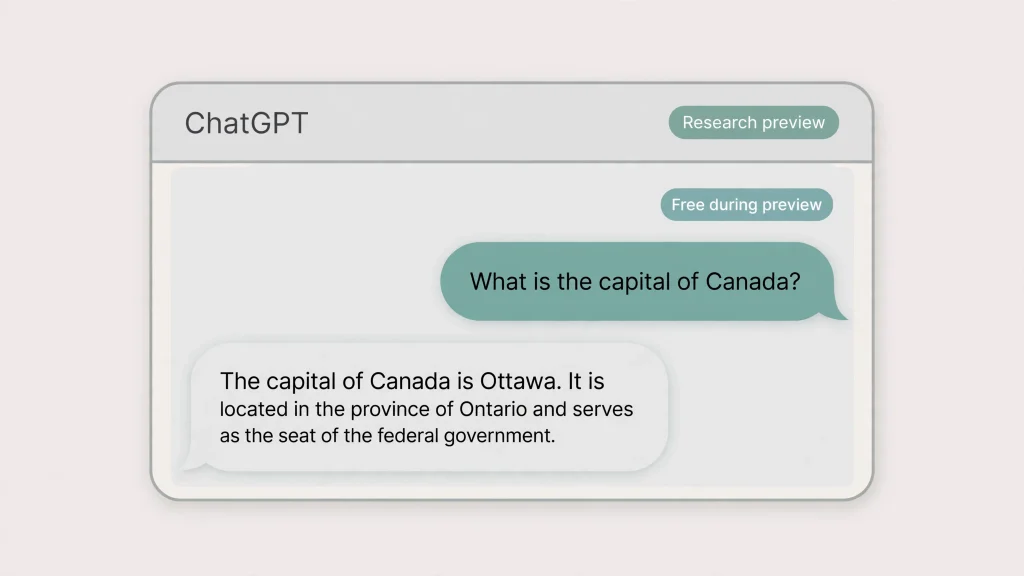
OpenAI published a post called “Introducing ChatGPT,” dated November 30, 2022. It described a model, also named ChatGPT, that interacts in a conversational way. According to OpenAI, the dialogue format lets the system answer follow-up questions, admit mistakes, challenge incorrect premises, and reject inappropriate requests.
OpenAI also said ChatGPT is a sibling model to InstructGPT, which is trained to follow instructions in a prompt. The company explained that ChatGPT was fine-tuned from a GPT-3.5 series model that finished training in early 2022, using a method called reinforcement learning from human feedback (RLHF). In plain terms, human trainers wrote example conversations and ranked answers to teach the model better behavior.
Why OpenAI Called It a Research Preview
The launch post said OpenAI was introducing ChatGPT to gather user feedback and learn about its strengths and weaknesses. It also stated that usage was free during the research preview.
A research preview is an early release, not a finished product. OpenAI listed limitations openly: answers that sound plausible but are wrong, sensitivity to small changes in phrasing, and wordy replies. It also ran a feedback contest with prizes of up to $500 in API credits.
OpenAI framed the release as the latest step in “iterative deployment,” meaning it releases systems in stages and applies lessons from earlier ones, such as GPT-3 and Codex. A note at the top of the original post today says it covers the 2022 launch and that ChatGPT has evolved substantially since.
What Was ChatGPT Like on Launch Day?
The original ChatGPT was a chat window. You typed a question or instruction, the system replied, and you could ask follow-up questions in the same conversation. OpenAI’s launch post showed samples that ranged from fixing code to explaining a math theorem to writing an introduction for a neighbor.
It is easy to read today’s features back into that day, so here is what the launch post does not describe: voice conversations, image input, plugins, or memory. Paid plans did not exist yet either. ChatGPT Plus arrived on February 1, 2023, and GPT-4 reached ChatGPT on March 14, 2023.
The format is a big part of why people noticed. About two and a half years earlier, OpenAI had given outside developers access to GPT-3 family models through an API that launched as a private beta on June 11, 2020. ChatGPT put a conversational model in front of ordinary people through a free interface.
What Is the Difference Between GPT and ChatGPT?
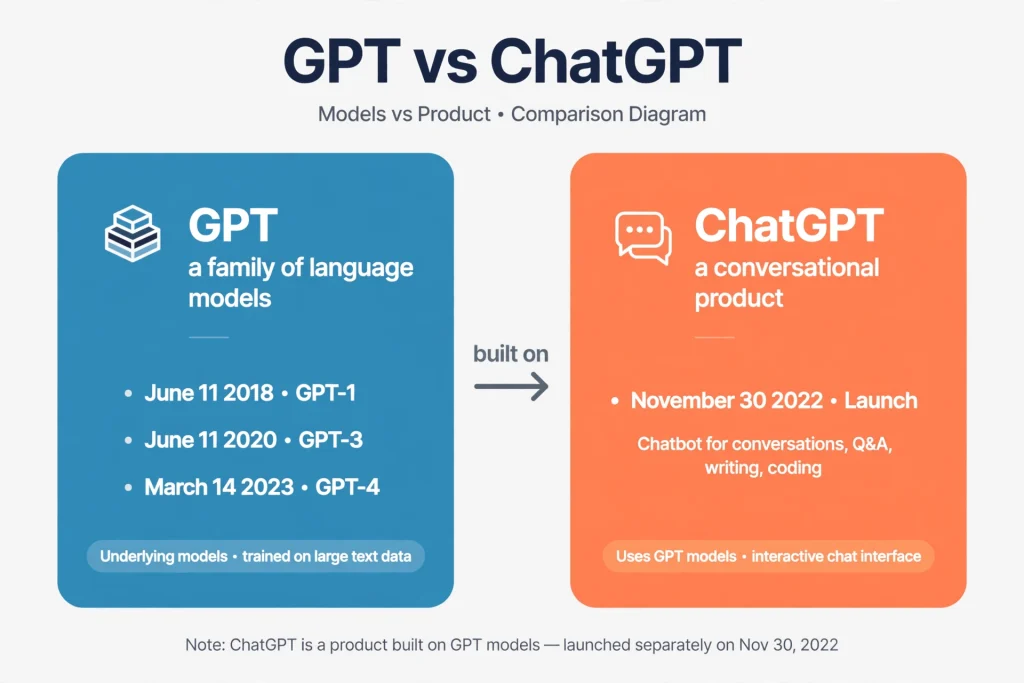
GPT stands for Generative Pre-trained Transformer. It names a family of language models. ChatGPT is a product: a conversational assistant built on those models. For a deeper breakdown of the acronym, see our explainer on what GPT stands for.
This distinction matters for dates, because GPT technology existed years before ChatGPT. OpenAI is the organization behind both. If you want the company background, our guide to who owns ChatGPT explains the structure.
Did GPT Exist Before ChatGPT?
Yes. This table separates the model milestones from the product launch:
| Date | What it was | Type |
|---|---|---|
| June 11, 2018 | OpenAI’s first published GPT research | Research model |
| June 11, 2020 | OpenAI API launched in private beta, running GPT-3 family models | Developer access |
| Early 2022 | GPT-3.5 series model finished training (per OpenAI) | Base model for ChatGPT |
| November 30, 2022 | ChatGPT introduced as a research preview | Consumer product |
| March 14, 2023 | GPT-4 announced | New model |
In short, ChatGPT’s launch date is not the release date of GPT-3, GPT-4, or any other model. ChatGPT is the product, and the models underneath it have changed many times.
ChatGPT Timeline: 9 Key Dates Since Launch
This timeline goes beyond when did ChatGPT come out and shows what followed. It covers the ChatGPT history that matters most for readers. It leaves out smaller updates, which OpenAI tracks in its ChatGPT release notes.
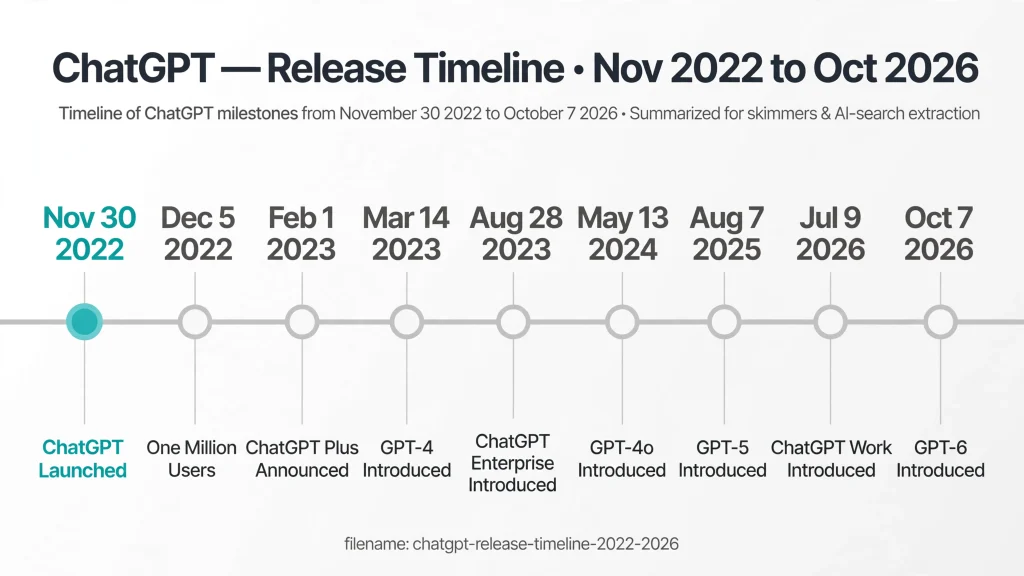
| Date | What happened | Why it mattered | Source |
|---|---|---|---|
| Nov 30, 2022 | OpenAI introduces ChatGPT as a free research preview | First public release of the product | OpenAI |
| Dec 5, 2022 | Sam Altman tweets that ChatGPT passed 1 million users in five days | Early sign of fast adoption | CNBC |
| Feb 1, 2023 | ChatGPT Plus launches as a $20/month pilot; access expands beyond the U.S. on Feb 10 | First paid plan, with free access continuing | OpenAI |
| Mar 14, 2023 | GPT-4 announced; text input available through ChatGPT and the API (API had a waitlist) | A new model reached ChatGPT; outlets reported it first went to Plus subscribers | OpenAI |
| Aug 28, 2023 | ChatGPT Enterprise launches | Business version with stronger security and privacy controls | OpenAI |
| May 13, 2024 | GPT-4o announced; text and image inputs released that day | Faster model; audio and video features came later | OpenAI |
| Aug 7, 2025 | GPT-5 introduced and set to become the default model in ChatGPT | Major model generation change | OpenAI |
| Jul 9, 2026 | ChatGPT Work introduced | An agent for longer, multi-step tasks, on paid plans except Free and Go | OpenAI release notes |
| Oct 7, 2026 | GPT-6 and Intelligent UI begin rolling out in ChatGPT | Answers can include interactive tools and visuals | OpenAI release notes |
A note on precision: the March 2023 row comes from OpenAI’s GPT-4 announcement plus news coverage of the Plus rollout. The May 2024 date comes from OpenAI’s own announcement post on X, quoted by several outlets, since the announcement page itself does not display a date.
If you are weighing the paid plans that began in 2023, our guides on whether ChatGPT Plus is worth it and whether ChatGPT Pro is worth it cover current pricing and limits.
Why Did ChatGPT Become So Popular So Fast?
The growth numbers are well documented, though not all of them come from OpenAI. Altman said on December 5, 2022 that ChatGPT had signed up 1 million users in five days, as reported by CNBC. The Swiss bank UBS later estimated that ChatGPT reached 100 million monthly active users in January 2023. That is an analyst estimate, not an OpenAI figure. CNBC noted that TikTok took nine months to reach the same mark.
Longer term, HISTORY.com reports that OpenAI said about 800 million people were using ChatGPT weekly by early November 2025.
Why did it spread so quickly? No single cause has been proven, but several factors likely helped:
- Free access. OpenAI made the research preview free to try.
- A simple interface. You only had to type in plain language.
- Broad usefulness. The launch samples showed coding help, math explanations, and everyday writing in one tool.
- Public experimentation. The preview invited people to test it and share what they found.
Treat this list as informed context rather than a ranked explanation. Researchers and journalists still debate how much each factor mattered.
How Has ChatGPT Changed Since 2022?
The answer to when did ChatGPT come out never changes, but the product itself has changed a lot. The ChatGPT of 2022 and the ChatGPT of October 2026 share a name and a chat box, but not much else. This table compares them using dates from OpenAI’s announcements and release notes.
| Area | At launch (Nov 30, 2022) | Later |
|---|---|---|
| Price | Free during the research preview | Plus pilot on Feb 1, 2023; Enterprise on Aug 28, 2023; today’s plans include Free, Go, Plus, Pro, Business, Enterprise and Edu |
| Models | A GPT-3.5 series model | GPT-4 (Mar 2023), GPT-4o (May 2024), GPT-5 (Aug 2025), GPT-6 (Oct 2026) |
| Tasks | Conversation and follow-up questions | ChatGPT Work for longer tasks (Jul 9, 2026) |
| Voice | Not mentioned in the launch post | New Voice experience powered by GPT-Live-1 (Jul 8, 2026) |
| Images | Not mentioned in the launch post | ChatGPT Images 2.0 (Apr 21, 2026) |
| Ads | Not part of the launch | Ads began rolling out to Free and Go users in Australia, New Zealand and Canada (Apr 16, 2026) and the UK (Jun 4, 2026) |
OpenAI’s release notes say Plus, Pro, Business, Enterprise and Education plans do not have ads, though that policy could change.
Do All Users Get Every Feature?
No. Many features depend on your plan, region, or workspace settings. Three examples from OpenAI’s release notes:
- Health in ChatGPT (July 23, 2026) started rolling out to signed-in Free, Go, Plus and Pro users aged 18 or older in the United States.
- ChatGPT Work is available on paid plans except Free and Go.
- Dots, always-on agents introduced on September 29, 2026, rolled out to eligible Pro and Business Premium users in supported markets. Pro access excluded the European Economic Area, Switzerland and the UK at launch.
Check OpenAI’s current release notes before assuming a feature is available to you.
Common Misconceptions About the ChatGPT Release Date
“ChatGPT launched with GPT-4.” It did not. This mix-up often happens when people ask when did ChatGPT come out and mean a specific model version. ChatGPT launched on a GPT-3.5 series model in November 2022. GPT-4 followed on March 14, 2023.
“ChatGPT is the same as GPT-3.” Not quite. OpenAI says ChatGPT was fine-tuned from a GPT-3.5 series model and is a sibling to InstructGPT.
“ChatGPT launched in 2023.” The launch was in 2022. Much of the explosive user growth, including the UBS estimate of 100 million monthly users, came in January 2023, which may be why some people remember it that way.
“ChatGPT has always been paid.” The research preview was free, and OpenAI said in February 2023 that it would keep offering free access when Plus launched. OpenAI’s current release notes still list Free and Go plans.
FAQ: Common Questions About ChatGPT’s Release
When did ChatGPT come out?
OpenAI introduced ChatGPT on November 30, 2022, as a free research preview.
When was ChatGPT first available to the public?
Also November 30, 2022. OpenAI invited people to try it free during the research preview.
Who released ChatGPT?
OpenAI released ChatGPT and continues to operate it.
What year did ChatGPT launch?
- Plus launched in 2023, and GPT-4 reached ChatGPT in 2023.
Did GPT exist before ChatGPT?
Yes. OpenAI published its first GPT research on June 11, 2018. It launched an API running GPT-3 family models in private beta on June 11, 2020. The GPT-3.5 series model behind ChatGPT finished training in early 2022.
What was ChatGPT originally released for?
OpenAI said it released ChatGPT to get user feedback and learn about the system’s strengths and weaknesses.
Was ChatGPT free when it launched?
Yes. OpenAI said usage was free during the research preview.
How has ChatGPT changed since 2022?
It added paid and business plans, newer models from GPT-4 through GPT-6, and tools such as ChatGPT Work. Availability varies by plan and region.
When was ChatGPT Plus introduced?
ChatGPT Plus launched on February 1, 2023, as a $20-per-month pilot. OpenAI’s post says access expanded to customers outside the U.S. on February 10, 2023.
Is ChatGPT’s launch date the same as GPT-4’s release date?
No. ChatGPT launched on November 30, 2022. GPT-4 was announced on March 14, 2023, about three and a half months later.
Conclusion
So, when did ChatGPT come out? On November 30, 2022, when OpenAI released it as a free research preview built on a GPT-3.5 series model. That date marks the moment a conversational AI became easy for ordinary people to try, which is why it is still the reference point for the history of public AI chatbots.
Remember the key distinction: GPT models existed before ChatGPT, and ChatGPT has since run on many different models. For the latest changes, OpenAI’s release notes are the best source.
Sources & References
- Introducing ChatGPT, OpenAI. https://openai.com/index/chatgpt/. Supports the November 30, 2022 launch, research preview and free usage, GPT-3.5 series base, InstructGPT relationship, limitations, and feedback contest.
- ChatGPT release notes, OpenAI Help Center. https://help.openai.com/en/articles/6825453-chatgpt-release-notes. Supports ChatGPT Work (July 9, 2026), GPT-6 and Intelligent UI (October 7, 2026), Voice (July 8, 2026), Images 2.0 (April 21, 2026), ads rollouts, Health, dots, and plan availability.
- Introducing ChatGPT Plus, OpenAI. https://openai.com/blog/chatgpt-plus. Supports the February 1, 2023 launch, $20/month price, continued free access, and the February 10, 2023 expansion outside the U.S.
- GPT-4, OpenAI. https://openai.com/research/gpt-4. Supports GPT-4’s release through ChatGPT and the API, and GPT-3.5 as an earlier test run.
- OpenAI unveils GPT-4 (Bloomberg report via Gulf Business). https://gulfbusiness.com/?p=247889. Supports the March 14, 2023 date and availability to ChatGPT Plus subscribers.
- Introducing ChatGPT Enterprise, OpenAI. https://openai.com/index/introducing-chatgpt-enterprise/. Supports the August 28, 2023 launch.
- Hello GPT-4o, OpenAI. https://openai.com/index/hello-gpt-4o/. Supports GPT-4o’s capabilities and the public release of text and image inputs.
- OpenAI Reveals Multimodal GPT-4o, SlashGear. https://www.slashgear.com/1581243/openai-reveals-chatgpt-4o-multimodal-visual-ai. Supports the May 13, 2024 date through OpenAI’s quoted announcement.
- Introducing GPT-5, OpenAI. https://openai.com/index/introducing-gpt-5/. Supports the August 7, 2025 date.
- Introducing GPT-5, OpenAI Academy. https://academy.openai.com/home/resources/intro-gpt-5. Supports GPT-5 becoming the default model on August 7.
- Improving language understanding with unsupervised learning, OpenAI. https://openai.com/index/language-unsupervised/. Supports the June 11, 2018 GPT research post.
- OpenAI API, OpenAI. https://openai.com/blog/openai-api/. Supports the June 11, 2020 private beta API running GPT-3 family models.
- All you need to know about ChatGPT, CNBC, February 8, 2023. https://www.cnbc.com/2023/02/08/what-is-chatgpt-viral-ai-chatbot-at-heart-of-microsoft-google-fight.html. Supports the 1 million users claim, the UBS estimate, and the TikTok comparison.
- ChatGPT, the generative AI chatbot, is released, HISTORY.com. https://www.history.com/this-day-in-history/chatgpt-released-openai. Supports the reported 800 million weekly users figure in early November 2025.
- OpenAI Rolls Out GPT-6 and Intelligent UI in ChatGPT, Let’s Data Science. https://letsdatascience.com/news/openai-brings-gpt-6-and-intelligent-ui-to-chatgpt-4f0d797c. Corroborates the October 7, 2026 GPT-6 rollout date.