
Last reviewed: October 2026. Tool limits and prices change often, so check each official page before relying on them.
A ChatGPT detector is software that estimates whether a piece of writing looks like it came from an AI model. Several ChatGPT detector tools offer free checks, including Scribbr, QuillBot, Copyleaks, GPTZero, and Sapling.
None of them can prove who wrote a text. They return an estimate, and independent research shows those estimates can be wrong in both directions.
This guide explains how a ChatGPT detector works and compares the main tools using their official pages. It also summarizes what independent studies found, so you can use these tools with realistic expectations.
Key takeaways:
- A detector score is an estimate, not proof of authorship.
- Free tools exist, but each one limits length, daily scans, or monthly words.
- Independent studies document false positives and false negatives.
- Vendor accuracy claims are not the same as independent evidence.
- Check a tool’s privacy policy before pasting sensitive text.
We did not run our own hands-on tests. The comparison below rests on official documentation and published research.
What Is a ChatGPT Detector?
A ChatGPT detector analyzes text and estimates how likely it is to be AI-generated. People also call it an AI text detector, an AI writing detector, or an AI content checker.
Most tools return an overall percentage. Some also highlight individual sentences or paragraphs that look machine-written.
Despite the name, most detectors are not limited to ChatGPT. They aim to catch writing from several AI tools. The models each vendor says it supports differ, and those lists change over time.
Who uses a ChatGPT detector?
Common users include:
- Teachers and professors who want a starting point for a conversation.
- Editors and publishers who review submitted articles.
- Bloggers and website owners who check freelance content.
- Students who want to see how their own writing might be scored.
In every case, the result should be a prompt for further review, not a final judgment.
How Does a ChatGPT Detector Work?
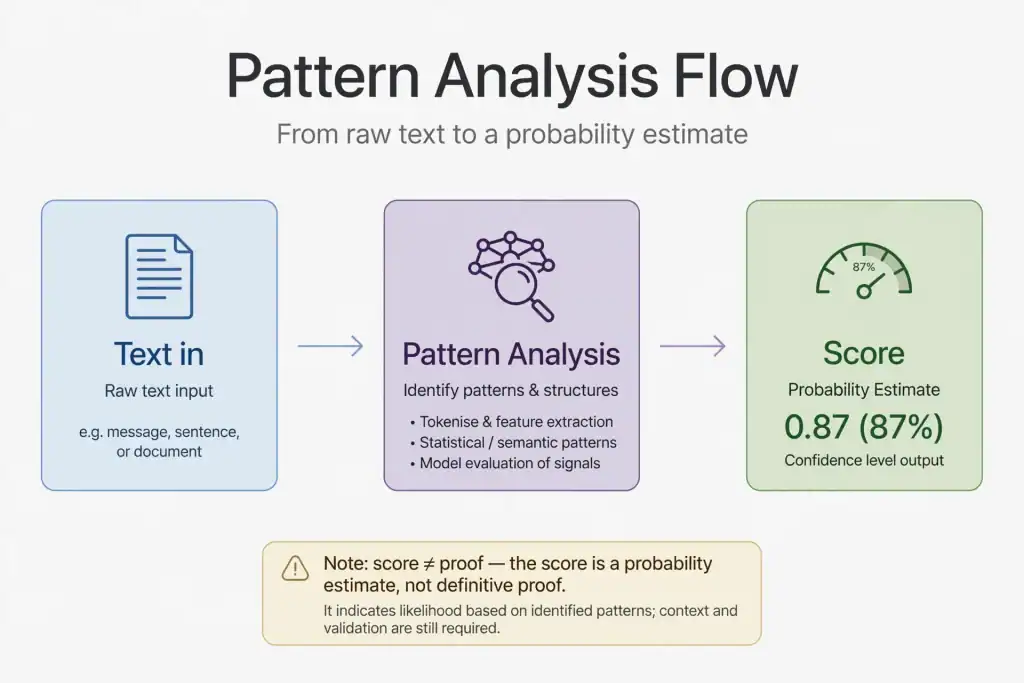
Vendors keep their models proprietary. No one outside the company knows exactly how a given tool works.
Researchers describe one common approach: perplexity-based detection. It looks at how predictable the wording is. Text that is very predictable may be scored as more machine-like.
Many tools also train classifiers on large collections of human-written and AI-written text. They learn statistical differences between the two groups.
A ChatGPT detector therefore measures patterns in the writing, not where the writing came from. It cannot see who typed the words or which tools were open at the time.
How should you read a detector score?
Three points matter:
- A percentage is not a universal probability. Tools calibrate scores differently, so 60% on one tool does not mean the same as 60% on another.
- Some tools split the result into categories. QuillBot’s page, for example, separates AI-generated, human-written and AI-refined, and human-written shares.
- Results shift with text length, editing, language, and writing style.
What a detector can and cannot tell you
| A detector can | A detector cannot |
|---|---|
| Estimate whether wording resembles patterns found in AI-written text | Confirm who wrote the text or which tools were used |
| Highlight passages that may deserve a closer read | Prove misconduct or honest authorship |
| Give a rough second opinion alongside your own judgment | Replace drafts, revision history, or a conversation with the author |
| Produce different scores on different tools for the same text | Give one agreed, universal score |
Treat the left column as the useful part. The right column is why a score should never be the last step.
Best ChatGPT Detectors to Consider
The table shows what each official page said when reviewed. Sources are listed at the end of the article.
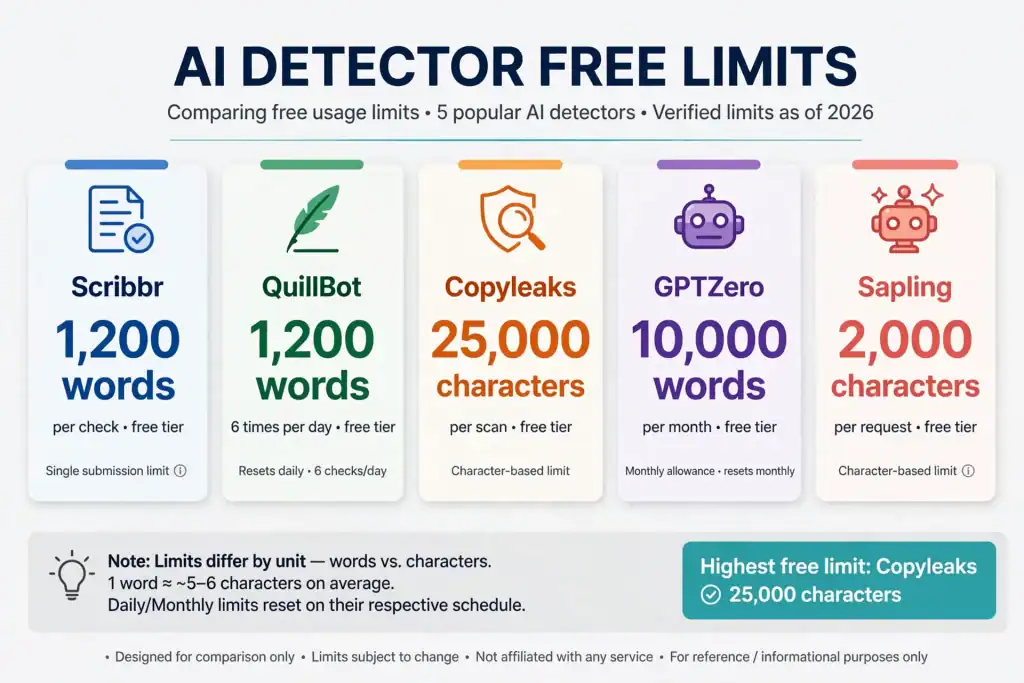
| Tool | Free access | Paid option | Notes |
|---|---|---|---|
| Scribbr AI Detector | Unlimited free checks, up to 1,200 words each, no sign-up | Higher limits and newer-model detection via a paid plan (third-party report, not verified officially) | Free tool aimed at students and writers |
| QuillBot AI Detector | Up to 1,200 words and 6 scans per day | Premium for higher limits | Reports AI-generated, AI-refined, and human-written shares |
| Copyleaks | Up to 25,000 characters per scan; a free account unlocks more scan credits | Credit-based plans | Vendor markets multilingual detection |
| GPTZero | A free tier of 10,000 words per month | Paid plans from $10 to $23 per month, with 150,000 to 500,000 words | A third-party review says individual free scans are capped at 5,000 characters (not verified officially) |
| Sapling | Free version cut off at 2,000 characters; paid plans accept up to 100,000 | Pro and Enterprise | Suits short text only |
| Originality.ai | No ongoing free plan, per a third-party review | $30 pay-as-you-go, or Pro at $12.95 per month billed annually ($14.95 monthly) | Includes plagiarism checks |
Prices appear in different billing forms across sources. They also change often, so confirm them on each vendor’s page.
ZeroGPT is left out. Its free-tier figures differed across third-party sources, and we could not confirm them officially.
Short profiles
Scribbr AI Detector. Best fit: a student or writer who wants a quick, no-account check of a short passage. Limitation: the 1,200-word cap means long papers must be checked in sections.
QuillBot AI Detector. Best fit: a user who wants a split between AI-generated and AI-refined writing. Limitation: free users get six scans a day.
Copyleaks. Best fit: someone checking a longer document in one pass. Limitation: its 99% accuracy claim is a vendor statement, and we found no independent test to confirm it.
GPTZero. Best fit: regular users who prefer a monthly word allowance over a per-scan cap. Limitation: the free tier runs out after 10,000 words a month. Plagiarism scanning is not included in the Essential plan, according to the pricing page.
Sapling. Best fit: short snippets such as an email or a paragraph. Limitation: the 2,000-character free cutoff.
Originality.ai. Best fit: publishers and teams who check content in volume and want plagiarism checks in the same plan. Limitation: there is no ongoing free plan.
Best Free ChatGPT Detectors
For a quick, no-account check of a short passage, Scribbr and QuillBot are the simplest options. Both cap each scan at 1,200 words.
Scribbr lists no sign-up. QuillBot limits free users to six scans a day.
For a longer single document, Copyleaks allows 25,000 characters per free scan. That is the largest single-scan allowance in the table.
For recurring use, GPTZero’s monthly allowance works better than a per-scan cap. Sapling suits snippets.
“Free” always comes with limits. It may be a word cap, a daily cap, a sign-up requirement, or fewer features. Read the limit before you paste anything.
How to Use a ChatGPT Detector
The exact screens differ by tool, but the steps are similar. Always follow the current instructions on the tool’s own page.
- Pick a tool and read its limits. Check the word or character cap and any minimum text length.
- Paste or upload the text. Use the full passage rather than a fragment, because very short text is a weak signal.
- Run the scan and read the result as an estimate. Look at the percentage and any highlighted sentences, but treat them as leads to investigate.
- Cross-check with context. If the stakes are real, compare against drafts, version history, sources, and the author’s own explanation.
- Don’t rely on one tool. Different detectors can disagree on the same text.
If you check long documents, split them into sections that fit the tool’s cap. Remember that each section gets its own score.
Common mistakes to avoid
These are editorial suggestions based on the limits described in the studies below, not tool-specific rules:
- Checking very short text. Research found commercial detectors lost accuracy on passages under 50 words.
- Treating a percentage as a verdict. A score is an estimate that varies by tool.
- Using a single tool. Two detectors can disagree on the same text, and neither is automatically right.
- Ignoring the writer. Non-native English writing has a documented risk of being flagged unfairly.
- Skipping the privacy policy. Check what happens to your text before you paste it.
A simple review routine helps editors and teachers. Run the check, read the flagged passages yourself, compare the text with earlier drafts or sources, and talk with the author before drawing any conclusion.
How Accurate Are ChatGPT Detectors?
Accuracy depends on the tool, the test, and the text. Independent studies, vendor claims, and anecdotes should not be mixed together.
OpenAI’s own detector was withdrawn
OpenAI launched an AI Classifier on January 31, 2023. It removed the tool on July 20, 2023, citing a low rate of accuracy.
At launch, OpenAI had acknowledged that the tool mislabeled human text as AI about nine percent of the time in its tests.
A 2023 academic test of 14 tools was harsh
Researchers led by Debora Weber-Wulff tested 12 public tools plus Turnitin and PlagiarismCheck.
They concluded the tools were neither accurate nor reliable. The main bias was toward classifying output as human-written. Content obfuscation made results significantly worse.
A secondary summary of the paper reports that every tool scored below 80% accuracy and only five cleared 70%. We could not confirm those figures in the paper itself, so treat them as reported.
This was a 2023 study, and tools have changed since then.
A 2025 University of Chicago study found large differences
Researchers evaluated Pangram, OriginalityAI, GPTZero, and an open-source RoBERTa model. They used a 1,992-passage corpus covering several topics, lengths, and AI models.
Their conclusions:
- Commercial tools outperformed the open-source baseline.
- GPTZero was favored for minimizing false positives. OriginalityAI was favored for separating AI from human text.
- RoBERTa had false positive rates of roughly 30% to 78%.
- GPTZero and OriginalityAI were not suitable for very short text. Both were susceptible to “humanizer” tools.
- GPTZero’s false negative rate was around 50% or higher in most cases once humanizers were used.
A summary in Chicago Booth Review adds detail on length. The commercial tools did reasonably well on medium and long passages, but accuracy dropped on passages under 50 words.
Vendor readings of the same data
GPTZero published its own reading of the same benchmark. It presented the results as putting GPTZero first on accuracy.
That is a vendor interpretation. The study authors’ conclusions differ by metric.
Different studies also use different texts, models, and thresholds. Never compare their percentages as if they came from one test.
Vendor claims
Copyleaks advertises over 99% accuracy and a very low false positive rate on its own page.
We found no independent test with a disclosed methodology to confirm that figure. Treat it as a marketing claim.
Can a ChatGPT Detector Identify Every AI Model?
No tool can credibly claim that. Vendors list the models they target, and those lists change as new AI models appear.
Detection also gets harder after text is edited, paraphrased, or machine-translated. The Weber-Wulff team found that accuracy degraded in these cases.
Check each tool’s documentation for the models it says it covers. A documented capability is not the same as a guarantee.
Can ChatGPT Detectors Flag Human-Written Text?
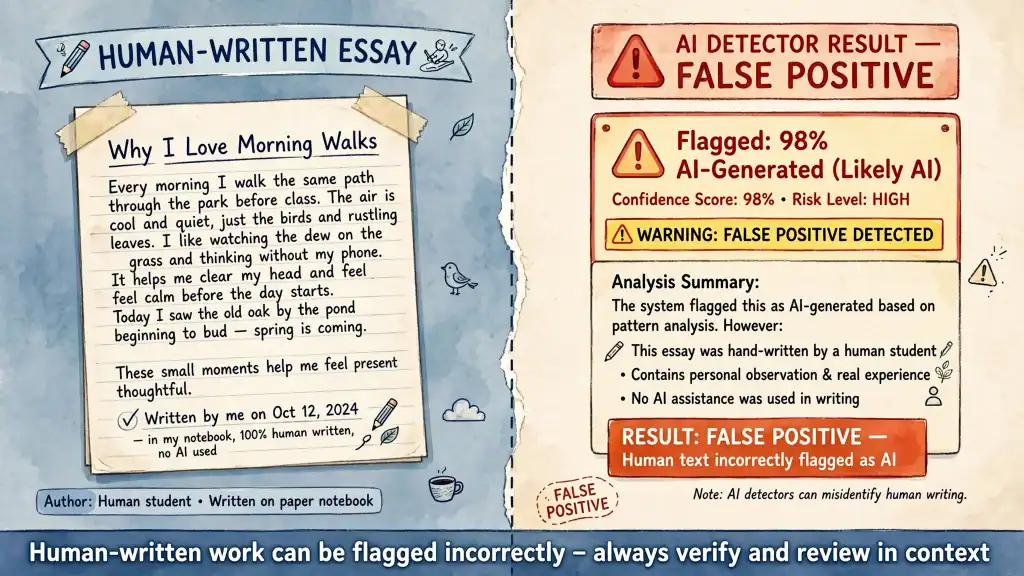
Yes. This is a false positive, and it is the most consequential error.
A Stanford-led study in Patterns tested seven detectors on writing by non-native English speakers. All seven flagged 18 of 91 TOEFL essays as AI-written. At least one detector flagged 89 of the 91.
The same detectors classified US eighth-grade essays accurately.
The authors suggest perplexity-based detection can penalize writers with limited linguistic variety. This is also a 2023 study, but it shows why a score can be unfair to some writers.
A university resource list cites Common Sense research on teens. It says about 10 percent reported having their work inaccurately identified as AI-generated.
If a ChatGPT detector flags your own writing, you have options. Share your drafts and notes, and ask the reader to look at the writing process rather than only the score.
ChatGPT Detector vs. Plagiarism Checker
A plagiarism checker compares your text against existing sources and finds matches. A ChatGPT detector looks at the style and statistics of the writing itself.
Original, never-published text can be fully AI-written. Copied text can be fully human-written.
Some products bundle both checks. Originality.ai’s pricing page lists AI detection and plagiarism checks in one plan. GPTZero’s pricing page lists plagiarism scanning in its Premium plan but not in Essential.
Even when bundled, they are different checks with different limits.
How to Choose the Right ChatGPT Detector
- Budget: Start with a free tool. Move to a paid plan only if you check text regularly.
- Text length: Match the tool’s cap to your documents. Don’t trust results on very short text.
- Language: Confirm the languages the vendor supports. Detection on non-English or non-native writing carries extra risk.
- Privacy: Review where your text goes before submitting it.
- Evidence: Prefer tools with independent evaluation over tools that publish only their own numbers.
- Stakes: For anything high-stakes, a detector is one input, not the decision.
Quick picks by situation
| Situation | Tool to consider | Why (based on published limits) |
|---|---|---|
| Short paragraph, no account | Scribbr or QuillBot | 1,200 words per scan, no sign-up listed for Scribbr; QuillBot allows six free scans a day |
| One long document | Copyleaks | 25,000 characters per free scan |
| Regular monthly checks | GPTZero | 10,000 free words per month, with paid tiers above that |
| Email or snippet | Sapling | 2,000-character free cutoff suits short text |
| Content team with plagiarism needs | Originality.ai | Plans listed with AI detection and plagiarism checks together |
These are starting points, not rankings. None of them is proven best, and your own text may behave differently.
Privacy and Responsible Use
Before pasting confidential, student, client, or unpublished text into any detector, check the tool’s privacy policy for these points:
- Whether submitted text is stored, and for how long.
- Whether it may be used to train models.
- Whether you can delete your submissions.
- What data an account requires.
We did not review each vendor’s privacy policy for this article. We make no privacy claims about specific tools.
Never treat a score as proof of misconduct. Look at the writing process, such as drafts, notes, sources, and a conversation with the author.
Frequently Asked Questions
What is the best free ChatGPT detector?
No tool is best for everyone, and none is proven best across all conditions. For a quick no-account check, Scribbr and QuillBot are easy starting points. For longer text, Copyleaks has the largest free per-scan allowance among the tools reviewed here.
Is there a free ChatGPT detector online?
Yes. Scribbr, QuillBot, Copyleaks, GPTZero, and Sapling all offer free access. Each limits length, daily scans, or monthly words.
Can a ChatGPT detector be wrong?
Yes. Independent studies document false positives (human text flagged as AI) and false negatives (AI text missed).
How accurate are AI detectors?
It varies by tool, test, and text. Results from one study cannot be applied to another. Vendor accuracy claims are not independent evidence.
Can ChatGPT detectors identify edited AI text?
Less reliably. Research found that paraphrasing, machine translation, and humanizer tools reduce detection performance.
Is an AI detector the same as a plagiarism checker?
No. One estimates machine-written style. The other finds text that matches existing sources.
Can an AI detector score prove who wrote a text?
No. It is an estimate. Use it alongside drafts, sources, and the author’s account.
Conclusion
A ChatGPT detector can be a useful first signal. Start with a free option that fits your text length, and read its limits and privacy policy.
Run important texts through more than one tool. Never use a single score as the final word.
If you need to judge authorship, rely on the writing process and context as well.
Sources & References
Official tool pages (limits and pricing)
- Scribbr AI Detector. Supports: free 1,200-word limit, no sign-up.
- QuillBot AI Detector. Supports: 1,200 words and 6 scans per day on the free tier; AI-generated, AI-refined, and human-written categories.
- Copyleaks AI Detector. Supports: 25,000-character free scans, free account credits, and the vendor’s accuracy claim (marketing, not independent).
- GPTZero Pricing. Supports: free 10,000 words per month, paid tiers, and which plans include plagiarism scanning.
- Sapling AI Content Detector. Supports: 2,000-character free limit and 100,000-character paid limit.
- Originality.ai Pricing. Supports: pay-as-you-go and Pro pricing, and AI detection with plagiarism checks in one plan.
Independent research and reporting
7. Liang et al., “GPT detectors are biased against non-native English writers”. Supports: perplexity-based detection and TOEFL false-positive results.
8. AI Magazine summary of the Stanford study. Supports: US eighth-grade essays classified accurately.
9. Weber-Wulff et al., “Testing of detection tools for AI-generated text” (2023). Supports: the 14-tool test and its conclusions.
10. AI Weekly summary of Weber-Wulff. Supports: the reported accuracy ceilings and degradation on paraphrased and machine-translated text (secondary source).
11. Jabarian & Imas, Chicago Booth BFI working paper. Supports: study design and the 1,992-passage corpus.
12. BFI summary: Artificial Writing and Automated Detection. Supports: commercial vs. open-source results and humanizer findings.
13. NBER working paper w34223. Supports: short-text and humanizer limits.
14. Chicago Booth Review: Do AI detectors work well enough to trust?. Supports: results by passage length, including accuracy loss under 50 words.
15. Search Engine Land: OpenAI classifier withdrawal. Supports: July 20, 2023 shutdown.
16. The Decoder: OpenAI classifier. Supports: the nine percent false-positive figure.
17. Brandeis AI Task Force: Limitations of AI Detection Tools. Supports: the teen false-flag finding.
Vendor and secondary sources (treat with caution)
18. GPTZero blog on the Chicago Booth benchmark. Vendor interpretation of the study.
19. Fast.io: Best Free AI Detectors 2026. Third-party review. Supports: GPTZero per-scan cap and no free Originality.ai plan; not verified officially.