
In this article
Checked on November 9, 2026 against Anthropic’s trademark guidelines, newsroom and press-kit link. Brand rules can change, so confirm them on Anthropic’s own pages before you publish anything.
The claude logo is the visual mark Anthropic uses to identify Claude, its AI assistant. In practice that means an orange, hand-drawn-looking starburst that appears across Claude’s apps and website, sometimes paired with the written name. Anthropic owns the brand, publishes a general press kit, and allows its trademarks to be used only as it permits. What I could not verify is a public page dedicated to downloading the claude logo, so any file that did not come from Anthropic should be treated as unverified.
People who search for the claude logo are not all after the same thing. Some want to know what the symbol looks like. Others need a transparent file for a slide, and a surprising number are checking whether an icon they spotted somewhere is genuine. This guide covers each need, separates verified facts from internet folklore, and says plainly where the evidence runs out.
Table of Contents
What Is the Claude Logo?
The claude logo is the identifying symbol of Claude, the AI assistant made by Anthropic, PBC. Claude is the product people chat with, while Anthropic is the company behind it. Because those are two different brands, the claude logo and Anthropic’s own wordmark are two different things, even when they share a web page.
Anthropic’s trademark guidelines define the marks they protect as names, logos, brand elements and anything else used to identify its goods and services. That wording matters here. It means the word “Claude” and the symbol are both under Anthropic’s control, not just one particular picture file.
A few terms keep the rest of this guide precise. “Symbol” or “icon” means the standalone starburst. “Wordmark” means the written name. “Claude AI logo” and “Anthropic Claude logo” are search variations of the same subject. I use the word “official” only for something Anthropic itself published or confirmed.
Eight Facts About the Claude Logo You Can Rely On
Everything below was checked against a primary source or is flagged as a secondary report.
- Ownership is clear. Anthropic’s guidelines apply to trademarks owned by Anthropic, PBC or its affiliates, so the claude logo belongs to Anthropic, not to the sites that display it.
- Permission is required. The guidelines say the marks may be used only as Anthropic specifically permits, in materials it approves beforehand.
- Alterations are off the table. Changes to color, font, proportion or anything else are not allowed for any version of the claude logo you might hold.
- Endorsement cannot be implied. Using the mark in a way that suggests sponsorship or affiliation requires Anthropic’s express authorization.
- A press kit exists. Anthropic’s newsroom lists a “Download press kit” link under media assets, and the link resolves to a ZIP archive on Anthropic’s content network.
- I could not open that archive. My tools cannot list ZIP contents, so I cannot tell you which Claude files or formats are inside.
- The symbol is an orange starburst. An independent design review describes it as a radiating, slightly off-balance burst with hand-drawn strokes, and it is not a stylized letter C.
- No official meaning is published. I found no Anthropic page explaining what the claude logo is meant to symbolize, so every “meaning” you read is someone’s interpretation.
What the Claude Logo Looks Like Today
The Starburst Symbol
The current claude logo centers on a single orange mark made of strokes that radiate outward from a middle point. The strokes are uneven on purpose. DesignRush, a design publication, describes the whole thing as a hand-drawn-looking burst rather than a mathematically perfect asterisk, and warns designers that treating it as a letter C is a mistake.
Viewers name it differently. Asterisk, sunburst, spark and pinwheel all circulate. That disagreement is harmless, but it is a good reminder that no single word has been officially assigned to the shape.
Inside the product, the mark sits next to the greeting on the chat screen. A help guide to Claude’s interface from iGeeksBlog points out that this orange mark is branding, not a button, which is a useful detail if you are writing a tutorial and want to label your screenshots correctly.
Color and Typography
Orange is the signature of Claude branding, and it stands apart from the blue and monochrome palettes common among AI products. That much is easy to see. The exact value is where sources disagree. One third-party write-up quotes #D97757, another quotes #C15F3C, and Brandfetch lists a different orange, #CC785C, as a company color for Anthropic. I found no Anthropic-published specification that settles the matter, so I will not give you an “official” hex code. If color accuracy matters, take it from an Anthropic-supplied file rather than from a blog.
The written name is just as hard to pin down. Some descriptions mention a serif wordmark. Geist, the studio that built Anthropic’s original identity, says the company’s typographic palette combines the Styrene and Tiempos families, but that page does not state which typeface the Claude wordmark uses. Until Anthropic says so, treat the wordmark’s typeface as unverified.
What Does the Claude Logo Represent?
Honest answer: Anthropic has not told us, at least not anywhere I could find. That means the most responsible line you can write about the meaning of the claude logo is that its meaning has not been officially explained.
Several readings float around. DesignRush argues the mark is a deliberate act of differentiation, an organic shape standing out in a category full of tidy geometry. Another site suggests the burst evokes ideas radiating outward. These are reasonable observations about how the symbol feels. They are not statements from the company, and they should be quoted as opinions.
Be especially wary of articles that assign meanings to individual strokes, claim the number of rays is symbolic, or tie the shape to the origin of the name “Claude.” None of that is backed by an Anthropic source I could retrieve, and repeating it would turn speculation into apparent fact.
Who Created the Claude Logo?
Here the verified record is partial. Geist, a Portland design studio, says it worked with Anthropic for about two and a half years, from stealth mode to product launch, and designed the company’s visual identity along with its website. Geist describes Anthropic’s own logo as a pure typographic mark with one standout detail, a slash that nods to the code underneath AI. Co-founder Jack Clark is quoted on the studio’s page saying Geist helped define the brand identity.
Notice what that page does not say. It credits Geist with Anthropic’s identity, but it does not state that Geist drew the Claude starburst. One secondary article attributes the brand work to Geist, which matches the studio’s own claim, yet nobody I found with authority names the person or team behind the symbol itself. If you need to credit a designer in print, ask Anthropic. Do not guess.
Claude Logo vs Anthropic Logo: Understanding the Branding
Mixing up these two marks is the single most common branding error I see in AI coverage. The table below keeps them apart.
| Branding | Represents | Typical context | Verified status |
|---|---|---|---|
| Claude (symbol and name) | The AI assistant and model family | Chat apps, product pages, model announcements, tutorials | Anthropic-owned; no public explanation of the design; official files must come from Anthropic |
| Anthropic (wordmark) | The company, a public benefit corporation | Newsroom, research, policy, legal pages, corporate news | Anthropic-owned; Geist describes it as a typographic logo with a slash detail |
| Claude product names (such as Opus, Sonnet, Haiku) | Specific models in the Claude line | Release posts, API documentation, comparison charts | Names are covered by Anthropic’s trademark definition; I could not confirm separate logos for each |
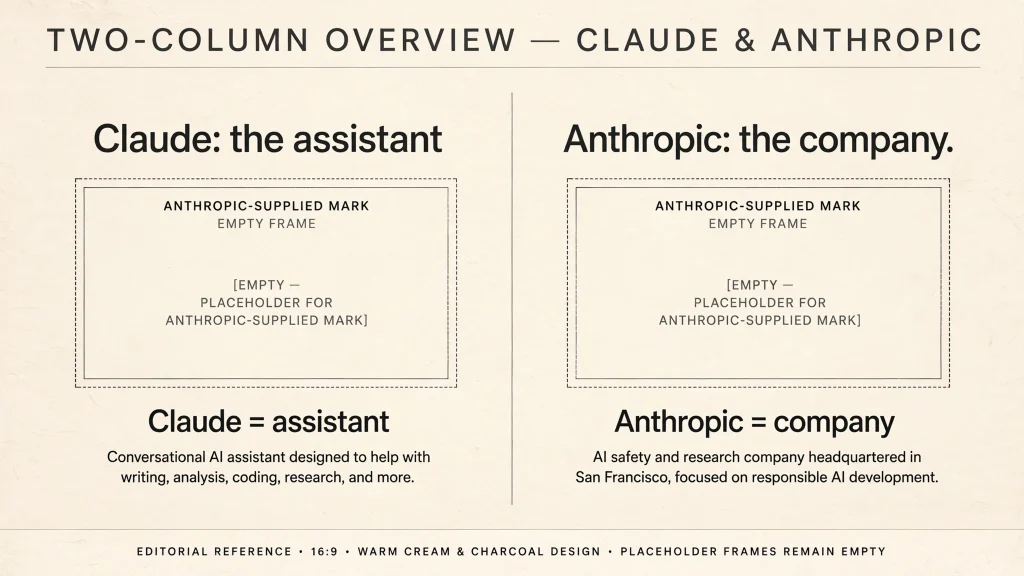
Think of it as product identity versus company identity. When you write about what the assistant can do, the claude logo is the relevant mark. When you write about funding, policy, research or corporate announcements, Anthropic’s mark is the relevant one. A story about Anthropic’s newsroom, for instance, belongs with the company wordmark even though it mentions Claude releases.
Sub-products complicate things further. Claude Code, the coding tool, has its own visuals, which I covered in a separate guide to the Claude Code logo. Community projects that build on Claude, such as the framework explained in Super Claude Code or the memory plugin covered in our guide on how to install Claude-Mem, are not Anthropic products, and borrowing Anthropic’s imagery for them is a trademark question of its own.
Claude Logo Variations
Anthropic has not published, in any place I could inspect, a catalog of approved variants. What I can describe is what is visible in the wild, and I will label each item accordingly.
- Symbol alone. The starburst by itself appears in app interfaces and tight spaces. This is observable, not an official specification.
- Symbol with the name. Web pages and listings commonly pair the burst with the written name.
- Light and dark treatments. Third-party icon libraries offer light and dark versions of the Claude mark. Whether Anthropic distributes the same variants is unconfirmed.
- Monochrome and text-only forms. LobeHub’s icon set lists mono, color and text versions of the claude logo for developers. That is a community library, not an Anthropic release.
- Claude Code’s pixel character. The coding tool shows a small terminal mascot that is separate from the starburst.
As for history, secondary sources say the symbol has not been redesigned since Claude’s 2023 launch. I found no credible record of an earlier, different mark that people now confuse with the current one. Still, “no evidence found” is not proof, so confirm with Anthropic if your project depends on a historical claim.
Claude Logo PNG and SVG: What Is Actually Verified
Searches for Claude logo PNG and Claude logo SVG return a long list of friendly-looking downloads. Here is the sorting that matters.
Verified from Anthropic: the existence of a press-kit archive and the trademark guidelines. Nothing I could open states which file formats the archive holds.
Reported by third parties: Dashboard Icons advertises SVG, PNG and WebP with light and dark versions. LobeHub offers SVG, PNG, WebP and React components. Toolradar lists PNG, JPG, WebP and SVG and states that it does not claim ownership of the mark. Each site is a middleman. A format being available there says nothing about whether Anthropic approved it.
Because formats come up so often, here is the practical difference. SVG is a vector format built from shapes, so it scales to a billboard without blurring and stays crisp on high-density screens. PNG is a raster format made of pixels, so it supports transparent backgrounds but softens when enlarged. JPG has no transparency and is poorly suited to a logo. WebP compresses well for fast pages. If an official file arrives in the press kit, vector is the better master and PNG the convenient web export, but never recolor or reshape either one.
If you cannot trace a file to Anthropic, do not call it the official claude logo, whatever its format.
Where to Find Official Claude Logo Assets
Three Anthropic pages are the only reliable starting points I can confirm.
- The newsroom. Its media-assets block links to the press kit and lists a press email for media questions.
- The press-kit link. It downloads a ZIP archive. Open it yourself and read the file names. If a Claude symbol is inside, that file is your official claude logo.
- The trademark guidelines. Anthropic says it will supply an image of the mark together with size, pixel and spacing requirements. The guidelines direct people with an existing business relationship who want to use the marks on a website or in a press release to a marketing email address.
If the kit does not contain what you need, ask. A short email to the contact listed on the newsroom costs less than a takedown request later. I am deliberately not linking to any “official download page” beyond these, because I could not verify that one exists.
How to Tell if a Claude Logo Is Official
You cannot authenticate a claude logo by eye. A tracing, a recolor or an AI redraw can look identical at thumbnail size. What you can authenticate is where the file came from.
- Follow the trail. Official means the file came from Anthropic’s domain or from the press-kit archive, and you can say which.
- Compare against live pages. Open Anthropic’s current site or the Claude app and check whether the proportions and color match.
- Check the date. A copy from an old screenshot may not match what Anthropic shows now.
- Look for edits. Stretched, glowing, outlined, shadowed or recolored versions are alterations, which Anthropic’s guidelines rule out.
- Be skeptical of labels. A site that calls its file “official” without pointing to Anthropic is making an unsupported claim.
- Keep a record. Write down where and when you got the file.
A plain rule works well: provenance beats appearance.
Common Unofficial Claude Logo Versions
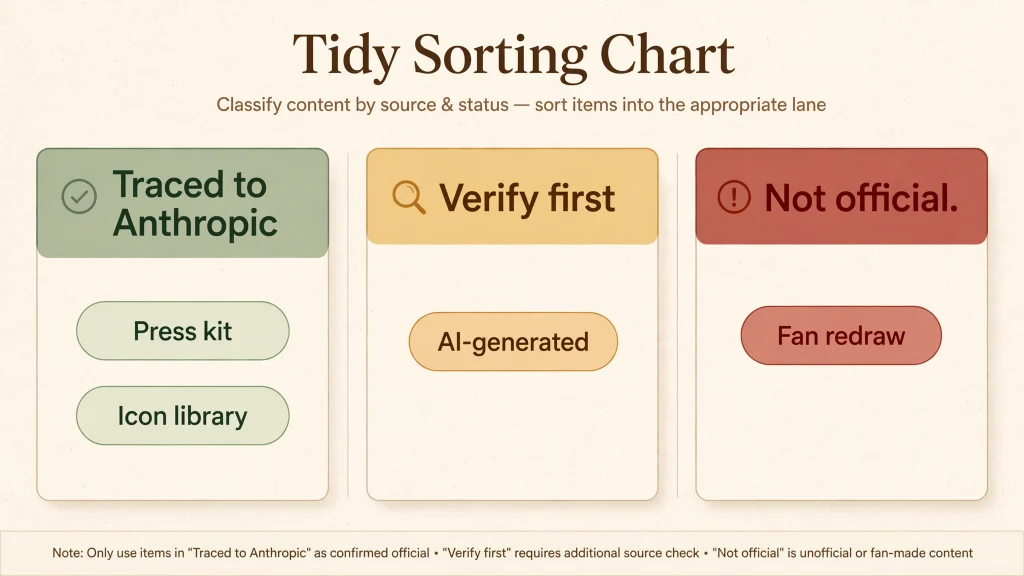
The table sorts categories, not individual files. I have not examined every image online.
| Type | Official? | What to check |
|---|---|---|
| File traced to Anthropic’s press kit or domain | Yes, once you confirm the trail | Where it came from and when |
| Icon-library copy (Dashboard Icons, LobeHub) | Unverified | The library’s own license notes and the original source |
| Logo-directory download (Toolradar and similar) | Unverified | Disclaimers about ownership |
| Random PNG from image search | Usually unverified | Source, date and rights |
| AI-generated or “regenerated” logo | No | Never present it as authentic |
| Fan redraw or recolored mark | No | Label it as fan-made |
| Wikimedia-hosted copy | Reported by secondary sources; I did not open it | The file page’s own license and trademark notes |
Two further traps are worth naming. First, chatbot “personas” built around the phrase claude logo exist on third-party platforms and claim an affiliation with Anthropic Claude that I cannot verify. Second, a copyright or license label on a file page, even a permissive one, does not override Anthropic’s trademark rules.
Can You Use the Claude Logo?
The short version is that the rules are permission-based. Anthropic’s guidelines do not open the claude logo to general use. They say Anthropic may end a permission at any time and that your use must follow the current version of the guidelines.
The guidelines add several concrete conditions. Do not alter the marks. Do not place them on a background that harms readability. Leave reasonable space around them. Do not add a trademark symbol. Do not use them in a way that could damage Anthropic’s reputation or goodwill. And by using the marks you accept that Anthropic owns all rights in them.
This is orientation, not legal advice. Review the current guidelines yourself, and ask Anthropic or a qualified lawyer when the stakes are high.
Claude Logo Copyright and Trademark Considerations
Trademark and copyright are different protections. Trademark concerns identifying the source of goods or services and avoiding confusion. Copyright concerns original creative works such as artwork. A logo can raise both questions, and answering one does not answer the other.
On trademark, the guidelines state that the covered marks are those owned by Anthropic, PBC or its affiliates and that include names, logos and brand elements. They do not list individual marks, but the broad definition reads naturally as covering the claude logo and the name. I did not search trademark registries, so I cannot cite registration numbers, and you should not repeat any you find unsourced.
On copyright, I found no Anthropic statement about copyright in the symbol, and I make no claim about it. What I can say is that a “public domain” or “CC0” tag on a third-party file page, even if accurate for that file, is a statement about copyright and leaves trademark rules in place.
Commercial use is the area to be most careful. Nothing in the guidelines grants a blanket commercial license. Modification is not permitted. Implying endorsement requires express authorization. If you run a site, app or storefront, assume you need Anthropic’s approval before displaying the mark prominently, and take that approval in writing.
Using the Claude Logo on Websites and Articles
Publishers can cover Claude responsibly with very little friction.
Lead with words. A sentence that says “Claude, an AI assistant from Anthropic” identifies the product more reliably than a decorative icon, and it makes clear your site does not make it. When you do show the claude logo, use an unaltered file with a traceable source, and keep it clear of busy backgrounds.
For alt text, describe what the image is. If it works as the identifier for Claude, writing “Claude logo” is accurate. If it is decoration, an empty alt attribute is better. Avoid badges, banners or layouts that read as a seal of approval, and do not use the mark in your own site’s header or branding, which would blur whose product it is.
In comparison articles, show each product’s mark at similar size and treatment. For example, a side-by-side of Claude and ChatGPT should give both brands equal footing, so the layout itself does not suggest a verdict.
Finally, date your work. A short note on when you checked your sources helps readers judge whether the visuals still match what Anthropic shows.
Using the Claude Logo in Videos, Presentations and Social Media
Creators run into the same rules in a more casual setting, which is exactly why mistakes happen there.
- Tutorials and educational videos. Showing the real interface teaches more than a logo in your intro animation, and it carries less risk.
- Thumbnails. A glowing, enlarged or recolored mark is an alteration. A thumbnail that makes your channel look sponsored by Anthropic is the kind of implied affiliation the guidelines warn about.
- Presentations. Use one unaltered file, keep spacing generous, and place it beside competitors at equal size.
- Social posts. A plain text title card often works as well as a borrowed mark. If you do include the claude logo, avoid cropping it into a profile picture that might look like an official account.
- Sponsored or client work. Treat these as commercial uses and ask first.
The pattern across all of these is accurate representation. The mark should help viewers identify the product and nothing more.
Practical Use Cases and Why Accuracy Matters
Different jobs raise different stakes.
- Technology articles and news coverage. Readers expect the real mark. A wrong or altered claude logo erodes trust in the rest of the piece.
- AI comparison articles. Equal treatment of each brand protects your credibility, and it keeps you from implying a ranking Anthropic never gave.
- Tutorials and software documentation. Screenshots of the actual product are usually safer than reproduced marks, and they stay accurate only as long as the interface does.
- Presentations and educational materials. Instructors and students tend to copy images freely, so a clear source note on the slide helps the next person reuse it correctly.
- Product pages and app listings. These are the highest-risk setting, because a prominent mark can read as a partnership. Written permission is the sensible standard.
Situations that create confusion about affiliation include “official partner” phrasing, the mark in your own navigation bar, or a page designed to look like Anthropic’s.
How to Avoid Suspicious Claude Logo Downloads
Most logo sites are ordinary and harmless, but verifying a file’s origin costs little, and the occasional bad actor costs a lot. A few habits help.
- Beware fake download buttons. On ad-heavy pages, a large green “Download” button can be an ad, not the file link. Check the link target before clicking.
- Treat executables as a red flag. A logo is an image. If a “branding kit” arrives as an EXE, installer or unexpected script, close it.
- Be careful with ZIP files from unknown hosts. Archives can hide anything. The press kit comes from Anthropic’s own newsroom, while a ZIP from a stranger’s repost deserves suspicion.
- Question “official” claims. If a site says official but does not cite Anthropic, assume it is not.
- Watch for look-alike domains. Spelling tricks and extra words in a web address are common.
- Run a file check. Scan downloads with your security software and prefer SVG or PNG over unfamiliar formats.
None of this means third-party sites are malicious by default. It means authenticity is yours to check.
When a Claude Logo Search Means Something Else
The phrase claude logo sometimes points to a different subject altogether, which is a useful reminder that search intent is broader than “download an image.”
Some searchers want to know how to make a logo with Claude. Android Authority has published a review of that experience, and a UX Planet article covers prototyping logos with Claude Code. Others land on Brandfetch’s “Claude’s Logo Library,” which is a connector that lets Claude find logos of other brands inside a deck, not a source for the Claude mark itself. And some results are about an unrelated brand that shares the first name, such as Claude Bernard, a shopping logo listed on a logo-archive site.
If you came for the symbol, you are in the right place. If you came for a different meaning, refine your search. Curious how the name itself is said? See our explainer on how to pronounce Claude.
Frequently Asked Questions
What is the Claude logo?
The claude logo is the orange starburst symbol Anthropic uses to identify Claude, its AI assistant. It sometimes appears beside the written name. Anthropic owns the mark.
Who owns the Claude logo?
Anthropic, PBC, according to its trademark guidelines, which cover trademarks owned by Anthropic or its affiliates, including names, logos and brand elements.
Is the Claude logo the same as the Anthropic logo?
No. Claude is the assistant, and Anthropic is the company. They are separate brands with separate marks, and each should be used for the subject it identifies.
Where can I find the official Claude logo?
Start with Anthropic’s newsroom, which links to a downloadable press kit, and read Anthropic’s trademark guidelines. Inspect the archive yourself, because I could not verify its contents.
Is the Claude logo available as an SVG?
Third-party sites advertise it. I could not confirm an official standalone SVG from Anthropic, so check the press kit directly.
Can I download the Claude logo as a PNG?
Many sites offer one, but permission comes from Anthropic, not from the site. Use a PNG only if you can trace it to Anthropic.
Can I use the Claude logo on my website?
Only as Anthropic permits, in approved materials, unaltered and without implying endorsement. For commercial sites, ask Anthropic first. This is not legal advice.
Is the Claude logo copyrighted?
I found no Anthropic statement on copyright in the symbol, so I make no claim. Copyright and trademark are separate, and Anthropic’s guidelines concern trademark use.
Is the Claude logo trademarked?
Anthropic’s guidelines state that its names, logos and brand elements are its trademarks. I did not check registries, so I cannot supply registration details.
How can I tell whether a Claude logo is official?
Trace the file to Anthropic’s domain or press kit, compare it with current official pages, and look for alterations. The source matters more than how it looks.
Conclusion
The claude logo is easy to recognize and surprisingly hard to source. What is solid: Anthropic owns the brand, its guidelines demand permission, no alterations and no implied endorsement, and its newsroom links to a press kit. What is not solid: a public dedicated download page, a confirmed list of formats and variants, an official color value, a named designer of the starburst, and any official explanation of what the shape means.
So the practical advice is short. Get files from Anthropic, label anything else as unverified, never alter the mark, ask before commercial use, and prefer clear words over borrowed artwork. Do that, and your use of the claude logo will be accurate and defensible. Re-check Anthropic’s pages before you publish, because brand rules can change.
Sources and References
Official Anthropic sources:
- Anthropic Trademark Guidelines (effective August 1, 2024): https://www.anthropic.com/legal/trademark-guidelines
- Anthropic Trademark Guidelines, PDF copy: https://assets.claude.com/f7874b435aabdaee5f836e888b4439b9b56a934b.pdf
- Anthropic Newsroom, including the media-assets block: https://www.anthropic.com/news
- Anthropic press-kit link (resolves to a ZIP archive; contents not inspected): https://www.anthropic.com/press-kit
Reputable secondary sources:
- Geist, Anthropic case study (studio that designed Anthropic’s identity): https://geist.co/work/anthropic
- DesignRush, Claude logo design analysis: https://www.designrush.com/best-designs/logo/claude-logo-design-the-ai-mark-built-to-look-none-of-its-rivals
- iGeeksBlog, guide to icons and symbols in Claude: https://www.igeeksblog.com/claude-icons-symbols-meaning/
- VectorSeek, analysis of the Claude logo (secondary commentary): https://vectorseek.com/logo-design/the-claude-logo-what-it-means-who-made-it-and-why-it-isnt-blue/
- Android Authority, using Claude to design a logo: https://www.androidauthority.com/using-claude-logo-design-disaster-3717711/
- UX Planet, logo design with Claude Code: https://uxplanet.org/logo-design-with-claude-code-a86c4cb06f4c?gi=4d3a2158fdcc
Third-party examples cited as unverified, non-Anthropic sources:
- Dashboard Icons, Claude icon: https://dashboardicons.com/icons/external/claude
- LobeHub, Claude icons: https://lobehub.com/icons/claude
- Toolradar, Claude logo directory page: https://toolradar.com/logo/claude
- Brandfetch, Anthropic brand page: https://brandfetch.com/anthropic.com
- Brandfetch, Claude’s Logo Library connector: https://brandfetch.com/developers/claude-logo-library.md
- WhatTheLogo, Claude Bernard logo (unrelated brand): https://whatthelogo.com/logo/claude-bernard/222790
 Daniel Carter