
In this article
Last updated: November 9, 2026. Every price and feature below was read from Anthropic’s official pricing page and Help Center on this date. Amounts are US dollars before tax and apply to web subscriptions; app-store and regional prices can differ.
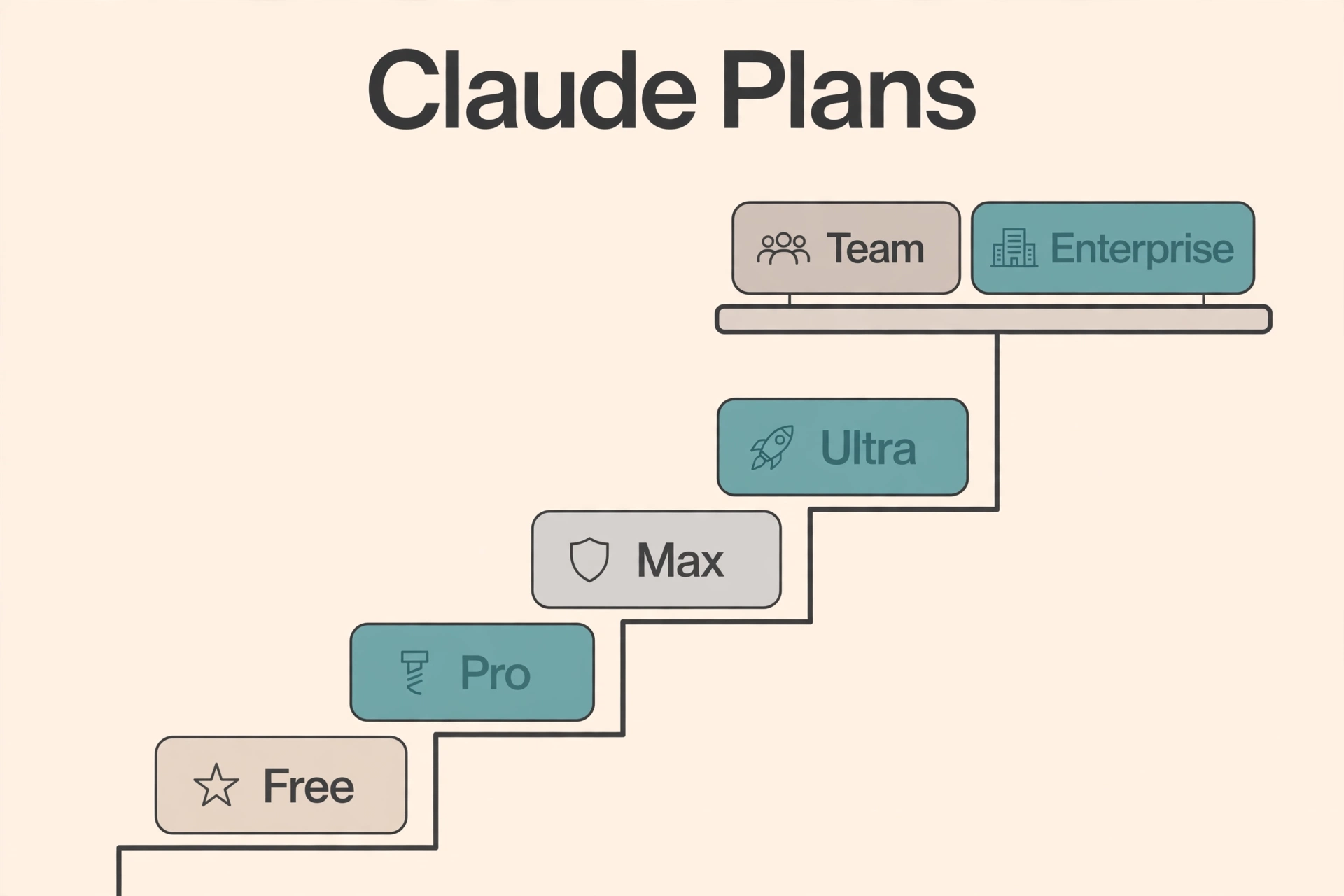
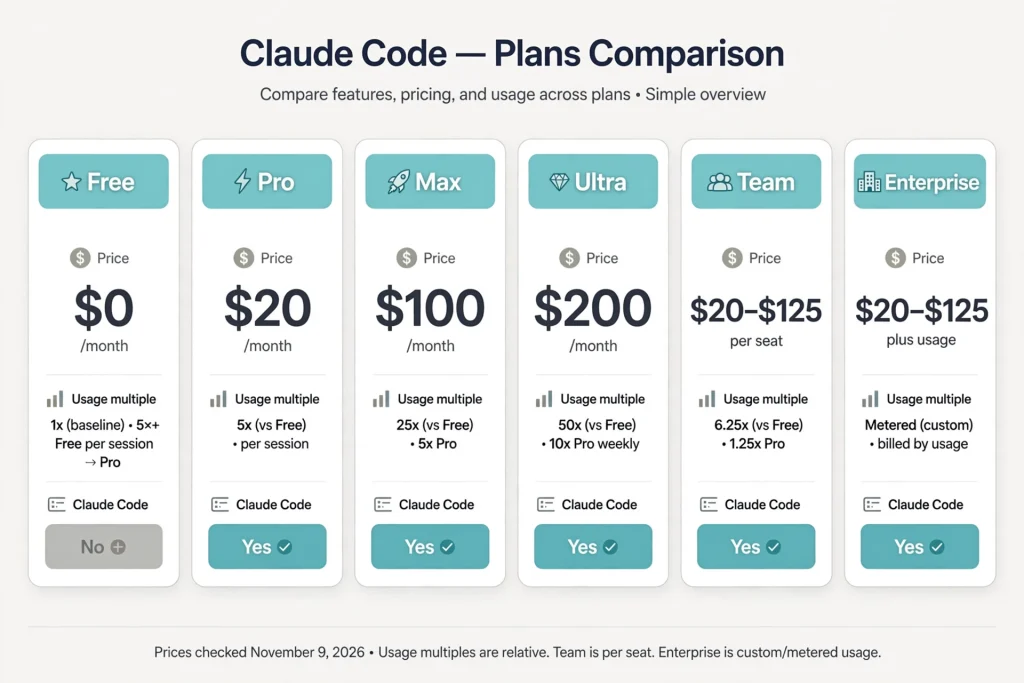
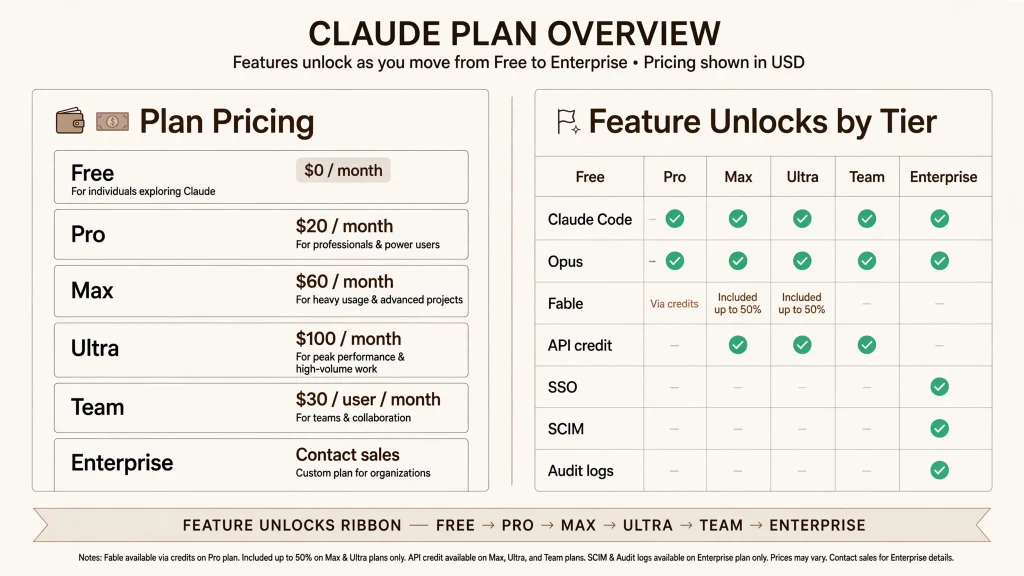
Claude plans currently come in six tiers: Free, Pro, Max, Ultra, Team and Enterprise. Free costs $0. Pro costs $20 a month, or the equivalent of $17 a month if you pay $200 up front for a year. Max is $100 a month and Ultra is $200 a month, and both are billed monthly only. Team seats start at $20 per seat per month on annual billing, while Enterprise is $20 per seat per month plus usage billed at API rates. Claude Code comes with every paid tier and is missing from Free. The Anthropic API is a separate product with separate billing.
That is the short answer. The sections below explain what sits behind each price across all six Claude plans, where Anthropic’s own pages disagree with one another, and how to choose without overpaying. If a number here ever clashes with what your checkout screen shows, believe the checkout screen.
Table of Contents
What Are Claude Plans?
Claude plans are the access tiers that decide how much you can use Claude, which models appear in your model picker, and which extra products arrive in the bundle. They sit on two levels. Individuals choose between Free, Pro, Max and Ultra. Groups choose Team or Enterprise, which add shared billing and administration. The API on the Claude Platform is a third thing entirely: it is pay-as-you-go developer access, not a subscription tier.
Anthropic’s own FAQ counts six Claude plans, although Team is sold in two seat types, Standard and Premium, so the price list actually has seven entries. One naming change trips up readers of older articles: the tier once sold as Max 20x is now called Ultra, and Anthropic’s help center says existing Max 20x subscribers were moved over automatically at the same price. If you only care about that upper individual tier, our Claude Max plan guide looks at the Max and Ultra split and whether the upgrade pays off.
Claude Plans at a Glance
The table condenses the current Claude plans as the official pricing page and Help Center describe them on November 9, 2026. Prices are in USD, before tax.
| Plan | Current price | Best for | Main features | Usage/access | Claude Code | Notes |
|---|---|---|---|---|---|---|
| Free | $0 | Trying Claude, light chat | Chat on web, desktop and mobile; web search; Artifacts; memory; up to 5 Projects | “Limited” usage every 5 hours and every week; no fixed message count published | No | Sonnet and Haiku only |
| Pro | $20/month, or $200/year ($17/month equivalent) | Daily individual use | Everything in Free, plus Research, Projects without the five-project cap, Opus, Claude in Chrome, Microsoft 365 | At least 5x Free per 5-hour session | Yes | Fable only via usage credits |
| Max | $100/month, monthly billing only | All-day heavy use | Everything in Pro, plus Fable and early access to features | 5x Pro every 5 hours and every week | Yes | Includes $100/month of API credit |
| Ultra | $200/month, monthly billing only | The heaviest individual workloads | Everything in Max | 10x Pro every week; no 5-hour limit for verified accounts | Yes | $200/month API credit; formerly Max 20x |
| Team | Standard $25/seat monthly or $20 annual; Premium $125 monthly or $100 annual | Groups of 2 to 150 | Shared projects, central billing, SSO, enterprise search | Standard: 1.25x Pro per session; Premium: 5x Standard | Yes, every seat | Limits are per member |
| Enterprise | $20/seat/month billed annually, plus usage at API rates | Large organizations | Everything in Team, plus SCIM, audit logs, Compliance API | No seat-level usage cap; pay per use | Yes | 20-seat minimum self-serve, 50 sales-assisted |
Is Claude Free?
Yes. Anyone in a supported location can sign up with an email address and use Claude at no cost. The Free tier is more generous than its reputation suggests: chat on web, desktop and mobile, web search, file creation with code execution, memory across conversations, Artifacts, connectors, voice mode, incognito chats, and Claude’s Design, Slides and Docs tools. Projects are capped at five.
Compared with the other Claude plans, Free withholds the heavier machinery. There is no Claude Code, no Research mode, no Claude in Chrome, no Microsoft 365 integration, no handing off or scheduling of tasks, and no Opus or Fable. Free runs on Sonnet and Haiku. The cap is described only as limited usage every five hours and every week. Anthropic does not publish a message count for it, and its pricing FAQ says there is no fixed message count on any plan. If you are asking whether Claude Code is free, our Claude Code Free guide walks through the options.
Claude Pro
Among paid Claude plans, Pro is the entry point. It costs $20 a month on monthly billing, or $200 billed once a year, which works out to about $17 a month. It is the only individual tier that offers both billing rhythms; Max and Ultra are monthly only.
On top of Free, Pro adds Claude Code, Research mode, Projects without the five-project cap, access to Opus, Claude in Chrome, Claude for Microsoft 365, Dashboards in beta, and the ability to hand off and schedule tasks. Usage rises to at least five times what Free gives per five-hour session, and a weekly ceiling applies across models. Fable, Anthropic’s top model, is not part of Pro’s included allowance; you reach it by switching on usage credits and paying API rates.
Two cautions. First, Pro carries no API usage and no monthly API credit, so building an app on the API means a separate Console account. Second, Anthropic’s pages contradict each other on priority access during busy periods: the Pro help article lists it as a benefit, while the pricing comparison table marks it “No” for Pro and “Yes” for Max and above. Treat priority access as unconfirmed on Pro. On price, the help center says none of the individual Claude plans carries a standing discount; only occasional promotions appear.
Claude Max and Ultra
Claude Max is $100 a month, billed monthly. Its headline is five times Pro’s usage, applied both to the five-hour window and to the weekly total. It also includes Fable for up to half of your weekly limit, early access to advanced features, priority access at high-traffic times, and a $100 monthly credit toward the Claude API.
Ultra is $200 a month, also monthly only. It doubles Max’s weekly allowance to ten times Pro and removes the five-hour limit for verified accounts. Verification is automatic and based on account and payment history; until it happens, a temporary limit applies. Ultra’s API credit is $200 a month. Everything else matches Max.
The arithmetic across these Claude plans is worth a moment. Pro at $20 buys one unit of usage, Max at $100 buys five, and Ultra at $200 buys ten, so weekly capacity per dollar is roughly flat across the three. What the higher prices really buy is concentration: fewer interruptions, Fable inside the plan, and the API credit. Someone who rarely touches a weekly limit gains little from either one.
Claude Team
Team is the smaller of the two organizational Claude plans, built for groups of two to 150. Standard seats cost $25 per member per month on monthly billing or $20 on annual billing. Premium seats cost $125 monthly or $100 annual. You can mix both types in one organization, which lets you give a heavier seat to the people who burn through limits.
Usage is per person and is never pooled. A Standard seat gets 1.25 times Pro’s per-session allowance, and a Premium seat gets five times a Standard seat, or 6.25 times Pro. One colleague hitting a limit does not slow anyone else. Every seat includes Claude Code and Cowork, and Premium seats can spend up to half their weekly limit on Fable.
The Team layer adds what individual plans lack: project sharing and collaboration, central billing and administration, single sign-on, enterprise search across connected tools, admin controls for connectors, usage analytics, spend controls, and organization-wide skills deployment. By default, Anthropic does not train on Team content. Monthly API credits are included too: $20 per Standard seat and $100 per Premium seat, pooled and capped at $500 a month.
Team plans are available only in supported locations. Nonprofits and scientists can qualify for discounted Team pricing. Past 150 seats, the route is Enterprise.
Claude Enterprise
Enterprise is the larger of the two organizational Claude plans and targets companies that need governance more than raw capacity. Anthropic does publish its price: $20 per seat per month, billed annually, plus all usage billed at API rates. The seat fee covers access only. Self-serve purchase needs at least 20 seats; a sales-assisted contract needs at least 50.
Because usage is metered, there are no per-seat caps and no included token allowance. Cost scales with the models and tasks your people run, and admins can set spend limits at the organization and user level. That makes budgeting a different exercise from the flat-seat plans.
Enterprise includes everything in Team, plus SCIM, audit logs, a Compliance API, custom data retention, network-level access control, IP allowlisting, customer-managed encryption keys, US-only inference, an Analytics API, and a HIPAA-ready configuration with a business associate agreement for eligible organizations. Claude Security is listed in beta. Self-serve buyers pay by card or ACH in USD, while sales-assisted buyers can get invoicing, multiple currencies, usage billed monthly in arrears, and trials. Anthropic says volume and committed-spend discounts exist but publishes no rates. Older seat-based Enterprise contracts are being moved to the current model at renewal.
Claude Plans Compared Feature by Feature
Here is the same information about Claude plans, sliced by feature instead of by tier. “Not publicly specified” means Anthropic’s pages I reviewed give no figure.
| Feature | Free | Pro | Max | Ultra | Team | Enterprise |
|---|---|---|---|---|---|---|
| Current price | $0 | $20 monthly / $17 annual equivalent | $100 monthly | $200 monthly | $25 or $125 monthly; $20 or $100 annual | $20/seat annual + API-rate usage |
| Models | Sonnet, Haiku | Adds Opus; Fable via credits | Adds Fable (up to 50% of weekly limit) | Same as Max | Opus, Sonnet, Haiku; Fable on Premium seats | All; Fable billed as usage |
| Usage | Limited; exact figure not publicly specified | 5x+ Free per session | 5x Pro | 10x Pro weekly | 1.25x or 6.25x Pro per session | No seat cap; metered |
| Claude Code | No | Yes | Yes | Yes | Yes | Yes |
| Monthly API credit | No | No | $100 | $200 | Up to $500 pooled | No |
| Collaboration | No project sharing | No project sharing | No project sharing | No project sharing | Project sharing | Project sharing |
| Admin controls | None | None | None | None | SSO, central billing, analytics | Team plus SCIM, audit logs, RBAC |
| Model training | Opt-out | Opt-out | Opt-out | Opt-out | None by default | None by default |
| Best for | Trying it | Daily work | All-day work | Longest tasks | Small teams | Regulated or large orgs |
Claude Usage Limits Explained
Usage limits are where most buyer’s remorse starts, so precision helps. Paid Claude plans use two clocks. A five-hour session window opens when you send your first message and refreshes in full five hours later. A weekly limit resets at a fixed time assigned to your account, regardless of when you subscribed. Verified Ultra accounts skip the five-hour clock.
Nothing is counted in messages. Anthropic says consumption depends on conversation length, attached files, the model, the effort level, and which features run. Long chats cost more per turn than fresh ones, because earlier text is carried forward. Web chat, the desktop app, mobile and Claude Code all draw from one shared pool, so a coding session leaves less for chat.
Max and Ultra add a separate Fable weekly limit on top of the main weekly limit those Claude plans carry. Anthropic also reserves the right to change limits, add weekly or monthly caps, and manage access during busy periods, and it does not promise uninterrupted service. Your current position is visible under Settings, then Usage.
When you run out, there are three options: wait for the reset, move up a plan (the new limits apply immediately), or switch on usage credits. Credits keep paid plans running at standard API rates and are billed separately from your subscription. They are non-refundable, and Anthropic’s help center says credits bought on or after December 7, 2026 generally expire after 12 months. Enterprise accounts on the current model have no plan-level cap to hit.
Length limits are a separate matter. They concern how big one conversation can grow. The pricing page lists a context window of up to one million tokens depending on the model, while a help article details it per model for paid plans: one million for Fable 5.1, Opus 5.5, Sonnet 5.5 and Haiku 5.5 in chat, with older models at 500,000 or 200,000. The Team help article still mentions 200,000, which does not match the pricing page, so confirm in your own account.
Model Access Across Claude Plans
Anthropic’s pricing page currently names Fable 5.1, Opus 5.5, Sonnet 5.5 and Haiku 5.5 as its latest models. Access across the Claude plans splits cleanly by tier, but model names rotate often, so always confirm in your own model picker.
Free users get Sonnet and Haiku. Pro adds Opus. Fable, the top model, is outside Pro’s included allowance and runs on usage credits. Max and Ultra include Fable for up to 50% of the weekly limit, and the same arrangement applies to Premium Team seats. Standard Team seats use credits for Fable. On the current Enterprise model, Fable is billed as usage at API rates.
One subtlety from Anthropic’s own help page: the 50% is a ceiling inside your existing weekly limit, not a bonus on top. Fable drains the allowance faster than other models, and everything else draws from the same pool.
Claude Code and Claude Plans
Claude Code is the terminal and IDE coding agent. Under the current rules, every paid tier among the Claude plans includes it: Pro, Max, Ultra, every Team seat, and the Enterprise seat. It is not part of Free. You sign in with the same credentials you use for Claude, and the plan covers terminal use as well as supported IDEs such as VS Code, Cursor and JetBrains.
The catch is shared metering. Claude Code usage and chat usage count against one limit, so a long agentic session can leave you short for the rest of the day. When a limit hits, Pro and Max users can enable usage credits, switch to a Console account with pay-as-you-go API billing, or wait. On Enterprise, Claude Code usage is simply billed at API rates.
Watch for one trap. If an ANTHROPIC_API_KEY environment variable is set on your machine, Claude Code uses the key instead of your subscription, and you will be charged per token. The monthly API credits that come with Max, Ultra and Team do not cover interactive Claude Code, either. For prices in more depth, see our Claude Code pricing guide.
A source conflict deserves a flag. Several third-party pricing pages misdescribe the Claude plans by saying Team Standard seats exclude Claude Code. Anthropic’s current Team and Enterprise help article says Claude Code is included with every Team seat. An older Anthropic help excerpt still circulating in search results says Team lacked it, which is another reason to read dates.
Claude Subscription vs Anthropic API
These are different products with different invoices. A Claude subscription gives you the apps and Claude Code, with usage limits. The API, managed through the Claude Console, gives developers keys and charges per token. Anthropic’s help center states that the API is billed separately from a paid plan, so buying any of the Claude plans does not create an API account.
Pro includes no API usage. Max, Ultra and Team include a monthly API credit, but it must be claimed by linking a Console organization after seven days on the plan, it expires at the end of each cycle, and it never rolls over. It works with the Messages API, Batches API, the Console playground, Managed Agents and the Agent SDK. It does not work inside the apps, Claude Code, usage credits, or through Amazon Bedrock, Google Vertex AI or Microsoft Foundry. Free and Enterprise are not eligible.
For scale, the API’s published per-million-token rates today are $2 input and $10 output for Sonnet 5.5, $4 and $20 for Opus 5.5, and $10 and $50 for Fable 5.1. Enterprise seat usage and consumer usage credits are billed at those same rates, which is why people confuse “API rates” with “the API.”
Which Claude Plan Should You Choose?
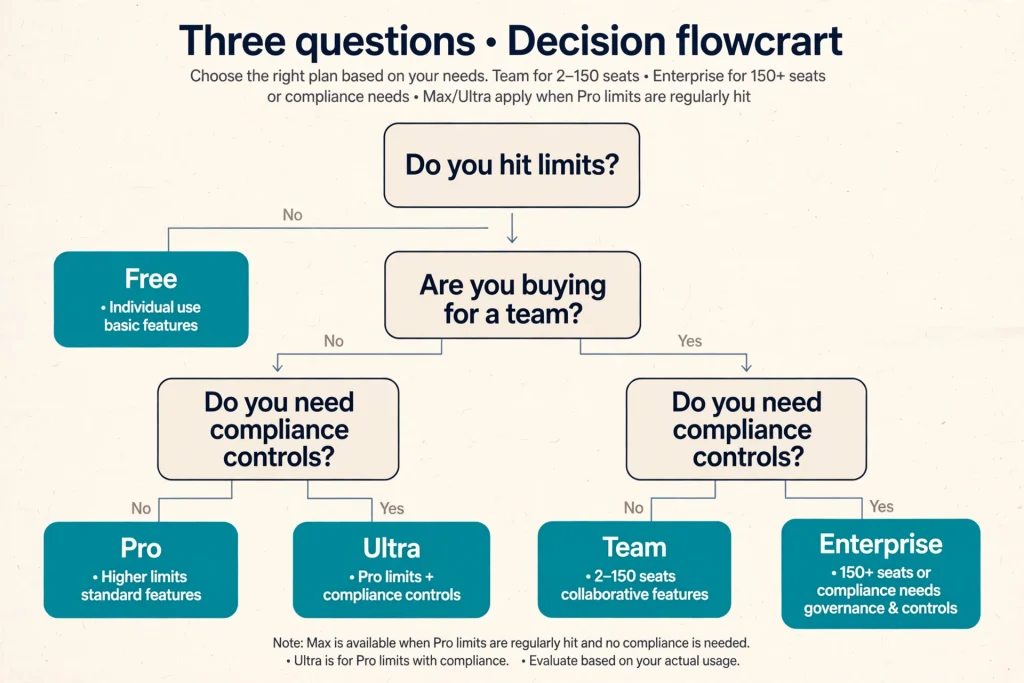
Among the Claude plans, pick the cheapest tier whose limits you do not hit. Moving up in price without hitting a ceiling just buys unused capacity.
Choose Free if…
You want to try Claude, ask occasional questions, or draft short pieces, and you can live without Opus, Research and Claude Code. It costs nothing, so the only risk is annoyance at the cap.
Choose Pro if…
You use Claude most days, want Opus, Research or Claude Code, and rarely run out. Annual billing saves roughly $40 a year compared with paying monthly. Plan on usage credits if you want Fable.
Choose Max if…
You regularly hit Pro’s five-hour limit mid-task, work with long documents or code for hours, or want Fable built in. Before upgrading, try usage credits for a month and watch what the overflow costs. As a rough break-even test on dollars alone, overflow under about $80 on top of Pro’s $20 is cheaper than Max, though Max also bundles Fable, priority access and the API credit.
Choose Ultra if…
Weekly limits, not five-hour limits, are your bottleneck, and your work involves long autonomous sessions. It pays off for people who would otherwise stack credits on Max.
Choose Team if…
Two or more people need shared projects, central billing, SSO and no-training-by-default handling, and you have fewer than 151 seats. Of the organizational Claude plans, it is the one built for that situation. It is also the cheapest way to give everyone Claude Code with administrative oversight.
Choose Enterprise if…
You need audit logs, SCIM, retention controls, IP allowlisting or a HIPAA-ready setup, or you will exceed 150 seats. Budget for variable usage costs on top of the $20 seat fee.
Claude Plans for Different Users
Students. Anthropic offers no individual student discount, and our Claude Student Discount roundup covers the real options. Start on Free. Move to Pro only when Research mode or Claude Code becomes a weekly habit. Universities can buy institution-wide education plans.
Writers and researchers. Pro is the sensible floor: Research mode, uncapped Projects and Opus all start there. Max makes sense only if long reference libraries keep exhausting your session.
Programmers and Claude Code users. Pro is enough for focused sessions. Daily all-day agentic work usually pushes toward Max. Remember that the shared pool means chat and coding compete.
AI power users. Max or Ultra, depending on whether your wall is the five-hour window or the week.
Freelancers. One Pro seat covers most client work. Upgrade only after you can name the limit you hit.
Small businesses. Two or more people can use Team, starting with Standard seats. Our guide to Claude for small business covers where it fits in daily operations. If your marketing will show the Claude brand, our Claude logo guide explains Anthropic’s trademark rules first.
Teams and enterprises. Team up to 150 seats, Enterprise beyond that or when compliance demands it. If you are comparing vendors rather than tiers, our Claude versus ChatGPT comparison sets pricing next to capabilities.
Upgrading, Downgrading and Cancelling Claude Plans
Upgrading between individual Claude plans is immediate. Moving from Pro to Max takes effect at once, with billing prorated for the rest of the cycle. If you are on annual Pro and the unused balance exceeds the Max price, you receive an account credit, provided the billing address matches. Subscribers who joined through Google Play are charged the full new price, and the unused value converts into extra days. Max to Ultra is also prorated. Switching Pro from monthly to annual takes effect immediately and credits leftover monthly time against the annual invoice.
Cancelling works on every individual plan. On the web, go to Settings, then Billing, and select Cancel. Access continues until the billing period ends, then the account drops to Free, and chats, projects and files stay intact. App-store subscribers cancel through Apple or Google, ideally at least 24 hours before renewal. Team and self-serve Enterprise owners cancel in organization billing settings; sales-assisted contracts go through your Anthropic contact.
Refunds are limited. Payments are generally non-refundable except where the consumer terms or local law say otherwise. Outside Europe, you can request a review through the Get help menu; in the EEA and UK, a 14-day withdrawal right applies. Apple and Google handle their own refunds. The pages I reviewed do not spell out a direct downgrade path from Max to Pro, so check Settings, then Billing, before assuming one.
Common Misconceptions About Claude Plans
Six myths about Claude plans come up again and again, and each one can be checked against Anthropic’s pages.
“Pro includes unlimited API usage.” It includes none. The API is billed separately, and only Max, Ultra and Team carry a monthly credit.
“Max means unlimited everything.” Max gives five times Pro, and even Ultra has a weekly cap. Anthropic’s pages describe every plan, Ultra included, as subject to usage limits.
“Free has every feature.” It lacks Claude Code, Research, Opus and Fable.
“Subscriptions and API billing are the same.” They are separate products with separate invoices.
“Claude Code is separate from my plan.” On every paid tier it is included and shares your usage pool.
“All Claude plans have identical limits.” The multiples run from Free’s limited allowance through 1x, 5x and 10x Pro, to Team’s per-seat tiers.
Security, Privacy and Business Considerations
Privacy terms differ across Claude plans. Per the pricing page, consumer tiers allow you to opt out of model training, while Team and Enterprise do not train on your content by default. Incognito chats exist on all tiers. Beyond that, the difference is governance. Team brings SSO, central billing and connector controls. Enterprise adds audit logs, SCIM, a Compliance API, retention settings, IP allowlisting, encryption key control and optional US-only inference.
HIPAA support is narrower than it sounds. Eligible Enterprise organizations can enable a HIPAA-ready configuration, but Anthropic’s documentation notes that some surfaces, such as the Claude Code IDE extensions, are not covered by the agreement. These are Anthropic’s stated features, not guarantees; have your security team read the terms.
Conclusion
Claude plans are easier to compare once you separate them into three questions: how much usage you need, which models and tools you want, and whether you need administrative control. Free is a real trial. Pro is the best-value starting point among the paid Claude plans for daily use, and Claude Code is included from there up. Max and Ultra reward people who actually hit ceilings. Team and Enterprise exist for governance. Revisit your pick among the Claude plans whenever a limit starts to bite, and check Anthropic’s pricing page first, since these terms change.
Frequently Asked Questions About Claude Plans
What are the Claude plans?
There are six: Free, Pro, Max, Ultra, Team and Enterprise. Free, Pro, Max and Ultra are for individuals; Team and Enterprise are for organizations.
Is Claude free?
Yes. Of all the Claude plans, the Free plan is the only one at $0, and it includes chat, web search and Artifacts, with limited usage every five hours and every week. It excludes Claude Code, Opus and Fable.
How much is Claude Pro?
$20 a month billed monthly, or $200 billed annually (about $17 a month), in US dollars before tax.
How much is Claude Max?
$100 a month, billed monthly only. The $200 tier above it is now named Ultra.
What is the difference between Claude Pro and Max?
Of the paid Claude plans, Max gives five times Pro’s usage every five hours and every week, includes Fable up to half the weekly limit, adds priority access and early features, and carries a $100 monthly API credit.
Does Claude Pro include Claude Code?
Yes. Claude Code is included in Pro and shares your usage limits with chat.
Does Claude Max include Claude Code?
Yes, and so do Ultra, Team and Enterprise. The monthly API credit on Max does not cover interactive Claude Code.
Is the Claude API included with a Claude subscription?
No. The API is billed separately. Max, Ultra and Team include a monthly API credit; Pro, Free and Enterprise do not.
Which Claude plan is best for developers?
Start with Pro, the cheapest of the Claude plans that includes Claude Code. Move to Max if you code all day, or use a Console account for pay-per-token work.
Which Claude plan is best for business?
Among Claude plans for organizations, Team suits two to 150 people. Enterprise suits larger or regulated organizations that need audit logs, SCIM and retention controls.
Sources and References
- Claude plans and pricing: https://claude.com/pricing
- What is the Pro plan?: https://support.claude.com/en/articles/8325606-what-is-the-pro-plan
- What is the Max plan?: https://support.claude.com/en/articles/11049741-what-is-the-max-plan
- What is the Ultra plan?: https://support.claude.com/en/articles/17728952-what-is-the-ultra-plan
- What is the Team plan?: https://support.claude.com/en/articles/9266767-what-is-the-team-plan
- What is the Enterprise plan?: https://support.claude.com/en/articles/9797531-what-is-the-enterprise-plan
- How do usage and length limits work?: https://support.claude.com/en/articles/11647753-how-do-usage-and-length-limits-work
- Claude Fable models on your plan: https://support.claude.com/en/articles/15424964-claude-fable-models-on-your-plan
- Use Claude Code with your Pro, Max, or Ultra plan: https://support.claude.com/en/articles/11145838-use-claude-code-with-your-pro-max-or-ultra-plan
- Use Claude Code with your Team or Enterprise plan: https://support.claude.com/en/articles/11845131-use-claude-code-with-your-team-or-enterprise-plan
- Monthly API credits for Max, Ultra, and Team plans: https://support.claude.com/en/articles/17154008-monthly-api-credits-for-max-ultra-and-team-plans
- Why is Claude API usage billed separately?: https://support.claude.com/en/articles/9876003-why-is-claude-api-usage-billed-separately-from-my-paid-claude-plan
- Manage usage credits for paid Claude plans: https://support.claude.com/en/articles/12429409-manage-usage-credits-for-paid-claude-plans
- How large is the context window on paid Claude plans?: https://support.claude.com/en/articles/8606394-how-large-is-the-context-window-on-paid-claude-plans
- How to change your Pro plan from monthly to annual billing: https://support.claude.com/en/articles/10185996-how-to-change-your-pro-plan-from-monthly-to-annual-billing
- How do I sign up for the Max plan? (upgrade proration, from search excerpt): https://support.claude.com/en/articles/11049752-how-do-i-sign-up-for-the-max-plan
This is the complete article with the Claude logo link included (7 internal links, 4,174 words, 42 exact “claude plans” uses). I can also put it in a doc you can edit, share, or download as Word or PDF, if you’d like.
 Daniel Carter