

In this article
Claude pronunciation is simpler than the spelling suggests: the name is said “klawd,” one syllable, with the same vowel you hear in “law” and “claw.” The final E stays silent, the “au” does not sound like the “ou” in “cloud,” and the whole word rhymes with “fraud.” That is the standard English claude pronunciation for the name Anthropic uses for its AI assistant, and it matches how major dictionaries record the name for people called Claude. The rest of this guide covers what is worth knowing beyond that one line: the IPA, small accent differences, the slips people actually make, how to say longer phrases such as “Claude AI,” and what can and cannot be verified about the name’s origin.
How Do You Pronounce Claude?
Short answer: Claude is pronounced “klawd” (IPA /klɔːd/ in British English). It has one syllable, the final “e” is silent, and it sounds the same as the word “clawed.”
That answer holds whether you are talking about the AI assistant or a person named Claude. The assistant did not get a special reading of its own; it borrowed an ordinary given name, so the claude pronunciation you hear in a conversation about the chatbot is the same one you would use to greet a colleague called Claude.
One honest caveat belongs up front. While researching this guide we looked for an official pronunciation note from Anthropic and did not find one, so everything below rests on dictionary and reference sources rather than on a company statement. Those sources agree on the core: a single syllable, a hard K, an L, a rounded vowel, and a D. They differ only in how that vowel is shaded from one accent to another, which the accents section explains.
Table of Contents
What Does the Claude Pronunciation Sound Like?
If you have never seen the name written in IPA, the easiest way to hear the claude pronunciation is to start from a word you already know. Say “claw,” the way you would describe a cat’s claw. Now add a quick “d” at the end, touching the tip of your tongue to the ridge behind your upper teeth. You have just said “klawd.” The result is the same sound as “clawed,” as in “the cat clawed the sofa,” and Wiktionary lists “clawed” as a homophone of Claude.
A few physical cues help if you are learning English or coaching someone who is:
- Jaw: drop it slightly, as if beginning a yawn, rather than closing it as you would for “cloud.”
- Lips: keep them gently rounded and still. They should not travel toward a tight “oo” shape at the end.
- Length: hold the vowel for one steady beat. British dictionaries mark it as a long vowel, but it still sounds like a single, natural beat.
- Ending: finish with a clean, light “d.” There is no extra vowel after it.
Notice what is missing from that list. There is no second syllable, no “ee” or “ay” sound at the end, and no glide in the middle. The shape of the claude pronunciation is flat and compact: consonants at both edges, one rounded vowel in the center. If your version has a moving vowel or a trailing sound, you are probably saying something other than Claude.
Claude Pronunciation in IPA
The International Phonetic Alphabet records sounds rather than spellings, which makes it the cleanest way to compare accents. Here is how the reference works we checked transcribe the name in English:
| Source | Variety | IPA |
|---|---|---|
| Cambridge Dictionary | British | /klɔːd/ |
| Cambridge Dictionary | American | /klɑːd/ |
| Collins English Dictionary | British | /klɔːd/ |
| Collins English Dictionary | American | /klɔd/ |
| Dictionary.com | American | /klɔd/ and /kloʊd/ (respelled “klawd, klohd”) |
| Wiktionary | Received Pronunciation | /ˈklɔːd/ |
| Wiktionary | General American | /ˈklɔd/ |
Reading the table is easier than it looks. Each symbol stands for one sound:
- /k/ is the hard K, as in “cat.”
- /l/ is the ordinary L, as in “look.”
- /ɔː/ is the rounded vowel of British “horse” and “law.” The small triangle-like mark after it means the sound is long.
- /ɑː/ is the open vowel of “father,” which Cambridge uses for its American entry.
- /d/ is the D of “day.”
Two details deserve attention. First, the American entries are not identical to each other: Cambridge writes an open “ah” vowel, Collins and Wiktionary write a rounder one, and Dictionary.com lists a second variant with a gliding vowel like the one in “load.” The difference is a matter of accent, not a disagreement about syllables. Second, the stress marks that Wiktionary adds mean nothing special here. A one-syllable word has only one place to put stress, so you can ignore them.
If you want the claude pronunciation in the simplest respelling a general reader will understand, “klawd” is the one that dictionaries themselves use. Use the IPA when you need precision, and “klawd” when you need to be understood.
Is Claude Pronounced Like “Cloud”?
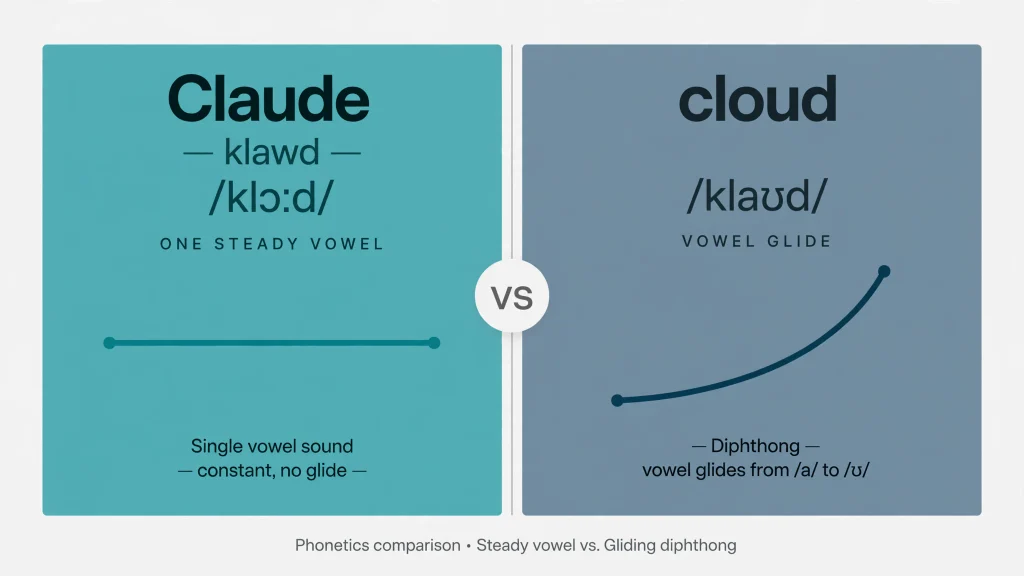
No. This is the most common confusion, and it comes from the spelling. “Claude” and “cloud” share the same opening consonants and the same trio of letters, so the eye treats them as relatives. The ear does not. “Cloud” is pronounced /klaʊd/, with a vowel that starts open and slides toward “oo” while the lips close. Claude stays on a single vowel from start to finish.
Here is a quick way to feel the difference. Say “cloud” slowly and watch your mouth: it narrows and rounds at the end. Now say “klawd”: nothing moves. The claude pronunciation is a held note, while “cloud” is a small glide.
| Feature | Claude | Cloud |
|---|---|---|
| Vowel type | Single steady vowel | Gliding vowel (diphthong) |
| Sounds like | “clawed” | “clowd,” as in “crowd” |
| Rhymes with | “fraud,” “applaud” | “loud,” “crowd” |
| Mouth movement | Stays rounded and still | Opens, then closes |
The mix-up matters more now than it once did, because “the cloud” is also a constant presence in technology talk. In a meeting about AI tools and cloud services, a spoken “Claude” and a spoken “cloud” may be mistaken for each other by listeners and by dictation software. A simple fix is to anchor the name the first time you say it: “Claude, C-L-A-U-D-E, the Anthropic assistant.” After that, a clean “klawd” is usually enough.
One more point in fairness to the confusion: none of the dictionaries we checked lists “cloud” as an acceptable variant of the claude pronunciation. They treat the two as separate words with separate vowels.
How to Say Claude Step by Step
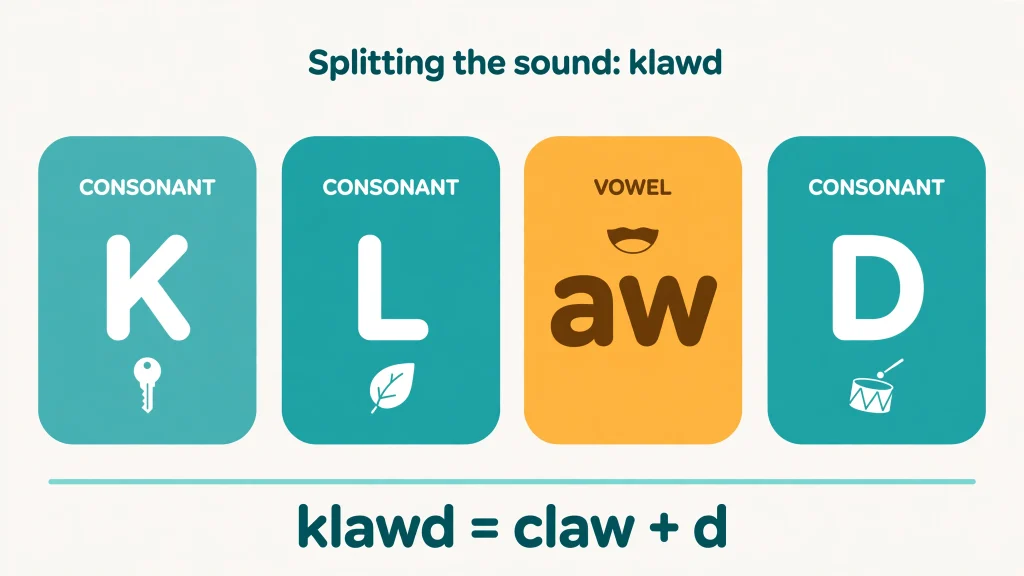
Break the sound into four moves and the claude pronunciation becomes almost mechanical.
Step 1: Start with a hard K
Press the back of your tongue against the soft palate and release it with a small puff of air. The letter C in “Claude” is a K sound, not an S sound, exactly as in “claw” and “class.”
Step 2: Slide straight into L
Without adding any vowel between the first two sounds, lift the tip of your tongue to the ridge behind your upper teeth. “Kl” is one quick unit. If you hear a tiny “uh” squeezed between K and L, tighten it up.
Step 3: Open into the rounded vowel
This is the sound that matters most. Drop your jaw, round your lips softly, and say “aw,” the sound you make when you see something cute. Spelling hides it: the letters “au” make this “aw” sound, as in “fraud,” “haul,” and “launch.”
Step 4: Close with a light D
Tap your tongue tip against the ridge and stop. Leave the final letter E alone. It is silent, and it only exists in the spelling to mark the name’s French and Latin ancestry.
Putting the four steps together
Say them slowly, then faster: “k-l-aw-d,” “kl-aw-d,” “klawd.” Record yourself on your phone and compare the playback with the audio on a dictionary site such as Cambridge, which offers recorded examples of the English claude pronunciation. If your recording matches the dictionary audio on length and ending, you are done.
Common Claude Pronunciation Mistakes
Most errors in claude pronunciation fall into a few predictable patterns. None of them prevents people from understanding you, but they are worth knowing, especially if you present or teach.
Saying “cloud”
As covered above, this swaps the steady vowel for a glide. It is the single most frequent slip, and it is driven by spelling and by the technology vocabulary around the word.
Adding a second syllable
Because the written word ends in E, some readers add a trailing vowel and say something like “KLAW-dee” or “KLOH-day.” Wiktionary categorizes the English word as a one-syllable word, and every dictionary we checked gives a single syllable. We also came across one online guide that recommended a three-part “klohdee” reading as the safest choice; that does not match any dictionary entry we verified, so we would not follow it.
Voicing the silent E
A related habit is to pronounce the last letter, as in “Claud-eh.” The E is silent in English. The French form of the name also ends on a consonant sound, so nothing is gained by pronouncing it.
Using an English vowel for a French moment, or the reverse
In French the name is transcribed /klod/, with a closed “o” vowel, and people who speak French will naturally say it that way. English speakers use the “aw” vowel. Neither is a mistake in its own language. The practical advice is to be consistent within the conversation you are having: if you are talking about the AI assistant in English, “klawd” is the expected form.
Over-correcting the vowel
A final, quieter mistake is to stretch the vowel into something exaggerated, such as “klaaaawd,” because you have read that it is long. In British English the vowel is long by dictionary convention, but it still sounds like a single, natural beat. Speak at an ordinary pace.
How to Pronounce Claude AI
“Claude AI” is spoken as the name followed by the two letters: “klawd” plus “ay” plus “eye.” You say the letters one at a time, not as a word, and you keep the name distinct from them. There is no linking sound between “Claude” and “A,” and the claude pronunciation does not change shape because letters follow it.
A few details smooth the delivery:
- Give both parts a clear beat, so the phrase has four syllables: klawd-ay-eye.
- Do not blend it into “Claudia,” which is a different name with an extra syllable.
- For the web address, say “Claude dot A-I.” The assistant’s web app is hosted at claude.ai.
When people search for “claude ai pronunciation” they are almost always looking for this same answer. The claude pronunciation inside the phrase is exactly the one described earlier, and “AI” is simply the standard letter-by-letter reading.
How to Pronounce Anthropic Claude
“Anthropic Claude” combines the company’s name with the product’s name. Say it as “an-THROP-ik klawd.” The stress in the first word falls on the second syllable, “THROP,” and the “th” is the unvoiced sound you make in “think,” not the voiced sound in “this.”
Dictionary sources record “anthropic” as an ordinary English adjective meaning “of or relating to human beings.” Their transcriptions are /ænˈθrɒpɪk/ in British English and /ænˈθrɑpɪk/ in American English, and Dictionary.com respells it “an-throp-ik.” A caution is in order here: those are the dictionary pronunciations of the English word. We did not find an official statement from the company about how it says its own name, so we are describing the standard English reading and not claiming it comes from Anthropic.
Put together, the full phrase has four main beats: an-THROP-ik KLAWD. If you are announcing the product in a talk, a clear pause between the two words keeps the claude pronunciation from being swallowed by the company name that precedes it.
Does Claude Have Different Pronunciations in American and British English?
Yes, but only in the vowel, and only slightly. Every variety of claude pronunciation keeps the same skeleton: K, L, one vowel, D. What changes is the shade of that vowel, and the differences follow familiar accent patterns rather than anything unique to this name.
- British English (Received Pronunciation): a long, rounded vowel, written /klɔːd/ in Cambridge, Collins, and Wiktionary.
- General American: a shorter, rounded vowel, /klɔd/ in Collins and Wiktionary’s main American entry.
- Accents with the cot–caught merger: where “cot” and “caught” sound alike, Wiktionary lists /klɑd/ for General American and Atlantic Canada, so Claude lands on the same vowel as “clod.” Cambridge’s American entry, /klɑːd/, uses a similar open vowel.
- Canada, Boston, and Maine: Wiktionary lists /klɒd/.
- Australia and New Zealand: Wiktionary lists /kloːd/, a long, close, rounded vowel.
Wiktionary also notes that “clod” is a homophone of Claude for speakers who merge those vowels. That is a genuine accent effect, not a mistake. It simply means that in some regions “Claude” and “clod” are indistinguishable by sound alone.
The practical takeaway is reassuring. You do not need to adopt a foreign accent to get the claude pronunciation right. Use the vowel you already use in “claw,” “law,” or “fraud,” keep it to one syllable, and you will match the standard reading in your own accent. We did not find reliable evidence of any region where the name is normally pronounced with a different number of syllables or a gliding vowel like “cloud,” and we are deliberately not inventing regional rules beyond what the reference sources record.
Where the Name Claude Comes From
The name arrives in English by way of French, from the Latin family name Claudius. Collins and Dictionary.com both describe it as a male given name derived from a Roman family name that traditionally meant “lame,” and Wiktionary adds that this meaning is the traditional explanation while the clan name itself is most likely of Sabine origin. In French, Claude is a unisex given name; in English-speaking countries it is mostly used for men.
That French and Latin heritage explains two things about spelling and sound, and it is the reason the English claude pronunciation looks stranger on the page than it sounds. The “au” spelling is a Romance-language holdover, which is why English speakers read it as “aw” rather than “ow.” And the silent final E follows a common French pattern. Understanding this makes the claude pronunciation easier to remember, because the spelling is not random: it is an old spelling attached to a modern English sound.
Famous bearers of the name show how widely it travels. The painter Claude Lorrain is traditionally called just “Claude” in English, and the composer Claude Debussy and the mathematician Claude Shannon carry the same first name. Each is pronounced in English with the same one-syllable reading, and the French versions use the French vowel.
Why Is the AI Assistant Called Claude?
Here the reliable evidence is thinner than many articles suggest, so it helps to separate what is reported from what is confirmed.
Reported: Anthropic’s assistant is widely said to be named in honor of Claude Shannon, the mathematician known as a founder of information theory. Bridge Michigan, in a June 30, 2026 article about Shannon’s Michigan roots, wrote that according to the New York Times, the AI model is an homage to him. Wikipedia’s coverage of the assistant uses the cautious word “reportedly.”
Not found: We looked for a formal statement from Anthropic confirming the origin and did not find one. Several independent write-ups reach the same conclusion, noting that the Shannon connection circulates as common understanding but without an official explanation. For that reason we treat it as a credible report, not a confirmed fact.
What follows for pronunciation: If the name does honor Shannon, it is the ordinary given name, which is exactly why the usual claude pronunciation applies. Nothing we found suggests a special or alternative reading tied to the AI product.
Shannon himself is worth a sentence for context. According to Bridge Michigan, he grew up in Gaylord, Michigan, and published the 1948 paper “A Mathematical Theory of Communication”; the outlet credits his research with helping to develop the internet and artificial intelligence. That is a useful reason to know the name even if the naming story stays unconfirmed. If you want a plain-language look at how the assistant compares with its best-known rival, our guide on whether Claude is better than ChatGPT covers models, pricing, and everyday use.
Saying Claude in Everyday Product Names
Once the name itself is settled, the products built around it follow the same rule: the claude pronunciation is “klawd” every time, and the word that follows is read normally.
- Claude Code is “klawd code.” If you are comparing plans, our walkthrough of Claude Code pricing explains the options, and the guide to Claude Code Web covers the browser version.
- Claude Max is “klawd max,” and a detailed look at that plan lives in our Claude Max guide.
- Claude in Chrome is “klawd in chrome,” covered in our guide to Claude in Chrome.
- Claude Opus, Claude Sonnet, and Claude Haiku keep the name first and the model name second, each read as an ordinary English word.
If you are hunting for the official documentation instead of a pronunciation, our overview of Claude Docs points to where Anthropic publishes its resources. In every one of these phrases, the claude pronunciation stays constant, so you only need to learn it once.
Claude Pronunciation: Quick Reference
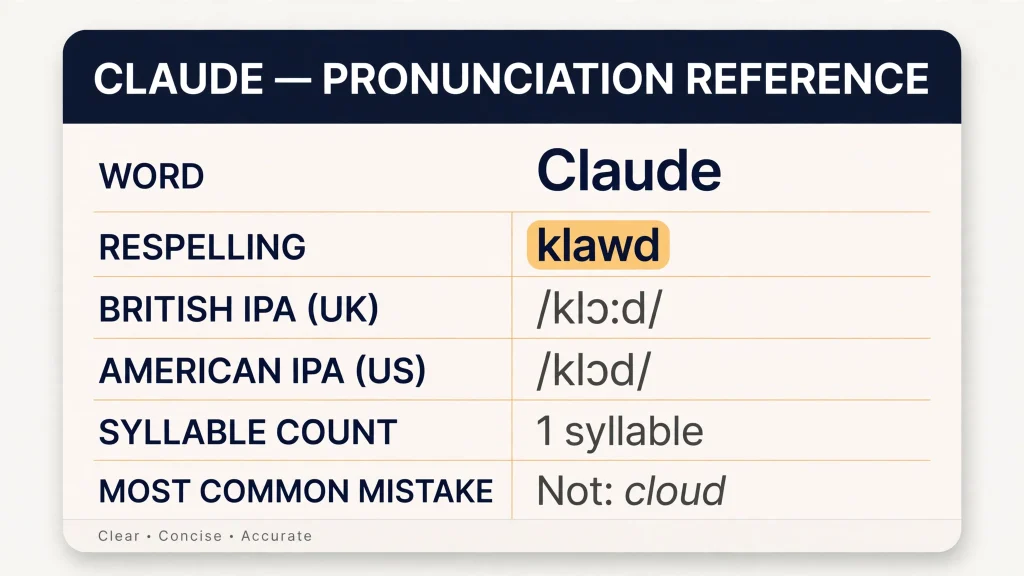
| Question | Answer |
|---|---|
| Word | Claude |
| Respelling | “klawd” |
| IPA (British) | /klɔːd/ |
| IPA (American) | /klɔd/ (Cambridge lists /klɑːd/; Dictionary.com also lists /kloʊd/) |
| Syllables | One |
| Silent letter | Final “e” |
| Rhymes with | “fraud,” “applaud” |
| Homophone | “clawed” |
| Common mistake | Saying “cloud” (/klaʊd/) |
| Related phrase | Claude AI, said “klawd ay-eye” |
Tips for Remembering the Claude Pronunciation
Pronunciation sticks when you attach it to something concrete. These techniques work for most learners:
- Think “claw plus D.” If you can say the animal’s claw, you already own the hard part of the claude pronunciation.
- Borrow a rhyme. Say “fraud, applaud, Claude” three times in a row. The shared ending locks in the vowel.
- Use the “clawed” test. Say “the cat clawed the sofa,” then swap in “Claude” for the verb. If the two sound identical, you have it.
- Keep it to one tap. Tap the table once while you say the name. One tap, one syllable. If you tap twice, you added an extra vowel.
- Contrast on purpose. Say “cloud, Claude, cloud, Claude” slowly. Feeling your mouth move for the first and stay still for the second makes the difference stick.
- Listen, then record. Play the dictionary audio, repeat it, and record yourself. Comparing two recordings is far more useful than self-judging by feel.
- Use it in a sentence early. Say “I asked Claude for a summary” out loud a few times. Practicing in a natural sentence builds rhythm that isolated drills do not.
Final Thoughts on the Claude Pronunciation
The correct everyday claude pronunciation is “klawd,” a single syllable that matches “clawed,” with the vowel adjusted slightly for your accent and a silent final E. It is not “cloud,” it does not need a second syllable, and it does not change when the word appears in “Claude AI” or “Anthropic Claude.” Dictionaries agree on the structure and differ only in the vowel shading, and the story behind the AI’s name is best treated as a widely reported tribute rather than a confirmed fact. Learn the four sounds once, and you can say every Claude phrase with confidence.
Frequently Asked Questions About Claude Pronunciation
How do you pronounce Claude?
Claude is pronounced “klawd,” with one syllable and a silent final E. In IPA, British English is /klɔːd/, and American entries vary slightly in the vowel. The claude pronunciation sounds the same as “clawed.”
Is Claude pronounced like cloud?
No. “Cloud” is /klaʊd/ and has a vowel that glides from open to rounded. Claude uses one steady rounded vowel, so the claude pronunciation is closer to “claw” plus “d.”
What is the IPA for Claude?
For British English, Cambridge, Collins, and Wiktionary give /klɔːd/. American variants include /klɔd/ and, in Cambridge, /klɑːd/. Dictionary.com also lists /kloʊd/ as an American alternative.
How do you pronounce Claude AI?
Say “klawd,” then the letters “A” and “I,” as in “klawd ay-eye.” The claude pronunciation does not change, and the letters are read individually.
How do you pronounce Anthropic Claude?
Say “an-THROP-ik klawd.” The dictionary reading of “anthropic” stresses the second syllable. We did not find an official statement from the company about its own pronunciation, so this is the standard English reading.
Is Claude a French name?
It came into English from French and ultimately from the Latin family name Claudius. In French it is a unisex given name; in English it is mostly a male name. In French the vowel is closed, /klod/, while the English claude pronunciation is “klawd.”
Does Claude have different pronunciations in American and British English?
Slightly. In every accent the claude pronunciation keeps the same syllable count and consonants, and only the vowel shifts. Some accents with the cot–caught merger make Claude sound like “clod,” a genuine accent effect.
Why is the AI called Claude?
It is widely reported to honor mathematician Claude Shannon, citing the New York Times via Bridge Michigan. We could not find a formal Anthropic statement confirming that, so it should be treated as reported rather than confirmed.
Is Claude pronounced “clod”?
For speakers who merge the vowels in “cot” and “caught,” yes: Wiktionary lists “clod” as a homophone of their claude pronunciation. For speakers who keep them apart, the two words differ, with Claude using the rounded “aw” vowel.
Sources and References
Official source consulted
- Anthropic, Statement on the US government directive to suspend access to Fable 5 and Mythos 5. Consulted as an official Anthropic page; it contains no pronunciation or naming-origin guidance.
Third-party pronunciation and dictionary references
- Cambridge Dictionary, Claude pronunciation entry.
- Collins English Dictionary, Claude.
- Dictionary.com, Claude.
- Wiktionary, Claude.
- Wiktionary-derived anthropic entry (kaikki.org dictionary data) and Dictionary.com, anthropic.
- Wikipedia, Claude (given name).
Reporting on the origin of the AI’s name
- Bridge Michigan, Ever tried Claude.AI? Meet the Michigander who inspired its name, June 30, 2026.
- Wikipedia, “Claude (language model)”, read via a mirror copy of the article, which describes the name as “reportedly” inspired by Claude Shannon.
- Wikipedia, Anthropic, consulted for the names of the Claude model tiers.