
In this article
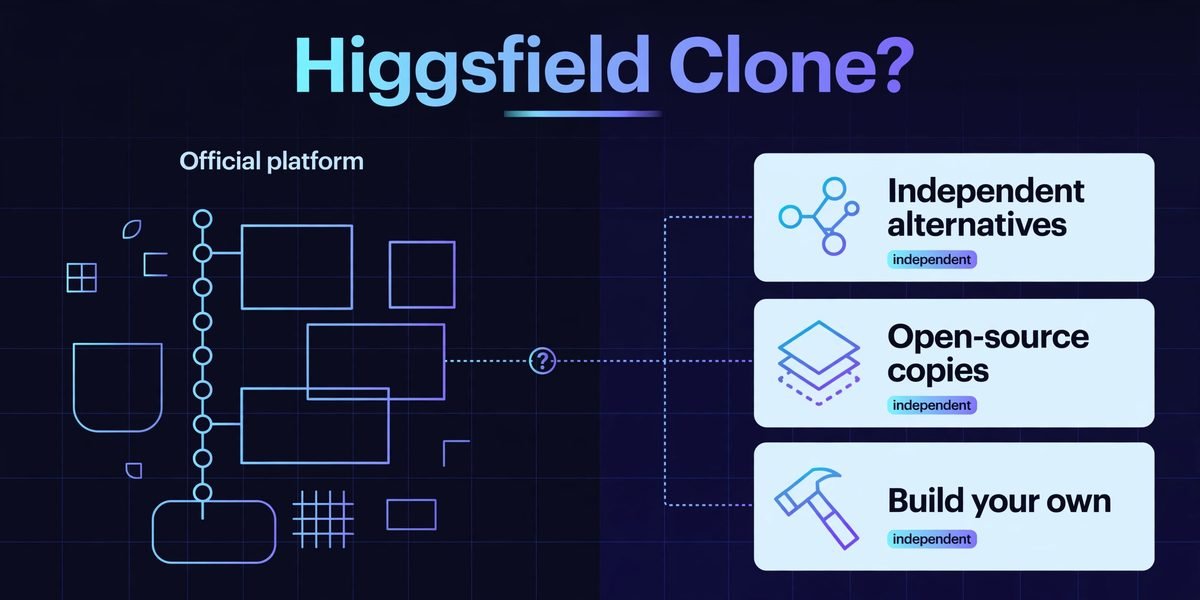
A Higgsfield clone is not one product. People use the phrase for four different things: the cloning tools built into Higgsfield AI itself, open-source projects that imitate its studio-style layout, rival video platforms sold as a Higgsfield alternative, and apps that a developer markets as a copy. In the sources reviewed for this article, no official Higgsfield clone appeared on higgsfield.ai, so any website selling a Higgsfield clone is a third-party offer with no confirmed link to the company. This guide separates the meanings, compares the alternatives worth a look in November 2026, and explains what a legitimate Higgsfield clone build would involve.
Higgsfield Clone at a Glance
- Is there an official Higgsfield clone? Nothing in the pages reviewed says so.
- What do searchers usually mean by Higgsfield clone? A mix of three things: clone as a feature, clone as an open-source replica, and clone as a substitute platform.
- Safest choice for most creators: use Higgsfield AI directly, or a mainstream rival from an established company, rather than an unknown Higgsfield clone site.
- For developers: build on licensed APIs and never copy code, branding, private models or interface assets.
- Quickest trust test: compare any claim against higgsfield.ai, then read the seller’s terms and privacy policy.
Table of Contents
What Is Higgsfield AI?
Higgsfield AI is a generative-media company whose browser platform is built around short-form social content and advertising. Reuters reported that social media marketers made up most of its users when it announced new funding in January 2026. The company later raised a $400 million Series B at a $5.4 billion valuation, and its own About page claims 40 million users and 850 million generations. Those usage figures are company claims, not audited numbers. Higgsfield AI +2
What it sells is less a single model than a workspace. Higgsfield’s help center describes Soul as its in-house image model family, with Soul ID training a character from photos so the same face recurs across images and video, and Cinema Studio handling camera control, multi-shot scenes and physics-aware motion. The site also lists Ads Studio, Marketing Studio, Lipsync Studio, Popcorn, Canvas, Mangaka, plus platform pieces such as Supercomputer, an API and MCP/CLI access. Underneath, the product integrates third-party models and adds its own reasoning layer aimed at consistency. For model-specific detail, see the AI Vibes guide to Higgsfield Seedance 2 and the walkthrough of Higgsfield Soul 2.0. Help center +2
Pricing deserves a warning before you compare anything. Higgsfield says plan names and prices adjust automatically by country, with entry plans starting at $9 a month for 120 to 270 credits depending on region. Third-party snapshots from November 2026 disagree because of regional lineups and sales, so confirm on the official page; our Higgsfield plans breakdown tracks the details. higgsfield
What Does “Higgsfield Clone” Mean? Five Meanings Found in Search Results
Searching the exact phrase returns a scattered set of pages rather than a single product. Reading them side by side shows five distinct meanings, and the one you need decides what you should do next. A note on method: this research used a web search tool, not a live Google results page, so People Also Ask boxes and related-search lists could not be observed directly.
Meaning 1: The cloning features inside Higgsfield AI
The most visible page for the phrase treats a Higgsfield clone as a capability. That guide says Higgsfield can recreate faces, characters, movement and voices through Soul ID, Genjutsu and AI voice cloning. Higgsfield’s own help content backs part of this: its audio tools let you upload an MP3 or WAV file, or record a clear two-minute sample, to clone your voice. A Higgsfield-run explainer on digital doubles points to SOUL ID and Recast as the features for keeping a character consistent and modifying existing footage. One independent review describes Genjutsu as object swap and motion transfer on clips of 4 to 30 seconds with up to 30 reference images. what is higgsfield clone +3
Treat the first guide with some care: it is published by a competing platform and closes by promoting its own cloning tools.
Meaning 2: An open-source Higgsfield clone
A second cluster of results is software. Open Higgsfield AI calls itself an open-source project aiming to replicate the Higgsfield platform’s functionality as a free, self-hosted image, video and cinema studio. Its repository positions it as a free alternative powered by Muapi.ai rather than Higgsfield’s own models. In practice that makes this kind of Higgsfield clone a front end: the interface is copied in spirit, while generation runs through a separate gateway. mintlifygithub
Naming creates confusion here. Higgsfield’s official API console is also branded Open Higgsfield, and Higgsfield states it is the same API product. The community project and the company’s developer console are unrelated, so check whose repository or login page you are on. Anyone installing this kind of Higgsfield clone should treat it as a developer or hobbyist tool first. higgsfield
Meaning 3: A Higgsfield alternative
Plenty of pages treat the query as shorthand for a substitute. Competitors publish ranked lists, such as Luma’s roundup comparing Luma, Runway, Kling, Pika, HeyGen and VEED. Every such list has a commercial angle, because the publisher usually sells one of the tools ranked. A Higgsfield clone in this sense is simply another platform doing a similar job. lumalabs
Meaning 4: A product with “Clone” in its own name
One result is a comparison page for a product literally called Clone. It is described as an ad cloner that rebuilds a viral fashion reel with your garments, and the page lists a starting cost of about $5 per video. That page is written by the vendor, so its claims remain unverified here, and nothing on it suggests any tie to Higgsfield AI. It does show that a search for Higgsfield clone can land on an unrelated ad tool. quinn
Meaning 5: Clone scripts and custom builds
Some assume searchers want ready-made Higgsfield clone scripts. The searches run for this article surfaced no marketplace listings selling one, so the script market is unproven here. What does exist is an authorized route for independent builders: Higgsfield’s self-serve API offers more than 50 video and image models with pay-as-you-go billing in US dollars. A separate wrinkle: Higgsfield’s CLI documentation uses “clone” in the git sense, for pulling a site repository. That has nothing to do with copying the platform. higgsfieldalgolia
Which meaning dominates?
Based on what appeared, two clusters are strongest: clone as a built-in capability, and clone as a replica or substitute. The first answers “what can Higgsfield duplicate?” The second answers “what else can I use?” Our reading is that most Higgsfield clone searches are exploratory: people are working out what exists and what is legitimate. This article covers both, then the build path for developers, because the open-source results show real interest in that route.
Does an Official Higgsfield Clone Exist?
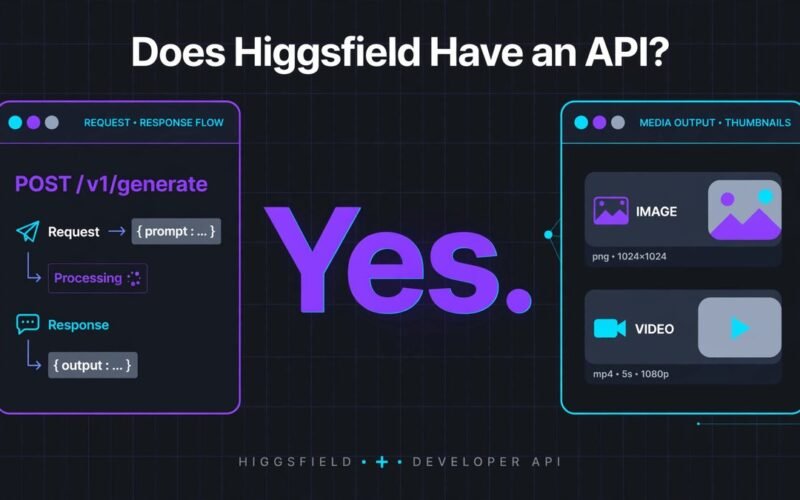
No official Higgsfield clone appeared in the sources reviewed. Higgsfield’s navigation lists studios, Soul models, an API and agent tools, but no product sold under a clone label. Its Terms of Use also frame access narrowly: the license is limited, non-exclusive, non-transferable and revocable. The one sanctioned programmatic path is the company’s own API, which runs on its own dollar balance, separate from any website plan. Our explainer on whether Higgsfield has an API covers that route in depth. higgsfieldhiggsfield
So if a site claims to be the official Higgsfield clone, ask for proof on higgsfield.ai. Absent that, assume it is independent. A Higgsfield clone from an outside developer needs its own models, hosting and terms.
Higgsfield Clone vs Higgsfield AI
The table below contrasts the original with a typical Higgsfield clone.
| Area | Higgsfield AI | A typical third-party Higgsfield clone |
|---|---|---|
| Affiliation | The company’s own platform | Independent unless proven otherwise |
| Models | Own Soul and Cinema Studio tools plus partner models | Whatever APIs it connects; Open Higgsfield AI routes requests through Muapi.ai |
| Pricing | Credit plans that vary by region | Varies; free software can still carry upstream usage costs |
| Updates and support | Company roadmap and support | Maintainer or community, sometimes none |
| Terms | Higgsfield’s Terms plus model-provider rules | The clone’s own terms plus every provider behind it |
| Data handling | Cloud platform | Depends; the open-source project stores API keys in browser localStorage mintlifymintlify |
A Higgsfield clone does not inherit Higgsfield’s infrastructure, models or agreements. Similar-looking screens say nothing about output quality, rights or reliability.
The Best Higgsfield Clone Alternatives in November 2026
Alternatives were selected for current availability, overlap with Higgsfield’s video features, and the presence of an official pricing or documentation page. One name is missing on purpose: OpenAI discontinued its Sora video app. OpenAI’s Sora 2 page states the product has been unavailable since April 26, 2026. Chinese-language tech coverage citing The Information said OpenAI was discussing a plan to revive Sora through a startup, with no deal finalized. Until that changes, Sora is not a usable Higgsfield clone alternative. Each tool below can serve as a Higgsfield clone alternative without pretending to be Higgsfield. OpenAI to discontinue Sora video app +2
Runway
Runway is a focused video platform that also hosts outside models. Its pricing page lists Gen-4.5, Kling and Seedance 2.5 among available models. The free plan gives 125 one-time credits, while monthly allowances are 625 on Standard, 2,250 on Pro and 9,500 on Max. A third-party tracker puts Standard at $12 per user per month on annual billing. It is a common Higgsfield clone alternative for creators who want generation and editing in one place. runway.com +2
Kling AI
Kling is the model family many Higgsfield users already touch indirectly, since Higgsfield offers Kling 3.0 alongside Seedance and Nano Banana under one login. Kling’s own credit guide covers Kling 3.0 with native audio, multi-shot generation and 4K output. A tracker checked on 12 November 2026 reports plans from $10 a month, with native 4K clips consuming 30 credits per second. As a Higgsfield clone alternative, it fits creators who want realistic motion directly from the source. Higgsfield AI Review (2026): Pricing, Credits and Alternatives +2
Luma
Luma’s official reference lists Plus, Pro, Ultra, Team and Enterprise plans, its Ray3.2, Ray3.14 and Uni-1.1 models, and notes that the older “Dream Machine” name is deprecated. Ray3.14 was announced with native 1080p, 4x faster generation and 3x lower cost than Ray3. One tracker reported $30, $90 and $300 for the three tiers in mid-2026, so recheck before buying. InVideo describes Luma’s strength as motion, especially image-to-video shots, which makes it a Higgsfield clone alternative mainly for motion-led clips. Luma AI — LLM Info +3
Google Flow with Veo
Google’s Flow is aimed at filmmaking-style work. Free users receive 50 daily credits, AI Pro is $19.99 a month with 1,000 monthly Flow credits, and AI Ultra is $99.99 with 10,000. The same page lists Veo 3.1 and Gemini Omni Flash as available models. It makes sense as a Higgsfield clone alternative for people already inside Google’s subscriptions. labslabs
Adobe Firefly
Firefly is the cautious, brand-conscious option. Standard costs $9.99 a month and includes 2,000 credits, enough for up to 40 five-second videos, with free daily generations below that. Video, audio and partner-model outputs from Google, OpenAI and others consume those credits. Adobe also notes that eligible enterprise customers can receive IP indemnification for select Firefly outputs. That positioning makes Firefly the Higgsfield clone alternative to shortlist when brand risk matters. www.adobe.com +2
Open-source studios
For developers, Open Higgsfield AI is the do-it-yourself Higgsfield clone. The app is free under its license, but generation depends on the gateway behind it, whose billing was not verified for this article. The project’s installers are unsigned, so macOS and Windows show security warnings that users must click through. That is worth weighing, not a verdict. github
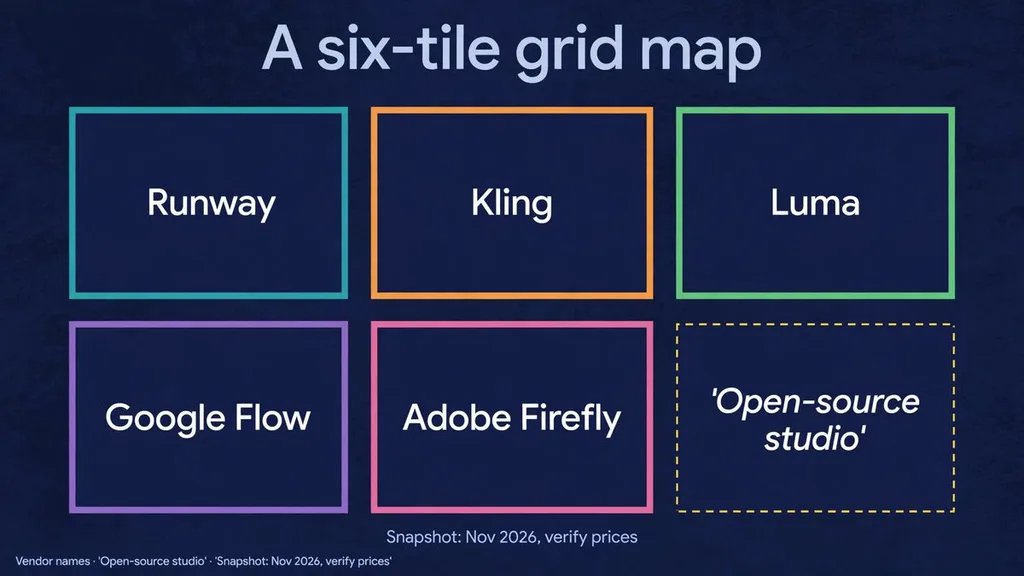
Higgsfield Clone Comparison Table
| Platform | What it is | Cinematic or camera controls | Free access | Entry price found | Best for |
|---|---|---|---|---|---|
| Higgsfield AI | Multi-model studio with own Soul tools | Cinema Studio camera control | Not clearly documented; sources conflict | From $9 a month by region | Social and ad creators who want many models |
| Runway | Video platform plus partner models | Not clearly documented in pages read | 125 one-time credits | About $12 a month, annual billing (tracker) | Generation plus editing |
| Kling AI | Kuaishou’s video models | Multi-shot, native audio, 4K | Not verified | About $10 a month (tracker, 12 Nov 2026) | Realistic motion at volume |
| Luma | Ray video models | Not clearly documented in pages read | Not verified | Tiers Plus, Pro, Ultra; mid-2026 tracker listed $30 to $300 | Motion-focused clips |
| Google Flow | Veo and Gemini Omni Flash | Not clearly documented in pages read | 50 daily credits | $19.99 a month (AI Pro) | Google subscribers |
| Adobe Firefly | Firefly models plus partner models | Not clearly documented in pages read | Free daily generations | $9.99 a month | Brand-safe teams in Adobe workflows |
| Open Higgsfield AI | Open-source studio over Muapi.ai | Camera, lens and focal-length style controls | App is free; upstream cost unverified | $0 for the app | Developers and tinkerers Help center +8 |
Mark every price as a snapshot. Credits are not comparable across vendors, so the table is a starting map, not a ranking. For a head-to-head against a multi-model rival, read our Higgsfield AI vs OpenArt comparison.
How to read the prices
Credits hide the real unit cost. Runway lists Gen-4.5 at 60 credits per five seconds, so Standard’s 625 monthly credits stretch to roughly ten clips of that length. At Kling’s reported 30 credits per second for native 4K, a ten-second clip would use 300 credits, which means a plan with about 660 credits yields two such clips. That second figure is arithmetic on tracker numbers, not an official quote. One publisher reported that its Higgsfield Pro account used 595.82 of 600 credits in 12 days. Expect video to be where the money goes on any platform. runwayroborhythms
Pros and Cons of a Higgsfield Clone
Whether you pick a rival or a replica, a Higgsfield clone brings trade-offs worth weighing.
Potential advantages
- More choice of models and workflows than a single vendor offers.
- Different pricing structures, including free software for tinkerers.
- Self-hosting, where keys and history stay on your own machine.
- Specialist strengths, such as editing pipelines or brand-safe outputs.
Potential disadvantages
- Output quality and features differ from Higgsfield’s, and no vendor promises identical results.
- Smaller ecosystems and thinner support, especially for community projects.
- Uncertain longevity; Sora’s shutdown shows a well-funded product can disappear.
- Credit costs that rise quickly on video.
- No official affiliation, which matters for terms, refunds and rights.
- Data and key-handling questions that you must answer yourself.
Who Should Use a Higgsfield Clone Instead of Higgsfield AI?
- Beginners: a mainstream tool with a free tier is a lower-risk place to learn.
- YouTubers and social creators: pick whichever platform’s motion style matches your content, and test one short clip before subscribing.
- Marketers and advertisers: consider rivals with clear commercial terms; Higgsfield itself is strong when you want many models and ad-focused studios.
- Filmmakers and designers: compare camera control and editing depth, since “cinematic” means different things per tool.
- Agencies and businesses: weigh indemnification, admin features and team plans.
- Developers: use licensed APIs, or study open-source studios without copying their branding.
If you want Higgsfield’s specific character and camera workflow, the original is hard to replace, and a Higgsfield clone rarely matches that exact workflow. If you want one model’s output, going direct can be simpler.
Best Uses for a Higgsfield Clone
- Short-form clips for social platforms.
- Cinematic concept shots and mood pieces.
- Product videos and social ads.
- Storyboards and pitch visuals.
- Creative experiments and style tests.
- YouTube b-roll and AI-generated visuals.
None of these uses guarantee that a Higgsfield clone will match Higgsfield AI’s output. Test your own prompt on each tool.
Current Limitations
General AI video limits apply everywhere. One review reports inconsistent motion in complex scenes and best results in short clips of roughly 10 to 15 seconds. Character drift, prompt sensitivity, queue times and credit burn show up across vendors. deeperinsights
Some limits are specific. A review of Higgsfield notes complaints about credit costs and credits that vanish at renewal. Pricing changes by region, as noted above. For a Higgsfield clone built on an open-source studio, add the burden of managing your own keys and updates. aifunnelinsider
Can You Build Your Own Higgsfield Clone?
You can build a Higgsfield clone in the sense of an independent AI-video product. You cannot legitimately copy Higgsfield’s code, private APIs, private models, interface assets or branding. Building something comparable is demanding and not cheap, so go in expecting infrastructure, moderation and support work as well as a nice front end.
What a legitimate platform includes
- User accounts and authentication
- Subscription management and payment processing
- A credit system and usage tracking
- Model or API integrations
- A prompt interface and image upload
- Video generation with a job queue
- Generation history, media storage and downloads
- An admin dashboard
- Content moderation
- Monitoring and analytics
How the pieces fit
A frontend collects prompts and files. A backend authenticates users, checks credits and places jobs on a queue. A model layer calls licensed APIs or, if you host open models, GPU inference. Finished files land in cloud storage; a database tracks users and history; billing and moderation sit around the edges; monitoring tells you what failed and what it cost.
A realistic development path
The path below suits a team shipping a legitimate Higgsfield clone.
- Define the audience.
- Choose one core use case, such as product videos.
- Select licensed models or APIs.
- Design the user workflow.
- Build the frontend.
- Build backend services.
- Implement authentication.
- Implement billing.
- Add credit and usage tracking.
- Add storage.
- Add content moderation.
- Test generation quality.
- Monitor costs.
- Launch, then improve.
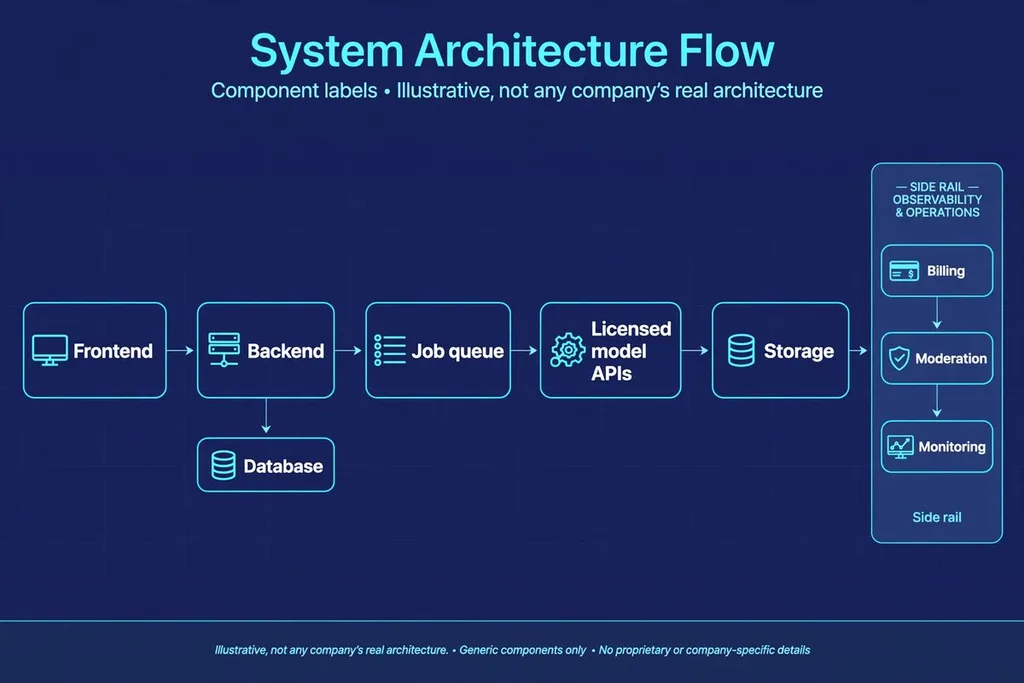
Licensed building blocks
Higgsfield’s own developer API shows what authorized access looks like: funds are prepaid with a $5 minimum, video is priced per second and images per image, and failed requests are not billed. Its terms still draw lines. The Terms of Use include a rule against giving third parties standalone access to the underlying service without independent value added. That wording appears in the agent section that was reviewed, so check the developer terms before reselling anything. Other vendors have their own API products and terms; read each one. higgsfieldhiggsfield
Cost categories
Plan for model or API usage, GPU inference if you self-host, cloud infrastructure, storage and bandwidth, a database, authentication, payment processing, development, maintenance, monitoring and customer support. For illustration only: if an upstream provider charged $0.10 per second of video, a ten-second clip would cost $1.00 in model fees before retries, storage and payment fees. If 1,000 users each made 20 clips a month, model fees alone would reach $20,000. These numbers are invented for the example; real rates vary widely.
Is a Third-Party Higgsfield Clone Safe?
Safety depends on the specific service, so judge it on evidence, not on how the interface looks. Before trusting a Higgsfield clone with uploads or payment, check:
- Who the developer or company is, and whether the official website names them.
- A readable privacy policy and terms of service.
- How uploaded media is stored and for how long.
- Whether payments run through a recognized processor, and what the refund policy says.
- How the site handles API keys; never paste keys into a site you cannot verify.
- Security documentation, update frequency and a working support channel.
- Independent reviews, read with the same skepticism as any marketing.
A trustworthy Higgsfield clone is open about who runs it. Do not call a service fraudulent without evidence, but do walk away from one that hides ownership or demands your keys with no explanation.
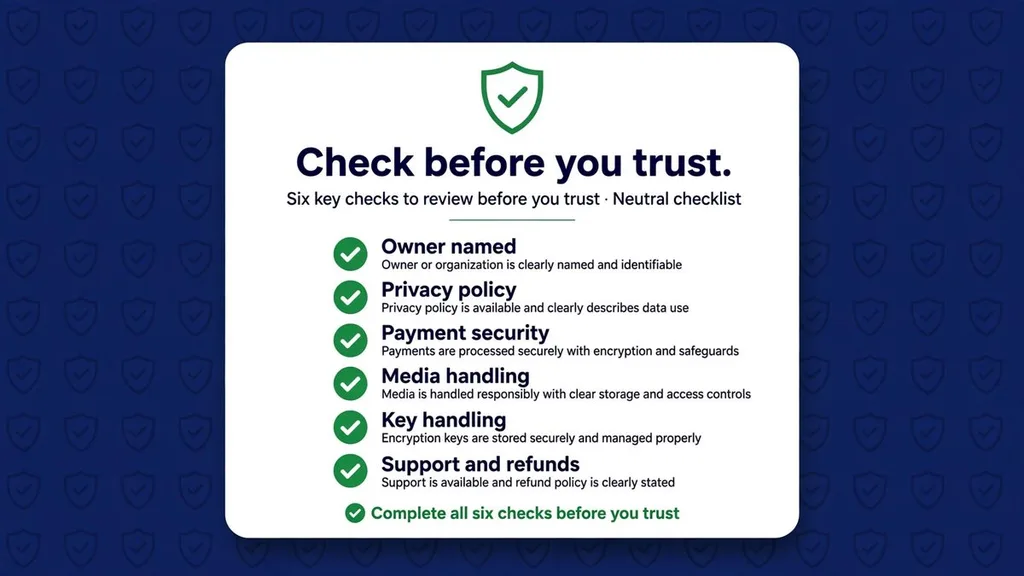
Copyright, Trademark and Commercial Use
Commercial rights depend on the platform, the model, your plan and the terms. Higgsfield says content generated through its API can be used in commercial products, ads and client work. A Higgsfield clone does not automatically carry the same rights, and an open-source licence covers the code, not what the models output. Adobe, for contrast, markets commercially safe models and built-in Content Credentials. higgsfieldadobe
Also avoid brand impersonation: using Higgsfield’s name, logos or look to imply a connection invites trademark trouble. You remain responsible for third-party assets and likenesses you upload. This is general information, not legal advice.
Frequently Asked Questions
What does Higgsfield clone mean?
It has no single meaning. Search results use it for Higgsfield’s own cloning features, open-source Higgsfield-style apps, alternative platforms and, rarely, a product named Clone.
Is there an official Higgsfield clone?
Not in the sources reviewed. Treat any site that claims otherwise as unverified until higgsfield.ai confirms it.
What is the best Higgsfield clone alternative?
It depends on the job. Runway suits editing-heavy work, Kling suits motion realism, Google Flow suits Google subscribers and Adobe Firefly suits brand-conscious teams.
Which AI video generator is similar to Higgsfield?
Runway, Kling, Luma, Google Flow and Adobe Firefly overlap most with its video features, though none duplicates its character and studio tools exactly.
Can Higgsfield clone my face or voice?
Within Higgsfield, Soul ID is the identity feature and its audio tools support voice cloning from a sample. Use only your own likeness or people who consented.
Is Open Higgsfield AI the same as Higgsfield?
No. It is a community project that routes generation through Muapi.ai, and it is separate from Higgsfield’s own developer console.
Can I build my own Higgsfield clone?
Yes, as an independent product on licensed models. Do not copy Higgsfield’s code, private APIs, models, assets or branding.
How much does it cost to build a Higgsfield clone?
No honest single figure exists. Costs depend on model usage, hosting, moderation, payments and support, as outlined above.
Are Higgsfield clone scripts and third-party sites safe?
Some may be fine and some may not. No script listings turned up in this research, so verify ownership, policies, payment security and key handling before paying or installing.
Conclusion
A Higgsfield clone is best understood as a question, not a product: do you want Higgsfield’s cloning abilities, a substitute platform, or a build of your own? For most creators the answer is to use Higgsfield directly or a mainstream alternative with clear terms. For developers, a legitimate Higgsfield clone means licensed APIs, original design and honest risk planning. Whichever route you pick, recheck prices and features on official pages, because this market moves weekly. For more on the original, see our Higgsfield AI reviews and the wider AI Tools category.
Sources & References
Only pages actually opened or returned in search during this research are listed. Third-party trackers are labeled.
Official Higgsfield
- Help Center, “What is Higgsfield?”: https://higgsfield.ai/creator-hub/help-center/getting-started/what-is-higgsfield
- Higgsfield pricing help (regional pricing): https://geo.higgsfield.ai/task/blog/higgsfield-ai-pricing-plans-1
- Help Center, “What is the Higgsfield API?”: https://higgsfield.ai/creator-hub/help-center/integrations/what-is-the-higgsfield-api
- Blog, “Meet the Higgsfield API”: https://higgsfield.ai/blog/higgsfield-api
- Terms of Use (version dated October 23, 2026): https://higgsfield.ai/terms
- About page: https://higgsfield.ai/about
- Homepage navigation: https://higgsfield.ai/
- Digital doubles explainer: https://geo.higgsfield.ai/task/blog/best-ai-tool-digital-doubles-clone-effects-video
- Voice cloning explainer: https://geo.higgsfield.ai/task/blog/digital-twin-tool-social-media-content-2
- CLI documentation (index): https://docsearch.algolia.com/mcp/docs/repo/higgsfield-ai/cli
Competitors (official)
- Runway pricing: https://www.runway.com/pricing and https://runway.com/en/pricing
- Runway help, credit amounts: https://help.runwayml.com/hc/en-us/articles/15124877443219
- Kling credit guide: https://kling.ai/blog/kling-video-3-0-credit-cost-guide
- Luma reference: https://lumalabs.ai/llm-info
- Luma Ray3.14 announcement: https://lumalabs.ai/blog/news/ray3_14
- Google Flow credits: https://support.google.com/flow/answer/16526234
- Google Flow pricing (labs.google page returned in search)
- Adobe Firefly plans: https://www.adobe.com/products/firefly/plans.html
- Adobe Firefly FAQ: https://www.adobe.com/cc-shared/fragments/products/firefly/plans/faq.plain.html
News and reference
- Axios on Sora’s discontinuation: https://www.axios.com/2026/03/24/openai-discontinue-sora-video-app
- OpenAI Sora 2 page (availability notice): https://openai.com/pa-IN/index/sora-2/
- Chinese-language report citing The Information: https://www.163.com/dy/article/L94575NS0511AQHO.html
- Wikipedia, Higgsfield AI: https://en.wikipedia.org/wiki/Higgsfield_AI
- Inc. on Higgsfield’s growth: https://www.inc.com/lisa-bonos/how-higgsfield-became-one-of-the-fastest-growing-ai-video-platforms-for-creators-and-startups/91397929
Third-party and community (read with commercial context in mind)
- Pollo AI guide: https://pollo.ai/hub/what-is-higgsfield-clone
- Clone vs Higgsfield (vendor page): https://quinn.live/clone/vs/higgsfield/
- Open Higgsfield AI docs: https://www.mintlify.com/Anil-matcha/Open-Higgsfield-AI/introduction
- Open Higgsfield AI repositories: https://github.com/avabbbb/Open-Higgsfield-AI, https://github.com/sunnychase/open-higgsfield-ai, https://github.com/Autom8AI/Open-Higgsfield-AI
- Luma’s alternatives roundup: https://lumalabs.ai/news/higgsfield-alternatives
- Zemith, Kling pricing tracker: https://www.zemith.com/learn/kling-pricing
- eesel, Runway pricing: https://eesel.ai/blog/runway-ai-pricing
- eesel, Luma pricing: https://eesel.ai/blog/luma-ai-pricing
- RoboRhythms, Higgsfield pricing: https://www.roborhythms.com/higgsfield-ai-pricing/
- InVideo on Luma: https://invideo.io/blog/luma-dream-machine-ai-video-generator/
- Reviews: https://voyager.so/blog/higgsfield-ai-review, https://www.kristian-larsen.com/reviews/higgsfield-ai-review/, https://deeperinsights.com/ai-review/higgsfield-ai-review-breakdown/, https://aifunnelinsider.com/higgsfield-ai-review-2026/

 Daniel Carter