
In this article
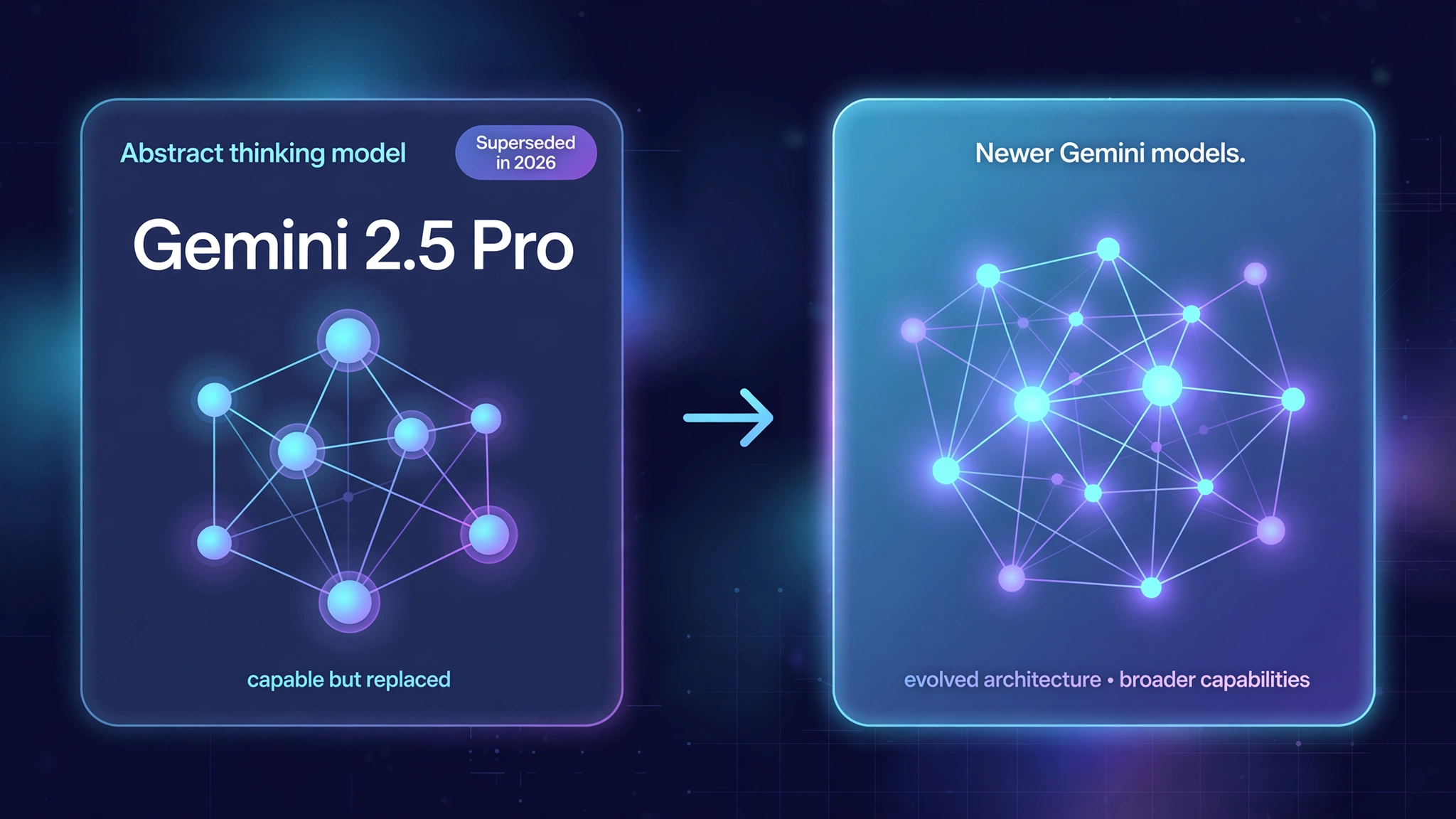
Gemini 2.5 Pro is a multimodal “thinking” language model from Google, released in stable form on June 17, 2025. It reads text, images, audio, video and PDFs, accepts up to 1,048,576 tokens of input in a single request, and answers in text of up to 65,536 tokens. What most guides skip is what happened afterwards. By November 2026, Gemini 2.5 Pro has been overtaken by Google’s Gemini 3 and Gemini 4 models, Google AI Studio no longer lets you select it, and Google’s pricing page says Gemini API requests to it will be rerouted to Gemini 3.8 Flash on December 1, 2026.
So this guide does two jobs. It explains what the model does and what it cost, and it tells you where it still runs and what to use instead. Every current-status claim below comes from a Google page we read on the date above, and where Google’s own pages disagree, we say so.
Table of Contents
Gemini 2.5 Pro at a Glance
- Type: a large language model with built-in reasoning (“thinking”), made by Google.
- Inputs and output: text, images, audio, video and PDF in; text out.
- Limits: 1,048,576 input tokens and 65,536 output tokens, per Google’s model page.
- Gemini API price: $1.25 per million input tokens and $10.00 per million output tokens for prompts up to 200,000 tokens, with higher rates above that.
- Status: deprecated. It cannot be selected in Google AI Studio, API access is limited to people who already used it, and a reroute to Gemini 3.8 Flash is scheduled for December 1, 2026.
- Use instead: Gemini 3.8 Flash, which Google names as the API replacement, or a Gemini 4 model for harder work.
What Is Gemini 2.5 Pro?
Gemini 2.5 Pro is a large language model (LLM), which is software trained on huge volumes of text, code and media to predict and generate language. Two labels explain most of what you need to know. “Multimodal” means it can take in more than text. “Thinking” means it spends extra computation working through a problem before it commits to an answer. Google’s model page describes it as a state-of-the-art thinking model for complex problems in code, math and STEM, and for analyzing large datasets, codebases and documents.
Who Makes Gemini 2.5 Pro and Where It Fits
Google makes the model, and the Gemini family comes out of Google DeepMind. According to the Gemini API release notes, an experimental build appeared on March 25, 2025, and the stable gemini-2.5-pro endpoint followed on June 17, 2025. The generation sits between Gemini 2.0 and Gemini 3. Since then Google has shipped Gemini 3 Pro in November 2025, Gemini 3.1 Pro in February 2026 and Gemini 4 Argon on October 13, 2026, which is why Gemini 2.5 Pro now reads as a previous-generation model.
What the Pro Tier Means
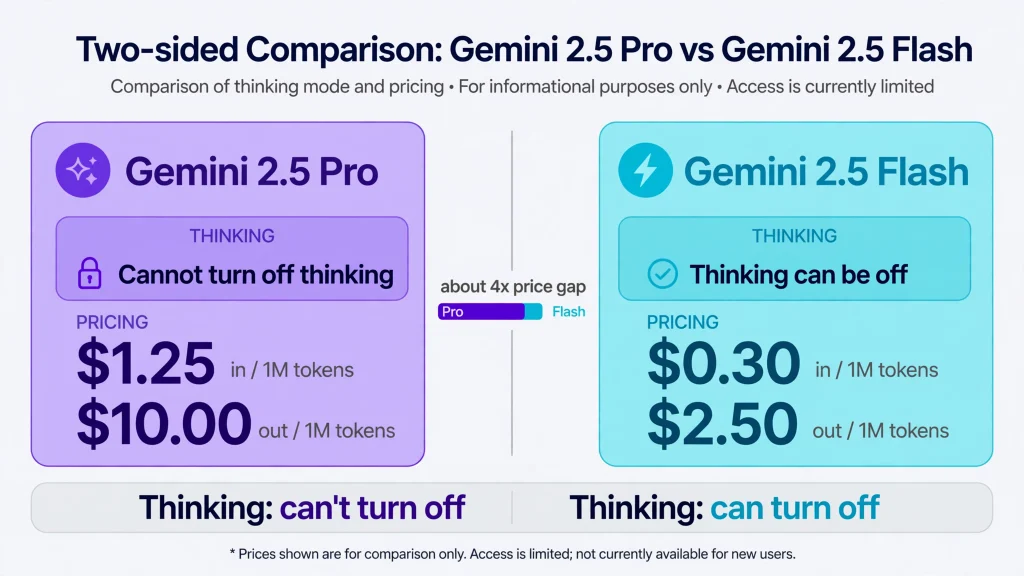
Google sells each Gemini generation in tiers. Pro is the larger, more capable tier, Flash trades some capability for speed and lower prices, and Flash-Lite goes cheaper still. In the 2.5 generation the gap is concrete: Gemini 2.5 Pro cannot have its thinking switched off, and it costs roughly four times as much per token as Gemini 2.5 Flash. The comparison section below sets the two side by side.
Who Gemini 2.5 Pro Was Built For
Google positioned the model for work where a quick answer is not enough: debugging, multi-step analysis, reading a long contract or a pile of research PDFs, and building prototypes. For simple summaries or rewriting, a Flash-class model was always the more economical pick. For a wider look at how Google’s assistant behaves across versions, our guide to Gemini characteristics covers the traits that carry over from model to model.
Is Gemini 2.5 Pro Still Available in November 2026?
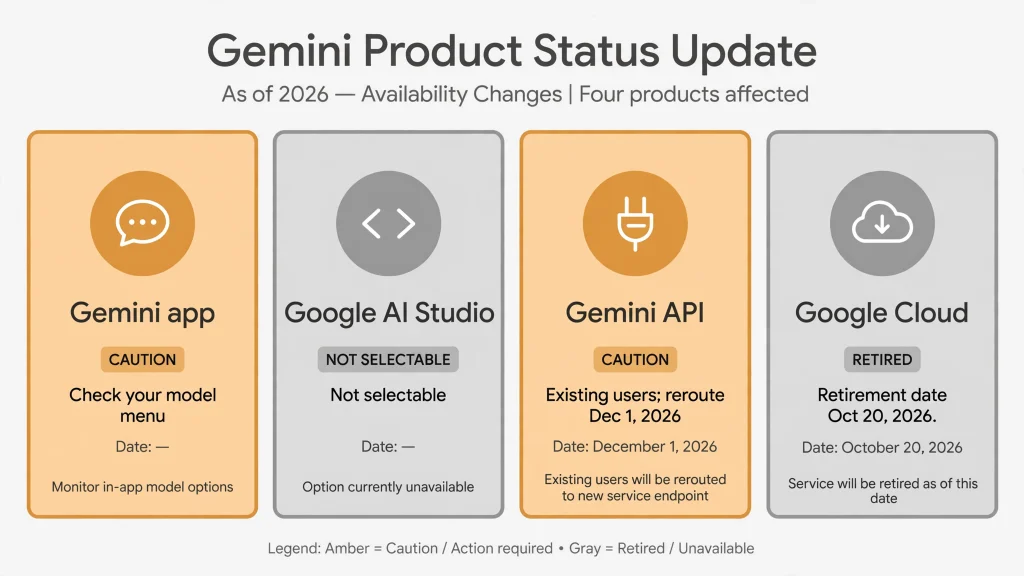
Only partly, and it depends on which Google product you mean. Four different things share the Gemini name here: the Gemini app (a consumer chat product), Google AI Studio (a browser workspace for developers), the Gemini API (programmatic access) and Google Cloud’s enterprise platform, which Google’s documentation now calls Gemini Enterprise Agent Platform and which many developers still know as Vertex AI. Each one has its own answer.
Gemini 2.5 Pro Status by Product
| Product | What it is | Status of Gemini 2.5 Pro on November 14, 2026 |
|---|---|---|
| Gemini app | Consumer chat app | Not named in Google’s recent app release notes. Gemini 4 Argon rolled out on October 13, 2026 for Google AI Pro and Ultra. Check your own model menu. |
| Google AI Studio | Browser workspace for developers | Deprecated and no longer selectable, per Google’s pricing page. |
| Gemini API | Programmatic access | Still served to existing users for now. Access is limited to people who used it before, and requests reroute to gemini-3.8-flash on December 1, 2026. |
| Gemini Enterprise Agent Platform (Vertex AI) | Google Cloud’s enterprise platform | Google Cloud’s lifecycle page lists October 20, 2026 as the retirement date, and that date has passed. |
Why Google’s Pages Disagree About Gemini 2.5 Pro
Google’s Gemini API pricing page carries the strongest notice. It marks the model deprecated, says it can no longer be selected in Google AI Studio, and states that from December 1, 2026 all API requests to gemini-2.5-pro are routed to gemini-3.8-flash and billed at Gemini 3.8 Flash rates. Google’s separate deprecations page, whose footer read October 22, 2026 when we fetched it, still showed no shutdown date and said that access to the 2.5 models is limited to users who have used them before. A September 18, 2026 release note says the same about access.
A third-party tracker reports a November 2 release-note entry that sets the December 1 date. The copy of the release notes we retrieved was last updated October 30, so we could not confirm that entry ourselves. The practical reading: treat December 1, 2026 as the working date for the Gemini API, and re-read Google’s live pages before you ship anything.
What Replaced Gemini 2.5 Pro
| Model | Why it matters | Gemini API price per million tokens (input / output) |
|---|---|---|
| Gemini 3.8 Flash | The replacement Google names for the API; generally available since September 2, 2026 | $0.75 / $3.75 through December 31, 2026, then $1.50 / $7.50 |
| Gemini 4 Argon | Released October 13, 2026; in the Gemini app for AI Pro and Ultra | $2.00 / $10.00 through November 30, 2026, then $4.00 / $20.00 (paid tier only) |
| Gemini 4 Carbon | Listed on Google’s pricing page as its most capable reasoning model | Same introductory prices as Argon (paid tier only) |
| Gemini 4 Hydrogen | Built for everyday coding and agent work, with a 1M-token window | $1.50 / $7.50, with a free tier |
Reports from outside Google say Carbon reached Google AI Ultra subscribers in the Gemini app on November 10, 2026. We could not find that on Google’s own release notes yet, so confirm it before relying on it.
Gemini 2.5 Pro Key Features
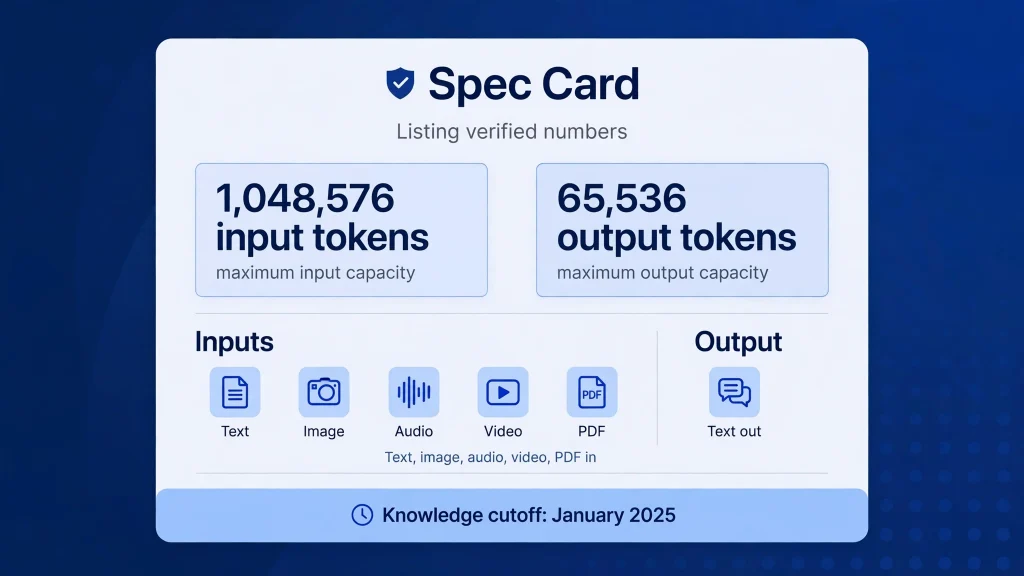
Google’s model page spells out what the model can and cannot do. In plain terms:
Built-In Thinking
Gemini 2.5 Pro reasons before it replies. Google’s June 17, 2025 release note described the stable version as having “adaptive thinking,” meaning the model decides how much effort a prompt deserves. Developers can cap that effort with a thinking budget between 128 and 32,768 tokens, or set the budget to -1 and let the model choose.
Multimodal Input, Text-Only Output
You can send audio, images, video, text and PDFs. The reply is text. Google lists image generation and audio generation as unsupported for this model, and it does not run on the Live API for real-time voice.
Developer Tooling
For developers, the model page lists function calling, structured outputs (replies in a fixed JSON shape), code execution, Google Search grounding, Google Maps grounding, URL context, file search and context caching. It can also be run through Batch, Flex and Priority inference modes, which trade price against speed.
A January 2025 Knowledge Cutoff
The model’s built-in knowledge stops in January 2025, according to Google. Anything newer, including most of 2025 and all of 2026, is invisible to it unless you connect a search tool or paste the material in.
Gemini 2.5 Pro Reasoning: What “Thinking” Means in Practice
Reasoning, in practical terms, means working through a problem in steps instead of matching it to the nearest familiar pattern. Before it answers, Gemini 2.5 Pro generates a stretch of internal reasoning, and Google bills those thinking tokens as output tokens. Unlike Gemini 2.5 Flash, Gemini 2.5 Pro has no setting that turns thinking off.
Where Stronger Reasoning Helps
Tasks with several dependent steps benefit most:
- Debugging a failure that only appears when two modules interact.
- Working out which clause in a long contract overrides another.
- Reconciling two datasets whose column definitions differ slightly.
- Checking a multi-step math or physics derivation line by line.
- Comparing the methods sections of several research papers.
For a one-step request such as fixing grammar or summarizing a paragraph, extra thinking adds cost and delay without improving the result.
Why Reasoning Is Not the Same as Being Right
A fluent chain of reasoning is not proof. A model can reason carefully from a wrong premise, misread a table or invent a citation that looks plausible. Treat Gemini 2.5 Pro’s explanation as a draft to verify, especially for numbers, legal wording, and medical or financial questions.
Benchmark scores deserve the same caution. A leaderboard number measures one model on one test set under one setup, usually reported by the lab that built it, and the test may look nothing like your work. We left benchmark figures out of this guide on purpose, because none could be tied to a current independent check. A better test: take 10 to 20 real tasks from your own work, run them through the model, and have someone score the answers without knowing which model wrote them.
Gemini 2.5 Pro for Coding
Gemini 2.5 Pro covers the everyday jobs of an AI coding assistant: generating code from a description, explaining unfamiliar code, finding bugs, writing tests, and converting code between styles or languages. Through the API, the tool support on Google’s model page matters for programming: function calling, structured output, a code execution tool that can run generated code, and URL context for pulling in documentation pages. In May 2025 Google described an upgraded Gemini 2.5 Pro with stronger coding, aimed at building web apps in the Gemini app’s Canvas tool.
A Realistic Coding Workflow With Gemini 2.5 Pro
Suppose you maintain a Node.js service written in the callback style and want to move it to async/await. A sensible approach is to paste the module and its tests, ask for a migration plan before any code, then request changes one file at a time and run the tests after each step. The long context window lets you include related files so the model can see how functions call one another. Google once described a one-million-token window as roughly 30,000 lines of code in its 2024 Gemini Advanced notes. Treat that as a rough guide, because token counts vary with language and formatting.
Coding Limits to Plan Around
The model can produce code that looks right and fails: it may call a library function that does not exist, skip an edge case, or ignore a convention in your repository. It cannot see your running system unless you provide logs and output. Its knowledge stops in January 2025, so recent library versions may be unfamiliar. Review every change like a pull request from a new colleague, run the tests, and never paste secrets or credentials into a prompt.
Gemini 2.5 Pro Context Window Explained
A context window is the amount of text, measured in tokens, that a model can consider at once. A token is a chunk of text, often a short word or part of one. Google’s model page lists 1,048,576 input tokens and 65,536 output tokens for gemini-2.5-pro, and those are separate limits. Google’s older rule of thumb for a one-million-token window was about 1,500 pages of text.
What a Large Window Is Good For
- Reading a long report, or several contracts, in one request.
- Comparing many research PDFs side by side.
- Giving the model a large slice of a codebase.
- Working through a long meeting transcript or chat history.
Where the Gemini 2.5 Pro Context Window Falls Short
- Cost: prompts above 200,000 tokens are billed at higher rates. Input doubles from $1.25 to $2.50 per million tokens, and output rises from $10.00 to $15.00.
- Attention: a bigger window does not guarantee the model weighs every part equally well. Test it by burying a known fact in the middle of a long document and asking for it.
- Product differences: limits in the Gemini app depend on your plan and have changed over time. Google’s February 2025 notes, for example, gave app users a 32K window while Gemini Advanced had 1M. Do not assume those figures still hold.
- Repeat costs: context caching lowers the price of reusing the same long input, at $0.125 per million cached tokens for prompts up to 200,000 tokens, plus $4.50 per million tokens per hour of storage.
Gemini 2.5 Pro Pricing
There is no single price for Gemini 2.5 Pro. There is a price per product, and mixing them up causes real billing mistakes.
Gemini API Pricing for Gemini 2.5 Pro
These are the paid-tier rates on Google’s pricing page, per million tokens in US dollars:
| Mode | Input (prompts up to 200k) | Input (above 200k) | Output (up to 200k) | Output (above 200k) |
|---|---|---|---|---|
| Standard | $1.25 | $2.50 | $10.00 | $15.00 |
| Batch | $0.625 | $1.25 | $5.00 | $7.50 |
| Flex | $0.625 | $1.25 | $5.00 | $7.50 |
| Priority | $2.25 | $4.50 | $18.00 | $27.00 |
Output prices include thinking tokens, so a short visible answer can still cost more than its length suggests. Google Search grounding includes 1,500 free requests per day, then $35 per 1,000 grounded prompts.
A worked example, using our own arithmetic: a Standard request with 100,000 input tokens and 5,000 output tokens costs about $0.125 for input plus $0.05 for output, or $0.175. The same request at Gemini 3.8 Flash’s introductory rates costs about $0.094, which is what the December 1 reroute will bill you.
Gemini App and Google AI Studio Pricing
The Gemini app is not billed per token. It is sold through Google AI plans whose prices and model access vary by country and change often, so check Google’s subscription page rather than a guide. Google’s pricing notes state that Google AI Studio usage is free of charge in all available regions, but Gemini 2.5 Pro can no longer be selected there.
Google Cloud Pricing for Gemini 2.5 Pro
Google says prices on Gemini Enterprise Agent Platform may differ from the Gemini API list. Because Google Cloud lists the model’s retirement date as October 20, 2026, there is little reason to budget for it there. Use Google Cloud’s own pricing page for the replacement models.
Is Gemini 2.5 Pro Free?
Not in any way you should plan around. Here is how it breaks down:
- Gemini API free tier: Google’s pricing table still shows “Free of charge” for Standard and Priority use of the model, and notes that free-tier content may be used to improve Google’s products. Batch and Flex are paid only. Paid-tier content is not used that way.
- Access limits: a September 18, 2026 release note limits the 2.5 models to users who have used them before. One third-party report says new projects receive an error saying the model is no longer available to new users, which we could not verify directly.
- Google AI Studio: free to use in available regions, but Gemini 2.5 Pro is not selectable.
- Gemini app: Google offered the model widely in 2025, but the app has since moved to newer models. Free access today means whatever model Google assigns to the free plan.
Region, account type and Workspace administrator settings can all change what you see. If you want a free model for new work, Google’s pricing page shows a free tier for Gemini 4 Hydrogen and Gemini 3.8 Flash.
How to Access Gemini 2.5 Pro
Follow the path that matches your situation:
- Decide which product you need. Chatting is the Gemini app. Prototyping prompts is Google AI Studio. Building software is the Gemini API. Enterprise deployment is Google Cloud.
- If you already call the model through the Gemini API, keep using the gemini-2.5-pro model ID. Google says the model will keep being served until further notice, with the December 1, 2026 reroute pending. Log the model version returned with each response so you notice when the reroute happens.
- If you are starting a new project, choose gemini-3.8-flash or a Gemini 4 model instead. Gemini 4 Argon and Carbon are not on the free tier.
- If you use the Gemini app, open the model menu and see what your plan lists. Google’s release notes point to Gemini 4 Argon for AI Pro and Ultra.
- If you work in Google Cloud, check the lifecycle table for the current replacement model ID before you deploy.
Gemini 2.5 Pro vs Gemini 2.5 Flash
| Factor | Gemini 2.5 Pro | Gemini 2.5 Flash |
|---|---|---|
| Positioning | Coding and complex reasoning | Google’s first hybrid reasoning model |
| Context window | 1,048,576 input tokens | 1M-token window |
| Thinking | Cannot be turned off; budget 128 to 32,768 | Can be turned off; budget up to 24,576 |
| Standard API price per million tokens | $1.25 input, $10.00 output | $0.30 input (text, image, video), $2.50 output |
| Status | Reroutes to Gemini 3.8 Flash on December 1, 2026 | Reroutes to Gemini 3.5 Flash-Lite on December 1, 2026 |
Neither is universally better. Gemini 2.5 Pro was the choice for hard, multi-step problems and large inputs where a wrong answer is costly. Gemini 2.5 Flash suited high-volume or latency-sensitive work such as classification, extraction and quick drafting, at about a quarter of the per-token price. Many teams routed easy requests to Flash and escalated difficult ones to Pro. That pattern still makes sense with the newer models.
Gemini 2.5 Pro vs ChatGPT
ChatGPT is a product and Gemini 2.5 Pro is a model, so a clean head-to-head is impossible, and the two come from different moments. OpenAI’s help center currently describes GPT-5.6 Sol on eligible paid plans, with GPT-6 Pro, powered by GPT-6 Astra, on eligible plans. Those are newer than Gemini 2.5 Pro, so most comparisons are really comparisons between generations. OpenAI also renames models often, so check its pages before you decide.
| Dimension | Gemini 2.5 Pro (verified) | ChatGPT (how to evaluate) |
|---|---|---|
| Reasoning | Built-in thinking, budget 128 to 32,768 tokens | OpenAI lists adjustable levels from Instant to Extra High; test on your own tasks |
| Coding | Function calling, code execution, 1M-token input | OpenAI offers Codex; test on your repository |
| Writing and research | Search grounding via API; January 2025 knowledge cutoff | Run a source-checking task and verify the citations |
| Multimodal | Text, image, audio, video and PDF in; text out | Check OpenAI’s current input and output list |
| Context handling | 1,048,576 in, 65,536 out | Varies by model and plan; check OpenAI’s documentation |
| Ecosystem | Gemini app, AI Studio, Gemini API, Google Cloud | ChatGPT apps, Work and Codex |
| Price | $1.25 / $10.00 per million tokens for existing API users | See OpenAI’s current pricing |
Which suits whom? Teams already living in Google’s tools, with long documents to read, will find the Gemini family the natural fit, though a newer Gemini model beats this one. People who want a general chat assistant should test current models from both companies on their own tasks. For a fair-minded look at how two other leading assistants compare, see our guide on whether Claude is better than ChatGPT. The only honest verdict is that no universal winner exists.
Gemini 2.5 Pro Use Cases
Each of these assumes a human reviews the output:
- Students: summarize a dense reading, then ask for a step-by-step walkthrough of a worked problem, and check the steps against the textbook.
- Developers and programmers: plan a refactor, explain legacy code, draft unit tests and migrate between frameworks.
- Researchers: compare the methods and limitations of several PDFs, then verify every cited claim at the source.
- Writers: get structural feedback on a long manuscript, keeping in mind the January 2025 knowledge cutoff.
- Businesses: triage a stack of contracts or internal documents so a specialist reads the flagged parts first.
- Analysts: reconcile tables, explain a spreadsheet’s logic and draft queries.
- Content creators: turn a video or transcript into an outline, since the model accepts video and audio input.
- Technical users: extract structured data into JSON through the structured-output feature.
None of this guarantees speed or accuracy gains. Measure on your own work.
Gemini 2.5 Pro Pros and Cons
| Strengths | Weaknesses |
|---|---|
| Built-in thinking for multi-step problems | Previous-generation model, overtaken by Gemini 3 and 4 |
| One-million-token input window | Thinking cannot be switched off, so simple prompts still pay for reasoning |
| Accepts text, images, audio, video and PDFs | Text-only output; no image or audio generation |
| Strong developer tooling, including function calling and code execution | Knowledge cutoff of January 2025 |
| Batch and Flex modes halve the API price | Deprecated, with access limited and a December 1, 2026 reroute |
Gemini 2.5 Pro Limitations
- Hallucinations: the model can state invented facts, sources or numbers with confidence. Verify anything that matters.
- Coding errors: generated code can compile and still be wrong. Test it.
- Outdated knowledge: the January 2025 cutoff means it misses recent events and library releases unless you add search grounding or paste the material in.
- Product differences: the Gemini app, Google AI Studio, the Gemini API and Google Cloud have separate limits, prices and lifecycles. For app-side privacy controls, our explainer on Gemini Apps Activity shows where saved conversations live.
- Pricing complexity: long-prompt surcharges, thinking tokens billed as output and different modes all change the final bill.
- Availability changes: deprecations move. If calls start failing, our guide to checking Gemini outages helps separate an outage from a retired model.
- Data use on the free tier: Google’s pricing page says free-tier content may be used to improve its products, so avoid sensitive material there.
Who Should Use Gemini 2.5 Pro?
In November 2026 the honest list is short. Teams with a production workflow already pinned to gemini-2.5-pro who need a stable baseline while they test a replacement fall into it. So do researchers who must reproduce results from 2025. Everyone else, especially anyone starting fresh, is better served by a current model. People who want speed and lower cost over deep reasoning should pick a Flash-class model from the newer lineup.
Is Gemini 2.5 Pro Worth Using?
For new work, rarely. The model was a strong reasoning and long-context tool for its time, and its feature set, including thinking, a one-million-token window, multimodal input and solid developer tooling, is still sound. But Google has restricted access, removed it from Google AI Studio’s picker and scheduled a reroute to a different model. Building on something with that trajectory means a migration is coming anyway.
If you already depend on it, use the time before December 1, 2026 to run your own tests against Gemini 3.8 Flash and a Gemini 4 model, compare cost and quality on real tasks, and switch on your schedule. If you are curious about it for learning or comparison, the facts above should let you read older reviews with the right context.
Gemini 2.5 Pro FAQ
What is Gemini 2.5 Pro?
Gemini 2.5 Pro is Google’s mid-2025 flagship reasoning model. It is a multimodal large language model that accepts text, images, audio, video and PDFs, thinks before answering, and replies in text. Its stable release was June 17, 2025.
Is Gemini 2.5 Pro still available?
Partly. Google marks it deprecated, removed it from Google AI Studio’s picker, limits API access to prior users and plans to reroute requests to Gemini 3.8 Flash on December 1, 2026. Google Cloud lists a retirement date of October 20, 2026.
Is Gemini 2.5 Pro free?
Google’s pricing table lists a free tier, but the model is no longer selectable in Google AI Studio and API access is limited to people who used it before. For new free access, look at newer models that still have a free tier.
What can Gemini 2.5 Pro do?
It can reason through multi-step problems, write and debug code, read long documents, and analyze images, audio, video and PDFs. It calls functions, returns structured JSON and runs code through the API. It cannot generate images or audio.
Is Gemini 2.5 Pro good for coding?
It handled code generation, explanation, debugging and migration well enough to be a popular choice in 2025. Verify every output by running tests, because generated code can look right and still fail.
How do I access Gemini 2.5 Pro?
Existing Gemini API users can keep calling the gemini-2.5-pro model ID until Google reroutes it. New users should pick gemini-3.8-flash or a Gemini 4 model, and Gemini app users should check their own model menu.
What is the Gemini 2.5 Pro context window?
Google’s model page lists 1,048,576 input tokens and 65,536 output tokens for the API. Prompts over 200,000 tokens cost more, and limits inside the Gemini app depend on your plan.
What is the difference between Gemini 2.5 Pro and Gemini 2.5 Flash?
Pro is built for harder reasoning, cannot turn thinking off and costs about four times as much per token. Flash is faster and cheaper, and its thinking can be disabled. Both are deprecated and scheduled to reroute on December 1, 2026.
Is Gemini 2.5 Pro better than ChatGPT?
There is no universal answer. ChatGPT now runs newer models, so the comparison is mostly generational. Test both on your own tasks and judge by accuracy, cost and ecosystem fit.
Can developers use Gemini 2.5 Pro through an API?
Yes, through the Gemini API with the model ID gemini-2.5-pro, though access is limited to users who previously used it. Pricing is $1.25 input and $10.00 output per million tokens for prompts up to 200,000 tokens.
Sources & References
- Google AI for Developers, Gemini deprecations: shutdown table, access-limit note for the 2.5 models.
- Google AI for Developers, Gemini API release notes: stable release dates, the September 18, 2026 access update, Gemini 3.8 Flash and Gemini 4 Argon launches.
- Google AI for Developers, Gemini Developer API pricing: token prices, deprecation notice, December 1, 2026 reroute, free-tier notes.
- Google AI for Developers, Gemini 2.5 Pro model page: token limits, supported inputs and tools, knowledge cutoff.
- Google AI for Developers, Gemini thinking guide: thinking budget range and the fact that thinking cannot be disabled on 2.5 Pro. We read this from Google’s localized copies of the guide and Google Cloud’s equivalent documentation.
- Google Cloud, Model versions and lifecycle: the Gemini Enterprise Agent Platform lifecycle table, including the October 20, 2026 retirement date.
- Google, Gemini Apps release notes: Gemini app model history, including 2.5 Pro in 2025 and Gemini 4 Argon on October 13, 2026.
- OpenAI Help Center, GPT-5.6 in ChatGPT: current ChatGPT model descriptions used for the comparison.
- Third-party context, EvalShift, Gemini model deprecation checklist: reports the November 2 deprecation entry we could not verify directly.
- Third-party context, Fello AI, All we know about Google Gemini 4: reports Gemini 4 Carbon access for AI Ultra.
 Daniel Carter