
Sources checked on November 2, 2026. AI products change quickly, so confirm tool-specific details before you rely on them.
Which task is a generative AI task? Any task whose result is newly produced content is a generative AI task: a written email, an image drawn from a description, a block of code, a melody, a short video. A task that only sorts, scores, flags, forecasts or measures something that already exists is not, even when it runs on AI. That one contrast settles most versions of the question, including the ones that appear in certification exams and classroom quizzes. In short, which task is a generative AI task is a question about outputs, not about brand names.
The confusion starts in the details. A language model can label a message as spam, and an image model can be pointed at a factory camera to spot defects, so the technology alone does not decide the answer. The job does. When someone asks which task is a generative AI task, the useful move is to inspect the output: did the system compose something new, or did it pick from options that were already defined?
This guide is written for students facing exam questions, professionals deciding which projects need a generative model, and readers who keep hearing the term and want it explained properly. You will get a working definition, a repeatable test, a comparison table, six practice questions with explanations, and a frank look at where generative systems go wrong. If the underlying technology is new to you, our plain-English explanation of how ChatGPT works pairs well with this article.
Table of Contents
Which Task Is a Generative AI Task? The Direct Answer
The direct answer to which task is a generative AI task is this: the task in which a model produces new content in response to a prompt or an example. Four quick signs point that way:
- The output is text, an image, audio, video, code, or synthetic data.
- The exact output did not exist before the request was made.
- Several different outputs could all be acceptable, so there is no single “correct” result.
- The input is often an instruction in ordinary language rather than a row of numbers.
Tasks that assign a category, estimate a number, locate an object, or rank a list are the contrast cases. They produce a verdict about existing data, not a new artifact.
Official definitions agree. IBM describes generative AI as AI that creates original content such as text, images, video, audio or software code from a user’s prompt. The Australian National AI Centre draws the same line from the other side: generative AI creates new content from prompts or examples, while machine learning analyses data to find patterns and make predictions.
One warning before we go further. Some quiz writers reward the answer “all of the above,” but that choice is correct only when every listed option truly creates content. Read each option before deciding; we return to this in the multiple-choice section.
What Is Generative AI?
Generative AI is the part of artificial intelligence that makes new material instead of only analysing old material. The U.S. Government Accountability Office notes that what sets it apart from other AI systems is the ability to generate novel content, together with the enormous volume of training data it needs, the scale and complexity of its models, and the use of natural-language prompts.
A librarian and a novelist make a useful comparison. A librarian, like a classifier or a recommender, is excellent at deciding which shelf a book belongs on or which title you might enjoy next. A novelist writes a book that was on no shelf. Generative AI behaves more like the novelist, with an important caveat: it writes by recombining patterns learned from training data rather than from lived experience, and it can be confidently wrong. Keeping that picture in mind makes it simpler to decide which task is a generative AI task.
Everyday examples include chat assistants that draft text, image tools that paint from a description, and coding assistants that suggest functions. If you want to see the picture-making side in practice, our guide to ChatGPT Image walks through creating and editing pictures from written instructions.
How Does Generative AI Work?
Understanding the mechanism helps you answer the question of which task is a generative AI task, because the mechanism explains why outputs are created rather than looked up. IBM describes three broad phases.
Training a foundation model
A foundation model is trained on huge volumes of raw, unlabeled data. During training it plays millions of fill-in-the-blank exercises, predicting the next word, the next piece of an image, or the next line of code, and it adjusts itself each time to shrink the gap between its guess and the real data. What remains is a network of parameters that encodes patterns and relationships, which the model can then use to produce content when it receives a prompt.
Tuning and human feedback
A foundation model is a generalist. To make it dependable at a particular job, developers tune it with examples of the questions it will face and the answers they want. Commercial developers also use reinforcement learning from human feedback, in which people evaluate and rank outputs and the model learns to imitate the preferred responses, as the GAO explains.
Generation, evaluation and retrieval
Once deployed, the model generates content, and its owners keep checking quality and tuning it. Some systems add retrieval-augmented generation, which lets the model draw on sources outside its training data so answers can reflect more current information.
The main model families
Several architectures sit behind today’s tools. Transformers use attention to weigh how parts of a sequence relate to each other, which suits text. Diffusion models add noise to training data and learn to reverse the process, which is why they dominate high-quality image generation. Generative adversarial networks pit a generator against a discriminator until the fakes become convincing. Variational autoencoders compress data and then decode new variations from the compressed form. IBM and NVIDIA both document these families in detail.
The shared thread is sampling: the model produces a plausible output from learned patterns. That is why two runs of the same prompt can differ, and why the output of a generative task is judged on quality instead of being marked right or wrong against a fixed answer key.
What Makes a Task Generative? Three Tests for Which Task Is a Generative AI Task
When you are unsure which task is a generative AI task, run it through three short tests.
- The output test. Is the result a creation or a verdict? A drafted paragraph is a creation. A label such as “spam” is a verdict.
- The variation test. Could several different results all be acceptable? Ten good product descriptions can coexist. Ten different answers to “how many faces are in this photo?” cannot.
- The source test. Is the answer retrieved or calculated, or is it composed? A database lookup and a sum are deterministic. A summary written in fresh wording is composed.
A task that passes all three is almost certainly generative. A task that fails all three is almost certainly not. The middle cases deserve care, and the table later in this article shows several of them.
One further point matters for borderline cases: the same model can do both kinds of work. A large language model can classify a review as positive or negative, yet the output of that task is still a label, so the task is classification even though a generative model performed it. The definition belongs to the task, not to the software brand.
Common Types of Generative AI Tasks
Knowing the main categories makes it easier to spot which task is a generative AI task in an unfamiliar setting.
Text generation
Drafting emails, articles, product descriptions, lesson notes, scripts and answers to questions all count. Summarising and translating sit here too, because the model writes new sentences. Google Cloud lists summarisation and translation among generative use cases, while the Australian National AI Centre files them under natural language processing; both views are reasonable, and the safe exam answer depends on whether the question stresses writing new text. When a quiz asks which task is a generative AI task and one option is a drafting job, that option is your strongest signal.
Image generation
Creating a picture from a written description, changing an image with a text instruction, or transferring a photograph into the style of a pencil sketch are image tasks. Our walkthrough of the ChatGPT Photo Editor shows what instruction-based editing looks like for everyday users. In an exam, a request to make a picture from words is the easiest way to answer which task is a generative AI task.
Video generation
Producing a short clip or animation from a prompt or script is generative, as is applying new effects to existing footage. Merely detecting a person in a video is not. If the choices include producing footage from a script, that option is a strong candidate for which task is a generative AI task.
Audio and music generation
Synthetic voice-overs, narration and original music created from a prompt are generative audio tasks. Transcribing speech into text is more often treated as recognition than creation, although Google Cloud lists advanced transcription among its generative use cases, so check how the question is framed. In a question on which task is a generative AI task, creating sound counts, while merely recognising it does not.
Code generation
Producing a function, a command-line instruction or a test from a plain-language description is generative. Google Cloud also lists writing explanations and documentation for code in the same group. Checking whether code compiles is not. A programming-themed version of which task is a generative AI task will usually set “write a function” against “check for errors.”
Document and content generation
Drafting a contract, an invoice, a report or a slide outline falls here. IBM groups this under what it calls digital labor: quickly drawing up or revising routine paperwork so people can focus on higher-level work. Drafting paperwork is another reliable answer to which task is a generative AI task.
Real-World Examples of Generative AI Tasks: Which Task Is a Generative AI Task in Practice?
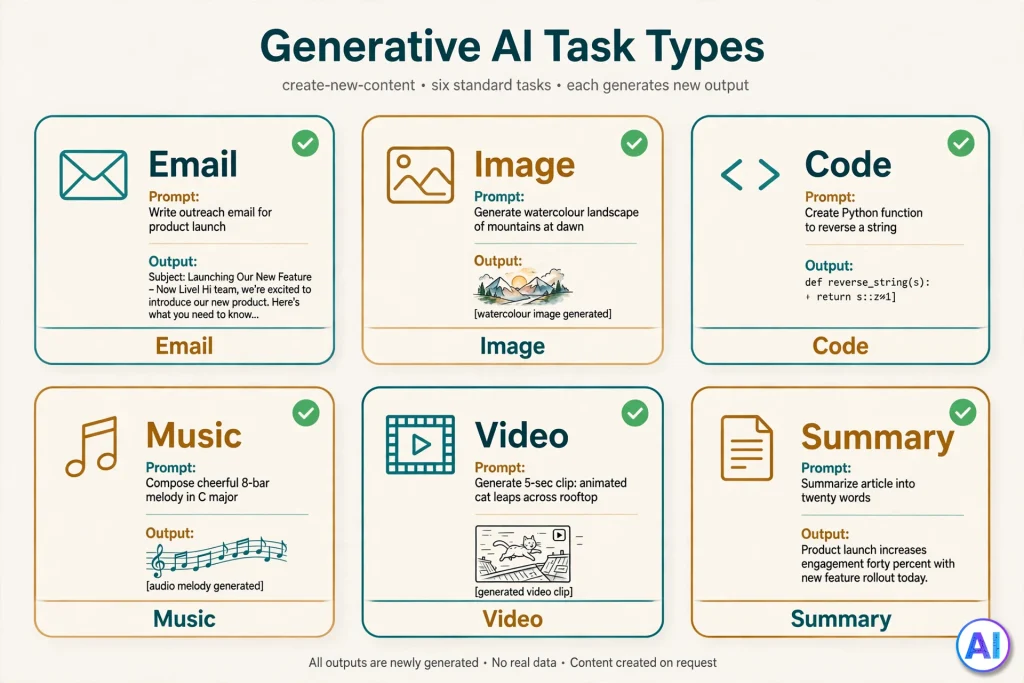
The table below gives a quick reference for which task is a generative AI task and which is not. Notice the qualifiers in the middle column, because they carry the nuance.
| Task | Generative AI Task? | Explanation |
|---|---|---|
| Writing a new email from a prompt | Yes | Creates new text |
| Generating an image from a description | Yes | Creates visual content |
| Writing computer code from instructions | Yes | Produces new code |
| Creating music from a prompt | Yes | Generates audio |
| Producing a video from a text description | Yes | Generates video content |
| Summarizing a report | Yes, when a model generates a new summary | Produces new text based on existing information |
| Classifying emails as spam or not spam | Usually no | Assigns a category |
| Predicting next month’s sales | Usually no | Estimates a future outcome |
| Detecting a face in an image | Usually no | Identifies an existing feature |
| Calculating a fixed mathematical total | No, by itself | Performs a deterministic calculation |
The words “usually” and “by itself” are deliberate. Whether a task is generative depends on the model and on how the task is designed. A generative model can be asked to classify or analyse, and a classic model can sit inside a larger pipeline that ends with generated text. The defining feature of a generative task remains the production of new content.
Generative AI Tasks by Field
The same test applies everywhere, but the examples look different in each field. Here is how the answer to which task is a generative AI task plays out across five common settings.
Generative AI tasks in education
A teacher can ask a model to draft practice questions, rewrite a passage at a gentler reading level, or propose three ways to explain fractions. A student can request feedback on a paragraph. Each of these produces new text. Grading a multiple-choice sheet against an answer key does not. In a school setting, asking which task is a generative AI task simply means asking which activity makes new material. Schools also set their own rules on AI assistance, so check them before using these tools for graded work.
Generative AI tasks in business and marketing
Drafting campaign copy, producing several subject-line variations, writing product descriptions and condensing a long customer-feedback file into a short brief are all generative. IBM notes that marketing teams can even generate personalised copy and visuals in real time. Google Cloud describes a combined approach: a predictive model identifies customer segments, and a generative model then writes content tailored to each segment. The segmenting is not generative. The writing is.
Generative AI tasks in software development
Google Cloud lists generating code, tests, API specifications and explanations as generative tasks across the development lifecycle. Our overview of ChatGPT Canvas shows a workspace built for drafting and revising both writing and code. A linter that flags style violations, by contrast, inspects code and returns findings, so it is not generative.
Generative AI tasks in design and creative work
Concept art, logo explorations, avatars, three-dimensional assets for games and special effects are generative. IBM mentions style transfer and image-to-image translation, and NVIDIA lists logos, avatars and three-dimensional models for video games. Choosing the best photograph from a shoot by ranking sharpness scores is not.
Generative AI tasks in healthcare and research
IBM points to synthetic medical images used to train and test imaging systems, and to generative models that propose molecular structures with desired properties for drug discovery. NVIDIA lists protein-sequence design for drug discovery and tasks such as scribing and medical coding. Context matters here: a system that generates a synthetic scan is performing a generative task, while a system that looks at a real scan and flags a suspicious region is performing detection. Neither replaces professional judgment.
Generative AI vs. Traditional AI: Key Differences
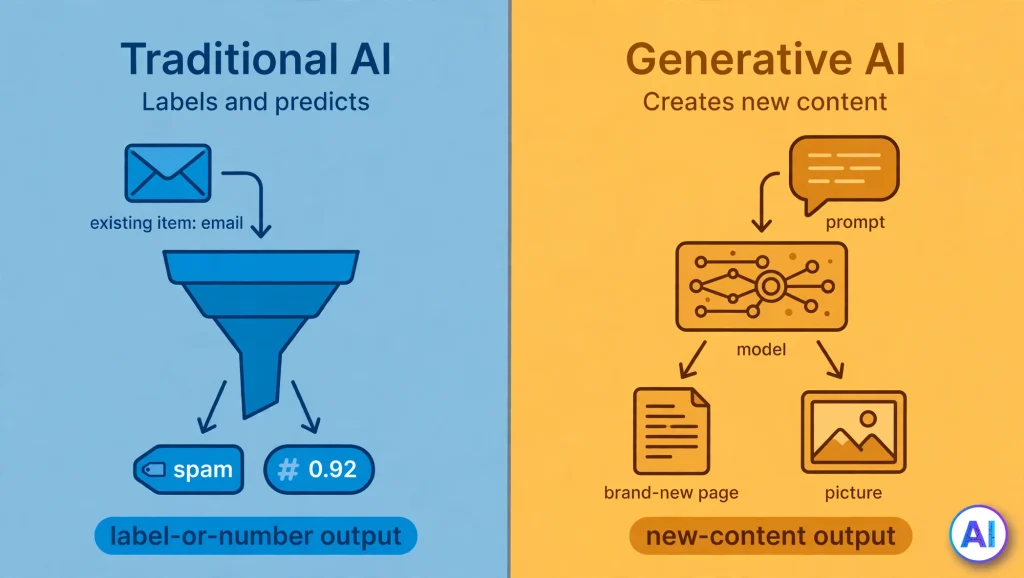
Google Cloud uses “traditional AI” for approaches such as classification and prediction that learn from existing data to sort information or forecast outcomes, and describes generative AI as extending those abilities to creating summaries or new content that reflects the style and patterns of its training data. The Australian National AI Centre adds a helpful reminder: unlike conventional software that follows fixed rules, any AI learns patterns from data.
| Feature | Traditional AI | Generative AI |
|---|---|---|
| Main purpose | Classify, detect or predict | Create new content |
| Typical output | A label, score, number or flag | Text, image, audio, video or code |
| Example | Marking a payment as suspicious | Writing a fraud-awareness leaflet |
| Same input, same output? | Usually yes | Not necessarily |
| How success is judged | Accuracy against known answers | Quality, usefulness and fit |
Which task is a generative AI task when both kinds of AI are involved? Break the workflow into steps and judge each one. A support system that tags incoming tickets and then drafts replies contains one classification step and one generative step. For the wider picture of why AI exists in the first place, see our guide to the purpose of AI.
Generative AI vs. Predictive AI
Predictive AI estimates what is likely to happen. Examples from Google Cloud include forecasting sales and demand, predicting house prices, and estimating how much revenue a customer might generate. Those results are numbers, and they are usually judged by how close they land to reality.
Generative AI composes. Given the same sales history, a generative model could write a readable commentary on the trend, but the forecast itself would still come from a predictive method. This is why “predicting next month’s sales” is usually not the answer when a question asks which task is a generative AI task.
The two work well in tandem. Google Cloud describes a pattern in which a predictive model estimates customer churn and a generative chatbot lets a sales team explore those estimates through conversation. The prediction is predictive. The conversation and any dashboard narration are generative.
Which Tasks Are NOT Generative AI Tasks?
Most non-generative tasks fall into a few families. When a quiz asks which task is a generative AI task, these are the typical distractors. Keep the list nearby while you practise which task is a generative AI task questions.
- Classification: assigning an existing item to a category, such as spam or not spam.
- Regression and forecasting: estimating a value, such as a house price or next quarter’s demand.
- Detection and recognition: finding something that is already present, such as a face, a defect or an unusual transaction.
- Clustering: grouping similar items, such as customers with similar buying habits.
- Ranking and retrieval: ordering or fetching existing items, such as search results.
- Deterministic calculation: following a fixed formula, such as adding up an invoice.
Classification, prediction, detection and recommendation examples
Here are concrete cases for each family. Flagging a loan application as high risk is classification. Estimating tomorrow’s electricity demand is prediction. Spotting a cracked bottle on a conveyor belt is detection; Google Cloud cites defect detection and spam filtering as standard traditional-AI uses. Suggesting the next video from a viewing history is recommendation.
Recommendation deserves one more sentence, because it can go either way. Ranking items that already exist is a classic task. Writing a brand-new personalised message for each viewer is generative. Read the question closely to see which of the two it describes.
Which Task Is a Generative AI Task in a Multiple-Choice Question? How to Identify It
Exam questions about which task is a generative AI task are usually solvable with a short routine.
A five-step method
- Read the stem for a verb of creation. Words such as write, draft, compose, generate, design or create are strong clues.
- Check what the output looks like. A paragraph, picture, tune or program points toward generative. A label, score or yes-or-no answer points away.
- Hunt for words that describe judging existing items. Classify, detect, predict, identify, rank, filter and measure usually signal a different kind of task.
- Watch for negation. If the stem says “NOT,” you are looking for the odd one out.
- Test “all of the above” honestly. Pick it only when every option passes the output test.
We have not assumed any particular answer is correct below without examining the options. Each question lists all four choices.
Practice questions
Question 1. Which task is a generative AI task? A. Flagging credit card transactions as suspicious B. Drafting a product description from a list of features C. Estimating next quarter’s revenue from past figures D. Sorting customers into groups by purchase history
Answer: B. The product description is new text. A is classification or anomaly detection, C is forecasting, and D is clustering.
Question 2. Which task is a generative AI task? A. Counting the faces in a photograph B. Sorting photographs by upload date C. Producing a new image of a lighthouse from a text description D. Checking whether two photographs are identical
Answer: C. Only the lighthouse image is created. The other options count, sort or compare existing files.
Question 3. Which of the following are generative AI tasks? A. Composing a short melody from a text prompt B. Writing a function from a plain-language description C. Generating a short video clip from a script D. All of the above
Answer: D. Here “all of the above” is right because options A, B and C each produce new audio, code or video.
Question 4. Which of the following is NOT a generative AI task? A. Writing a draft cover letter B. Labeling a customer review as positive or negative C. Creating a logo concept from a text brief D. Producing a synthetic voice-over
Answer: B. The output is a label. A language model may perform it, but the task remains classification.
Question 5. A model receives two years of weekly sales figures and outputs a number for next week. Which description fits best? A. Image synthesis B. Time-series forecasting, a predictive task C. Code generation D. Music generation
Answer: B. The output is an estimate of a future value, not newly created media.
Question 6. A support tool first tags each incoming ticket as billing, technical or other, and then writes a suggested reply. Which step answers the question of which task is a generative AI task? A. The tagging step B. The reply-writing step C. Both steps D. Neither step
Answer: B. Tagging assigns a category. Writing the reply creates new text.
Common Mistakes When Identifying Generative AI Tasks
Even careful readers trip over the same few errors when deciding which task is a generative AI task.
- Assuming every AI task is generative. Most deployed AI still classifies, detects or predicts.
- Equating the tool with the task. A chatbot can answer a fixed-answer lookup, and a language model can output a label. Judge the output.
- Dismissing summaries because the source already exists. The wording of the summary is new, so it is usually generative.
- Ignoring the word “NOT” in the stem. Many wrong answers come from reading too quickly.
- Defaulting to “all of the above.” Verify each option.
- Treating generated output as automatically accurate or original. Generative models can produce plausible falsehoods, and their output still needs checking.
Benefits and Limitations of Generative AI
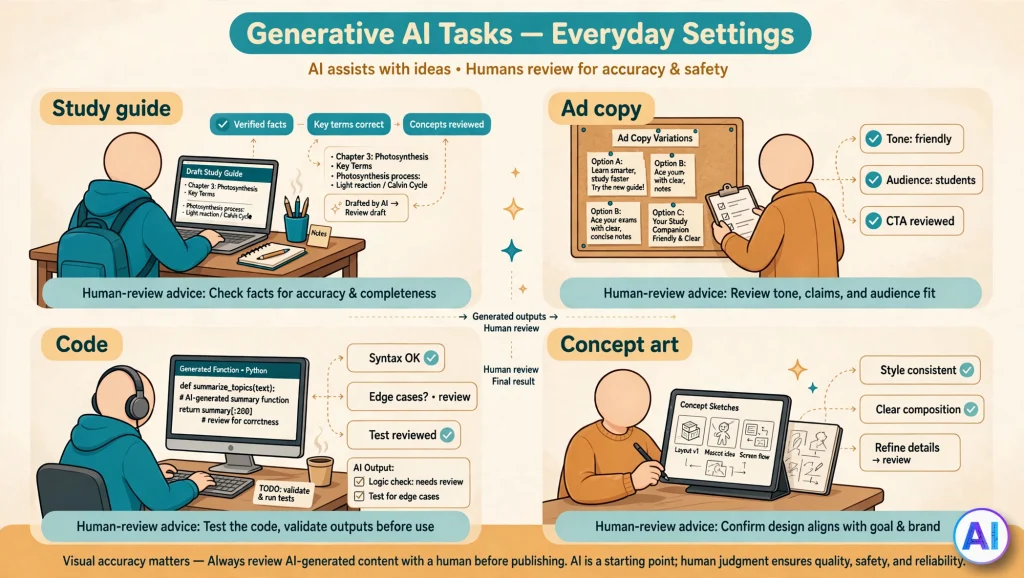
On the benefit side, IBM highlights efficiency, support for brainstorming and creativity, faster analysis, personalisation and round-the-clock availability. Our own advice is to measure each benefit on a real task rather than assume it.
The limitations are just as important when you weigh which task is a generative AI task worth automating:
- Hallucinations. IBM defines these as outputs that are inaccurate or nonsensical but look convincing, and cites a case in which a legal research tool produced fictional cases with quotes and attributions.
- Inconsistency. Because the models are probabilistic, the same prompt can produce different results.
- Bias. Models may absorb biases present in training or tuning data.
- Limited explainability. It can be hard to trace why a model produced a specific output.
- Cost and data needs. The GAO reports that training large models can take tens of thousands of processors running for months and may cost several hundred million dollars.
Responsible Use, Accuracy, Copyright and Privacy
A generative task is not automatically a good idea, so before you hand a job to a model, run four checks.
Accuracy. Can a competent person verify the output quickly? Treat facts, figures, citations and legal or medical statements as claims to check, never as established truth.
Copyright. The GAO notes that training data is commonly drawn from public internet information and can include copyrighted content. IBM advises users to be careful that prompts do not expose intellectual property and to monitor outputs for material that infringes someone else’s rights. Generated content should not be assumed copyright-free or unique, and that caution applies however clearly you answered which task is a generative AI task.
Privacy. Avoid pasting personal, confidential or regulated information into tools unless your organisation has approved them. Our explainer on whether ChatGPT is safe covers privacy and accuracy in plain language.
Misuse. IBM warns that generative tools can produce convincing phishing messages and deepfakes, and the GAO lists disinformation among the risks. Label synthetic media and avoid passing it off as real.
The Future of Generative AI Tasks
Three directions look likely, though none is guaranteed. First, multimodal systems that accept and produce several kinds of content are becoming more common, and NVIDIA describes models that can turn text into images or images into sound. Second, synthetic data is expanding as a way to train other systems when real data is scarce or restricted. Third, agentic AI, which the Australian National AI Centre describes as working toward goals and completing multi-step tasks with other software, will often use generated content as one ingredient in a longer workflow.
For quiz purposes this means more mixed tasks. The reliable response to which task is a generative AI task will remain the same: find the step where something new is created, and separate it from the steps that classify, predict, detect or calculate. Better prompts also lead to better results, so our guide to ChatGPT prompts is a practical next step.
Conclusion
So, which task is a generative AI task? The one that produces new content: written text, pictures, sound, video, code, documents or synthetic data. Tasks that sort, score, flag, forecast, detect, rank or calculate belong to other branches of AI, even when the same model family powers them. When a question or a project brief leaves you unsure, apply the output test, the variation test and the source test, read every answer option, and remember that generated content still needs human review. Used with that discipline, the question of which task is a generative AI task becomes easy to answer.
Frequently Asked Questions
Which task is a generative AI task?
A task is generative when the system creates new content, such as writing an email, producing an image, composing music, generating a video or drafting code. Tasks that only label, rank, predict or detect existing information are not.
What is an example of a generative AI task?
Asking an assistant to write a short speech about a school fundraiser is a clear example. The speech did not exist before the request, and many different speeches would be acceptable.
Is writing an email a generative AI task?
Yes, when a model composes the message from your prompt. Using a template that only fills in a name and date is not generative, because nothing is composed.
Is creating an image using AI generative AI?
Yes. Producing a new picture from a text description is one of the best-known generative tasks. Using AI only to recognise what appears in a photograph is not.
Is predicting sales a generative AI task?
Usually no. Forecasting estimates a future number from historical data, which Google Cloud classifies as a traditional predictive use case. A generative model could write a commentary about the forecast, but the forecast itself is predictive.
Is classifying data a generative AI task?
Typically no. Classification assigns a category such as spam or not spam. A generative model can be used to classify, but the task still produces a label rather than new content.
What is the difference between generative AI and traditional AI?
Traditional AI mainly classifies, detects or predicts from existing data. Generative AI creates new content, such as text, images, audio, video or code. Many real systems combine both.
Can generative AI create computer code?
Yes. It can generate functions, scripts, tests and documentation from plain-language instructions. Developers should still review, test and secure that code before use.
Can generative AI produce audio and video?
Yes. Generative models can produce synthetic speech, music and short video clips from prompts. Quality varies by tool, and synthetic media should be labelled clearly.
How can students identify generative AI tasks in exams?
Look for creation verbs and for outputs that are new text, images, sound, video or code. Treat verbs such as classify, detect, predict, rank and measure as warnings, and check every option before choosing “all of the above.” That habit is the quickest route to getting which task is a generative AI task right under exam pressure.
Sources and References
All five sources below were opened and read on November 2, 2026.
- Google Cloud, When to use generative AI or traditional AI. Used for the traditional versus generative split, classification and forecasting examples, code generation, and combined use cases.
- IBM, What is generative AI?. Used for the definition, training phases, model families, content types, benefits, hallucinations, intellectual property and deepfake concerns.
- U.S. Government Accountability Office, Artificial Intelligence: Generative AI Technologies and Their Commercial Applications (GAO-24-106946). Used for what distinguishes generative AI, human-feedback tuning, training costs, copyrighted training data and risks.
- Australian National AI Centre, Artificial intelligence explained. Used for the comparison of generative AI, machine learning, computer vision, natural language processing and agentic AI.
- NVIDIA, What is generative AI?. Used for diffusion, GAN, VAE and transformer descriptions, multimodal inputs and outputs, synthetic data, and data-licensing challenges.