
If you have ever wondered what is the purpose of AI, here is the short answer: artificial intelligence exists to let machines handle tasks that normally require human judgment, such as recognizing patterns, understanding language, predicting outcomes, and recommending or carrying out actions. The point is to help people work faster, decide with better information, and tackle problems that are too large or too tedious for unaided effort.
That single sentence hides a lot of variety. AI is not one gadget with one job. It is a family of techniques that turns up in a phone keyboard, a hospital scanner, a bank’s fraud alerts, and a drone that monitors crops. So the honest way to answer what is the purpose of AI is to look at the goals designers build into these systems, the work they actually do, and the limits that keep them from being a cure-all.
This guide is written for students, professionals, business owners, and curious readers who want a clear picture without jargon. It separates what AI does well today from what remains speculation, and it leans on official and academic sources rather than hype.
Table of Contents
What Is the Purpose of AI? A Beginner-Friendly Explanation
Strip away the marketing and what is the purpose of AI comes down to three jobs.
- Reduce effort. AI takes over repetitive, high-volume work, such as sorting thousands of emails or checking millions of card transactions for unusual activity.
- Improve judgment. By spotting patterns that people would overlook, AI gives doctors, engineers, teachers, and managers better information to decide with.
- Extend reach. A single person can translate a report into another language, analyze a satellite photo, or explore a dataset that would once have occupied a whole team for months.
Notice what is missing from that list. The purpose of AI is not to imitate people for its own sake, and it is not to remove people from important decisions. Every system is aimed at a goal that humans chose. When the goal is well chosen and oversight is sound, the result is useful. When the goal is poorly chosen, a system can be remarkably efficient at the wrong thing. That gap between capability and intention is why any serious answer to what is the purpose of AI has to talk about responsibility as well as power.
What Is Artificial Intelligence?
The OECD frames an AI system as a machine-based system that is given objectives, stated or implied, and works out from incoming data how to produce predictions, generated content, recommendations, or decisions that affect physical or digital environments. It also stresses that systems differ in how autonomous they are and how much they adapt after they are put to use (OECD AI Principles). IBM offers a plainer description: AI is technology that lets computers imitate human abilities such as learning, problem-solving, and decision-making (IBM).
Two ideas inside those definitions help beginners.
- “Works out from data” means the system infers its answers instead of following a hand-written rule for every situation. That is the main difference between AI and ordinary software.
- “Objectives” means every AI system is aimed at something. A spam filter aims to separate unwanted mail from wanted mail. A navigation app aims to estimate quick routes.
Once you know the objective, you understand what is the purpose of AI inside that specific product. The word “intelligence” can be misleading here. These systems calculate and predict very well within the boundaries they were trained for, but that is different from understanding the world the way a person does.
Why Was AI Created, and What Is the Purpose of AI Today?
The field has a traceable starting point. According to IBM’s historical timeline, the term “artificial intelligence” was coined by John McCarthy at Dartmouth College in 1956 (IBM). The researchers of that period shared a bold hunch: if learning and reasoning can be described precisely enough, a machine should be able to reproduce some of it.
Several motives pushed the early work forward, and they still apply.
- Curiosity about intelligence. Building a machine that learns is one way to test ideas about how learning works.
- Practical need. Organizations accumulate more records and calculations than people can process by hand.
- Human limits. People tire, get distracted, and cannot read a million documents overnight. Software can.
So the origin story contains two questions at once: a scientific one (can intelligence be modeled?) and an engineering one (can we build tools that finish jobs people cannot finish fast enough?). Today, the engineering question dominates. When people ask what is the purpose of AI in 2026, they usually mean the practical version: which useful work can this technology do reliably, and under what supervision?
What Are the Main Goals and Purposes of AI?
Engineers usually describe the goals of AI as a handful of working purposes. They overlap, and one product can serve several, but seven of them make the broad question of what is the purpose of AI easier to handle.
1. Perceiving the World
This is the first practical answer to what is the purpose of AI: giving machines senses.
Computer vision and speech recognition let machines turn pixels and sound waves into something usable: reading a handwritten address, detecting a crack in a bridge photo, or converting a voice message into text.
2. Learning From Data
Instead of being told every rule, a learning system adjusts itself using examples. This is the engine behind most modern AI.
3. Reasoning and Predicting
Forecasting demand for a product, estimating the chance that a payment is fraudulent, or ranking which support tickets are urgent are all prediction tasks.
4. Understanding and Producing Language
Translation tools, chat assistants, and summarizers aim to read and write human language well enough to be genuinely helpful.
5. Automating Routine Work
Filling in forms, routing calls, sorting images, and reconciling invoices are tasks where consistency matters more than creativity.
6. Augmenting Human Ability
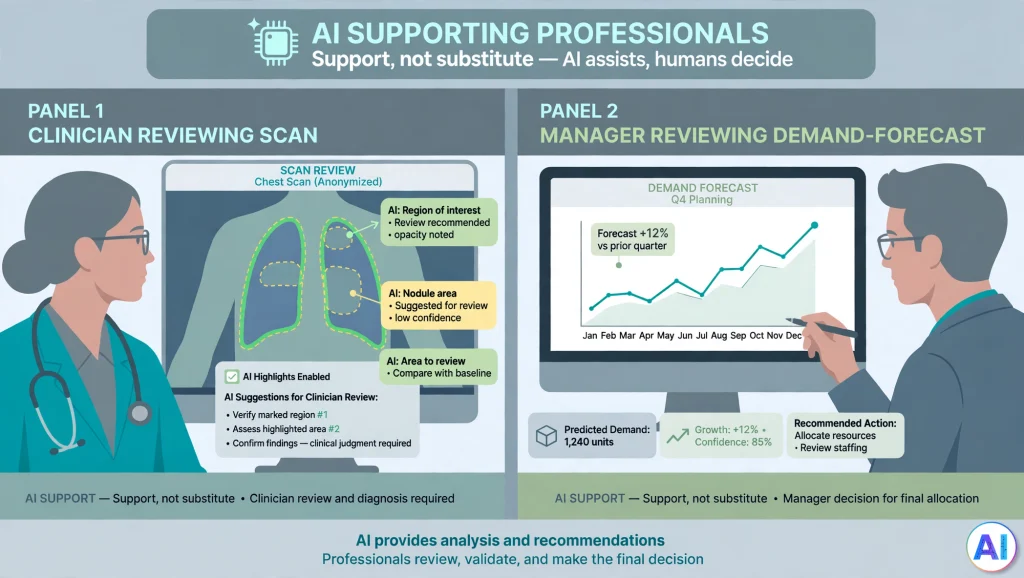
A radiologist who gets a second look at a scan, a lawyer who searches thousands of contracts in seconds, or a student who receives instant feedback is still the decision-maker. AI sharpens the person rather than replacing them.
7. Generating New Content
For many newcomers, this is where what is the purpose of AI feels most visible, because the output appears right on screen.
Generative systems draft text, images, audio, and code from a prompt. The purpose is to speed up first drafts and give people raw material to refine.
How Does AI Work?
You do not need advanced math to grasp the basic cycle.
- Collect data. Examples are gathered, such as labeled photos, past transactions, or large amounts of text.
- Choose a model. A model is a mathematical structure with adjustable settings.
- Train. The model makes guesses, measures how wrong it was, and nudges its settings to be less wrong. This repeats an enormous number of times.
- Test. The model is checked on examples it has never seen to learn whether it truly generalizes.
- Deploy and monitor. The finished model is placed into a product, and its performance is watched because real-world conditions drift.
Think of an apprentice electrician who studies thousands of fault reports. After enough of them, the apprentice can often guess the likely cause of a new fault from a few symptoms. The apprentice is not following a manual line by line; they have absorbed patterns. Machine learning works in a similar spirit, and deep learning, which uses many layered networks of simple calculating units, is the branch behind most recent progress in image and language tasks (IBM). To see how this plays out inside a popular chat assistant, our explainer on how ChatGPT works walks through it step by step.
The same analogy reveals a limit. The apprentice’s guess can be wrong, and a model’s answer can be confidently wrong too. Generative systems in particular can produce fluent statements that are simply false. Knowing how AI works is therefore part of understanding what is the purpose of AI: these tools support decisions, and the decisions still need checking.
How AI Helps Humans Solve Problems
Problem-solving is the clearest test of what is the purpose of AI in practice.
AI earns its place when a problem has one or more of these traits: it is huge, it is repetitive, it hides subtle patterns, or it must be handled quickly.
- Scale. A shipping company that plans delivery routes for thousands of vehicles cannot do it on paper.
- Speed. Fraud detection has to flag a suspicious payment while the customer is still at the checkout.
- Subtle patterns. A model may notice a faint combination of signals in machine vibration data long before a technician hears anything unusual.
- Accessibility. Live captions help people who are deaf or hard of hearing follow a conversation, and image-description tools help blind users understand what is on a screen.
In each case, the benefit comes from pairing machine speed with human purpose. That pairing is the most practical answer to what is the purpose of AI when someone asks how it helps people.
Everyday Uses of AI in Daily Life
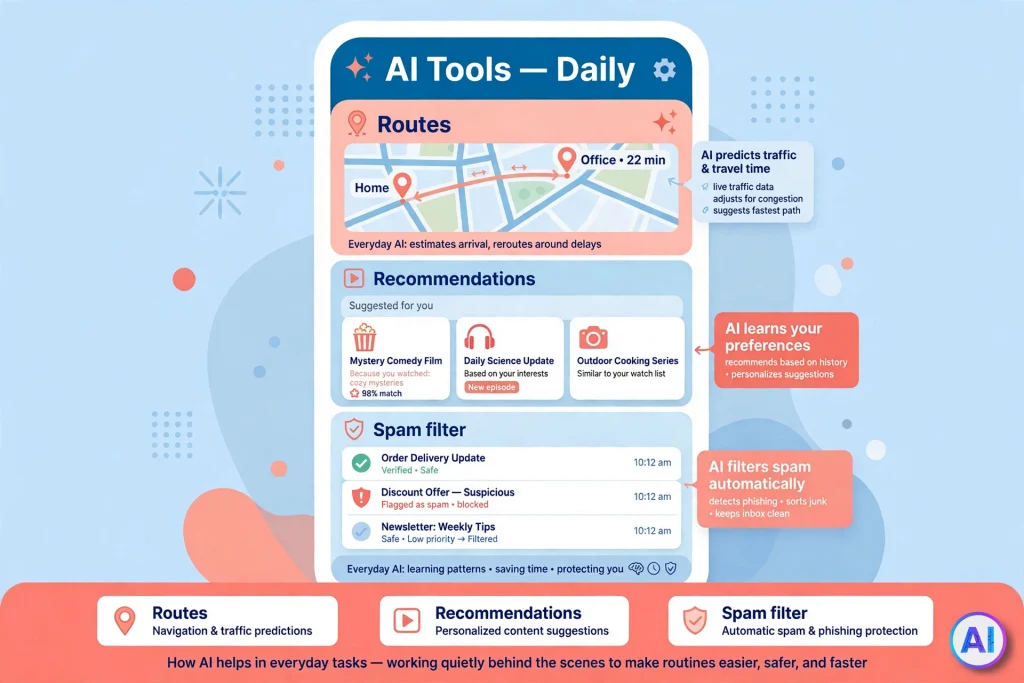
Most readers already use AI dozens of times a week without labeling it that way.
- Phones and keyboards: autocorrect, predictive text, face unlock, and voice dictation.
- Maps and travel: estimated arrival times that change as traffic conditions shift.
- Streaming and shopping: suggestions based on what you watched or bought before.
- Email: spam filtering and suggested replies.
- Banking: alerts when a transaction looks unlike your usual behavior.
- Photos: searching your gallery for “beach” or grouping pictures of the same person.
- Language: instant translation of a menu, sign, or message.
These conveniences share one feature: they turn a mountain of past data into a small, timely suggestion. They also raise questions about how much personal information such services collect, which is why privacy appears again later in this guide. If a chat assistant is part of your routine, our guide to ChatGPT prompts shows how to ask clearer questions and get more useful answers.
What Is the Purpose of AI in Education and Learning?
In classrooms and self-study, what is the purpose of AI? Mainly to personalize practice and lighten the load of routine tasks.
- Adaptive practice. A learner who struggles with fractions can receive more fraction exercises while a faster learner moves on.
- Instant feedback. Students can get comments on a draft paragraph or a coding exercise outside school hours.
- Language learning. Conversation partners that never get impatient help learners practice speaking.
- Teacher support. Drafting worksheets, organizing materials, and handling administrative paperwork frees teachers for the human work of mentoring.
- Accessibility. Text-to-speech, captioning, and translation open lessons to more learners.
The risks are real. Students may lean on AI answers instead of building their own understanding, and generated explanations can contain mistakes. The healthiest pattern is to treat AI as a tutor that must be questioned, not an answer machine that must be believed. UNESCO’s global standard on AI ethics, adopted by its member states in 2021, is built around human rights and human dignity, which is a useful reminder that learning technology should serve learners (UNESCO).
What Is the Purpose of AI in Healthcare?
Healthcare is one of the most closely watched areas, because the stakes are high and the potential is large.
- Imaging support. Software can highlight regions of a scan for a clinician to examine more closely.
- Triage and monitoring. Models can flag patients whose readings suggest they may need attention sooner.
- Documentation. Tools that draft visit notes can give clinicians more time with patients.
- Drug research. Machine learning helps scientists screen candidate molecules and sift through published studies.
Here the answer to what is the purpose of AI is deliberately modest: to assist trained professionals, not to stand in for them. Researchers at Stanford HAI have described spending several years building progressively harder and more realistic benchmarks to measure what medical AI can actually do, which underlines that performance claims in medicine need careful testing before anyone relies on them (Stanford HAI). If you have a health concern, a licensed clinician, not a chatbot, is the right authority.
How Businesses and Industries Use AI
Companies adopt AI for an unromantic reason: it can lower costs, shorten waits, and catch problems early.
| Industry | Typical use | Underlying goal |
|---|---|---|
| Retail | Demand forecasting, recommendations | Stock the right items, personalize offers |
| Banking and insurance | Fraud detection, document review | Reduce losses, speed up approvals |
| Manufacturing | Visual quality checks, predictive maintenance | Cut defects and unplanned downtime |
| Logistics | Route planning, warehouse scheduling | Deliver faster with fewer resources |
| Agriculture | Crop and soil monitoring | Use water and inputs more precisely |
| Customer service | Chat assistants, ticket sorting | Answer routine questions at any hour |
A business owner asking what is the purpose of AI for a small company should start from a single, specific pain point, such as slow replies to customers or inaccurate stock counts. Starting from the problem, instead of from the tool, is the most reliable way to avoid wasted money. For a closer look at one widely used option, read our overview of ChatGPT for business.
AI in Science, Research, and Innovation
Researchers use AI to find structure in data that is too large or too tangled to read by eye. Examples include predicting how a protein folds (DeepMind’s AlphaFold is the widely reported case), searching astronomical surveys for unusual objects, and building faster approximations of climate and materials simulations.
In science, what is the purpose of AI? It acts as a hypothesis generator and a screening tool. It narrows thousands of possibilities to a short list worth testing, but the experiment, the peer review, and the interpretation remain human work. A model’s prediction is a lead, not a proof.
How AI Improves Productivity and Automation
Two ideas are often mixed up. Automation means a system performs a task from start to finish with little human input, like sorting incoming parcels. Augmentation means a system helps a person do their task better, like suggesting a first draft of a report.
Most workplace gains today come from augmentation: summarizing long documents, drafting routine messages, suggesting code, or extracting figures from invoices. The time saved is real, but it is partly offset by the time needed to review the output. The Stanford AI Index has summarized the broader picture in measured terms, noting that AI outperforms people on some benchmarks but not on all of them (Stanford HAI AI Index). That balanced view should shape expectations when you estimate what is the purpose of AI in your own workflow. Working professionals can also see practical examples in our article on how professionals use ChatGPT.
Different Types of AI and Their Purposes: Another Angle on What Is the Purpose of AI
IBM separates AI into narrow (or weak) AI, built for specific tasks like voice assistants, and general (or strong) AI, a hypothetical system that could match human ability across many domains (IBM). Everything in daily use today is narrow AI, however impressive it looks. Another helpful way to sort systems is by what they do.
| Type | Main purpose | Example | Status |
|---|---|---|---|
| Narrow AI | Excel at one defined task | Spam filter, route planner | Widely used |
| Predictive AI | Forecast an outcome from past data | Fraud scoring, demand forecast | Widely used |
| Perceptual AI | Interpret images and sound | Face unlock, speech-to-text | Widely used |
| Generative AI | Produce text, images, audio, or code | Writing and design assistants | Widely used, accuracy varies |
| Robotic AI | Sense and act in the physical world | Warehouse robots | Growing, mostly specialized |
| General AI | Match human ability broadly | None exists | Hypothetical |
Seeing the table, you can tell that what is the purpose of AI depends on the type: a predictive model forecasts, a generative model drafts, a perceptual model interprets. No single purpose covers them all.
Benefits and Advantages of Artificial Intelligence in Answering What Is the Purpose of AI
When used carefully, AI offers clear advantages.
- Speed and scale on tasks that would overwhelm a human team.
- Consistency, because software does not get tired at the end of a shift.
- Round-the-clock availability for routine questions.
- Discovery of patterns in data that people would not spot.
- Accessibility features such as captions, translation, and voice control.
- Personalization of learning, services, and recommendations.
- Safer work when robots or software handle hazardous inspections.
These benefits explain why interest keeps growing, and they are the strongest practical reason behind most answers to what is the purpose of AI.
Limitations, Risks, and Challenges of AI
Any honest discussion of what is the purpose of AI must include what the technology cannot do.
A fair guide must give the downsides equal attention.
- Errors and invented details. Generative tools can state falsehoods fluently.
- Bias. Systems trained on skewed data can treat groups of people unfairly.
- Privacy. Many services rely on personal data, and careless handling can expose it.
- Opacity. It is often hard to explain exactly why a model reached a given answer.
- Security and misuse. The same tools that help honest users can also help scammers.
- Environmental cost. Training and running large models consumes energy. Stanford HAI’s coverage of its 2026 AI Index highlights environmental costs and transparency among the urgent questions raised by the field’s rapid progress (Stanford HAI).
- Accountability. When AI contributes to harm, deciding who is responsible is, in the words of Stanford HAI, one of the hardest unsolved problems in AI policy (Stanford HAI).
- Over-reliance. People may trust output they should have double-checked.
None of this means AI should be avoided. It means the answer to what is the purpose of AI must always come with a list of safeguards.
Can AI Replace Human Intelligence or Jobs?
It helps to separate tasks from jobs. AI can take over specific tasks, and when enough tasks in a role are automated, that role changes. That is not the same as AI replacing human intelligence. Current systems lack lived experience, common-sense grounding, personal accountability, and the ability to care about the people affected by their output.
What the evidence supports today is change, not a single outcome. Stanford’s Digital Economy Lab has built dashboards that track how AI adoption is shifting employment trends and job growth, precisely because the effects are still being measured (Stanford HAI). The OECD’s recommendations for policymakers include building human capacity and preparing for labor market transitions, which signals that governments expect disruption and want to manage it (OECD AI Principles).
For an individual, a practical stance is to ask which parts of your work are routine, which depend on judgment and relationships, and how AI could take the first group so you can spend more time on the second. In that sense, what is the purpose of AI for workers is to shift effort, not necessarily to end careers, though some roles will certainly be reshaped.
Responsible AI, Ethics, Privacy, and Human Oversight
Good intentions are not enough, so international bodies have written down shared expectations.
- UNESCO adopted its Recommendation on the Ethics of Artificial Intelligence in November 2021 as the first global standard on the subject, agreed by all 193 member states. It rests on human rights, human dignity, and environmental sustainability (UNESCO).
- The OECD adopted its AI Principles in 2019 and updated them in May 2024. Its values-based principles cover inclusive growth and well-being, human rights and democratic values including fairness and privacy, transparency and explainability, robustness and safety, and accountability. Forty-seven adherents have committed to them (OECD AI Principles).
You can apply the same thinking at a personal level.
- Protect private data. Avoid pasting passwords, medical records, or confidential client details into public tools. Our breakdown of whether ChatGPT is safe covers privacy habits in more depth.
- Verify important claims. Check figures, quotations, and citations against original sources.
- Keep a human in charge. For hiring, lending, health, and legal matters, a qualified person should review and own the decision.
- Ask how it was built. Prefer tools that explain their limits and data practices.
Responsibility is not an add-on to the topic. It is part of the definition of what is the purpose of AI when the goal is lasting benefit rather than quick gains.
What Is the Future Purpose of AI?
Predictions are uncertain, and anyone who sounds completely sure deserves some skepticism. Still, several directions are plausible based on current trends.
- More capable assistants that handle multi-step tasks, such as gathering information, drafting, and scheduling, under human supervision.
- Deeper personalization in education and health guidance.
- Faster research cycles as AI helps screen ideas before costly experiments.
- Stricter oversight as governments and organizations apply frameworks like the OECD Principles and UNESCO’s Recommendation.
Whether AI ever reaches general human-level ability is an open question, and it should be treated as speculation, not as a scheduled event. What is the purpose of AI going forward? It will be whatever people, companies, and regulators decide to aim it at. The technology is a tool whose direction depends on its builders and its users.

Practical Real-World Examples of AI
Examples make what is the purpose of AI easier to grasp than definitions do.
Here are concrete situations that show the idea in motion, with the purpose behind each.
- A spam filter learns what junk mail looks like so your inbox stays usable. Purpose: filtering at scale.
- A maps app blends live traffic with past patterns to suggest a route. Purpose: prediction for faster decisions.
- A bank’s fraud system flags a payment from an unusual location. Purpose: protecting customers in real time.
- A clinic’s imaging tool marks a suspicious region for the radiologist. Purpose: a second look, not a verdict.
- A factory camera spots a surface defect on a part. Purpose: consistent inspection.
- A language-learning app adjusts exercises to your mistakes. Purpose: personalization.
- A live-captioning feature turns speech into text during a video call. Purpose: accessibility.
- A farm sensor system estimates which field section needs water. Purpose: precise resource use.
Every example links back to one theme: a narrow, well-defined job performed under human direction. That is the most grounded way to explain what is the purpose of AI to a newcomer.
Final Conclusion
So, what is the purpose of AI? At its core, it is to extend human capability by taking on tasks of scale, speed, and pattern-finding that people cannot easily manage alone. In daily life it saves small amounts of time many times a day. In classrooms it personalizes practice. In hospitals it offers a second look. In business it forecasts and flags. In science it narrows the search for answers.
Equally important, the purpose of AI is bounded by human choices. These systems make mistakes, reflect the data they were trained on, and need oversight. The best results come from treating AI as a capable assistant that must be directed, checked, and held to ethical standards. If you remember one thing from this guide, let it be that what is the purpose of AI is ultimately a question about human goals, and the answer improves when people keep their hands on the wheel.
Frequently Asked Questions About What Is the Purpose of AI
What is the main purpose of AI?
The main purpose of AI is to let machines perform tasks that normally need human intelligence, such as learning from data, recognizing patterns, understanding language, and supporting decisions. The practical aim is to help people save time, reduce errors, and handle problems at a scale they could not manage alone.
Why do humans use artificial intelligence?
People use AI because it can process far more information than a person can, work quickly, and stay consistent on repetitive tasks. It also opens up new abilities, such as instant translation or scanning huge document collections, that were impractical before.
How does AI help people?
AI helps by automating routine chores, offering recommendations, spotting patterns in data, and making services more accessible through captions, voice control, and translation. In professional settings it assists doctors, teachers, engineers, and analysts rather than replacing their judgment.
What are the five main uses of AI?
Five common uses are: language tasks such as translation and chat assistants; image and speech recognition; prediction and forecasting, such as fraud detection; automation of repetitive work; and content generation, including drafting text and images.
Can AI make decisions?
AI can make decisions within rules and goals that people set, such as approving a low-risk transaction or choosing a delivery route. For high-stakes matters involving health, law, or livelihood, responsible practice keeps a human reviewer accountable for the final decision.
Does AI improve productivity?
It often does for tasks like drafting, summarizing, sorting, and searching, but gains vary. Time saved on a first draft can be partly spent reviewing the output for mistakes, so the real benefit depends on the task and on how carefully the tool is used.
Can AI replace human workers?
AI can automate certain tasks, and some roles will change as a result. Replacing a whole human worker is a bigger step, because many jobs rely on judgment, relationships, accountability, and physical presence. Researchers are still tracking how adoption affects employment.
What are the disadvantages of AI?
Main drawbacks include errors and made-up details, bias from skewed training data, privacy risks, limited transparency, potential misuse, energy use, and the temptation to over-trust the output. These are manageable with oversight, but they cannot be ignored.
Is AI important for the future?
Asking what is the purpose of AI also means asking where it is heading. AI is widely expected to remain influential in education, healthcare, science, and business, and governments are already writing rules for it. How beneficial it becomes depends on responsible design, honest testing, and thoughtful use by ordinary people and organizations.
Sources and References
- IBM. What Is Artificial Intelligence (AI)?: definitions, narrow versus general AI, machine learning and deep learning, and the 1956 Dartmouth origin of the term.
- OECD.AI. OECD AI Principles overview: definition of an AI system, five values-based principles, policy recommendations, 2019 adoption and May 2024 update, and the number of adherents.
- UNESCO. Artificial intelligence: the 2021 Recommendation on the Ethics of Artificial Intelligence, adopted by 193 member states.
- Stanford HAI. Inside the AI Index: 12 Takeaways from the 2026 Report.
- Stanford HAI. The 2024 AI Index Report.
- Stanford HAI. Measuring What Medical AI Can Actually Do.
- Stanford HAI. Who Is Responsible When AI Causes Harm?
- Stanford HAI. Tracking AI’s Real-Time Footprint on the Labor Market