
Last checked against OpenAI sources on October 31, 2026.
The ChatGPT-5 Release Date is August 7, 2025. That is the day OpenAI officially introduced GPT-5 and started rolling it out inside ChatGPT. The story did not stop there. Access reached different plans at different speeds, the original models have since vanished from the ChatGPT model picker, and a long chain of GPT-5-series and GPT-6 releases now sits on top of them. This guide separates the announcement, the rollout, and the retirement, so you can use the right date for the right question.
Table of Contents
What Is the ChatGPT-5 Release Date?
The short answer: OpenAI published “Introducing GPT-5” on August 7, 2025, and the rollout began the same day. “ChatGPT-5” is the popular nickname for GPT-5 as it appeared inside ChatGPT. OpenAI itself uses the name GPT-5, so you will see both in this guide.
| Question | Verified answer |
|---|---|
| Official GPT-5 introduction | August 7, 2025 |
| First ChatGPT rollout | Began August 7, 2025 for Free, Plus, Pro and Team users |
| Enterprise and Edu access | The following week, according to OpenAI |
| Original GPT-5 Instant and Thinking leave ChatGPT | February 13, 2026 |
| Extended access for GPT-5 Pro and Enterprise ends | February 19, 2026 |
| Original GPT-5 API models, scheduled shutdown | December 11, 2026 |
Everything else in this article hangs off those six rows. If a page tells you the ChatGPT-5 Release Date is “expected” or “rumored,” it was written before August 2025 and has not been updated.
When Did OpenAI Officially Release GPT-5?
OpenAI’s launch post is dated August 7, 2025, and it announced that GPT-5 was starting to roll out that day. A livestream accompanied the post, so the announcement and the ChatGPT-5 Release Date share one calendar day. CNBC’s same-day report described the launch as a Thursday release open to everyone, including free users, which matches the calendar: August 7, 2025 fell on a Thursday.
Was GPT-5 Released on August 7, 2025?
Yes, with one qualification. August 7 is the official release and rollout start, not the moment every person saw GPT-5 in their app. OpenAI’s own wording was that the model was beginning to roll out, and its release notes later described a slow rollout across web, mobile and desktop. So the honest phrasing is: the ChatGPT-5 Release Date is August 7, 2025, and availability spread outward from there.
ChatGPT-5 Release Date vs Rollout Date: Three Dates People Confuse
Three different things hide inside the phrase “release date”:
- Announcement. OpenAI revealed GPT-5 and published its capabilities on August 7, 2025. For GPT-5, announcement and release start landed on the same day, which is not always true of AI products.
- Rollout. Users received the model gradually. Free-tier users were told that the full reasoning behavior could take a few days to arrive, and Enterprise and Edu workspaces were scheduled for the week after launch.
- Stable availability. The launch-day experience was rough enough that OpenAI changed course within a day and again within a week (details below), so the setup most people eventually used was not the one shown on August 7.
A practical rule: when someone asks for the ChatGPT-5 Release Date, answer August 7, 2025. When someone asks when they personally got GPT-5, the answer depends on their plan and account. I could not verify an exact calendar date for the Enterprise and Edu start, so treat “the following week” as OpenAI’s stated target rather than a confirmed day.
ChatGPT-5 Release Date Timeline: Launch, Rollout and Retirement
The table below keeps one line per verified event. Dates that come only from secondary reporting are marked as such.
| Date | Event | Explanation |
|---|---|---|
| Aug 7, 2025 | Official introduction and rollout start | GPT-5 became the default for signed-in users on Free, Plus, Pro and Team; Pro users also received GPT-5 Pro |
| Aug 8, 2025 | First course correction | Sam Altman said GPT-4o would return for Plus users, Plus limits would double, and the auto-switching problem was being fixed |
| Week of Aug 11, 2025 | Enterprise and Edu access (planned) | OpenAI said the week after launch; exact day not confirmed in the sources I could open |
| Aug 12, 2025 | Auto, Fast and Thinking modes | TechCrunch reported a picker with three GPT-5 modes and a way for paid users to restore older models |
| Nov 12, 2025 | GPT-5.1 begins rolling out | Paid plans first; OpenAI kept GPT-5 under a legacy menu for three months |
| Nov 19, 2025 | GPT-5.1 Pro replaces GPT-5 Pro | Noted in ChatGPT release notes |
| Dec 11, 2025 | GPT-5.2 released | Date from secondary reporting |
| Jan 29, 2026 | Retirement notice | OpenAI announced the February 13 removal of older ChatGPT models |
| Feb 13, 2026 | GPT-5 Instant and Thinking retired from ChatGPT | Alongside GPT-4o, GPT-4.1, GPT-4.1 mini and o4-mini |
| Feb 19, 2026 | Extended access ends | GPT-5 Pro (paid users) and Enterprise workspaces |
| Jun 11, 2026 | API deprecation notice | Original gpt-5 family scheduled to shut down December 11, 2026 |
| Jul 9, 2026 | GPT-5.6 Sol arrives in ChatGPT | Paid plans only at first |
| Oct 7–8, 2026 | GPT-6 reaches ChatGPT chat | Paid plans on October 7; Free and Go on October 8 |
| Oct 14, 2026 | GPT-5.5 retired from ChatGPT | API access unaffected |
| Dec 11, 2026 | Scheduled API shutdown | Original gpt-5, gpt-5-mini, gpt-5-nano and gpt-5-pro |
How GPT-5 Was Introduced in ChatGPT at the ChatGPT-5 Release Date
OpenAI framed GPT-5 as one system rather than one model. Behind the chat box sat a fast, efficient model for ordinary questions, a deeper reasoning model called GPT-5 Thinking for harder problems, and a real-time router deciding which to use. The router weighed the type of conversation, its difficulty, whether tools were needed, and explicit cues such as asking the model to think hard. OpenAI said it would keep training the router on signals like users switching models and how often people preferred each answer.
When a person hit their usage limit, a smaller “mini” version of each model took over. OpenAI also said it planned to fold these pieces into a single model later. If the idea of a router sounds abstract, our plain-English explainer on how ChatGPT works covers the underlying mechanics.
For signed-in users, GPT-5 became the default and replaced GPT-4o, o3, o4-mini, GPT-4.1 and GPT-4.5 as the everyday choice. That replacement is a large part of why the ChatGPT-5 Release Date felt like a turning point instead of a routine upgrade.
What Were the Main Features Announced at the ChatGPT-5 Release Date?
Everything below describes the August 2025 launch. Treat the numbers as OpenAI’s own evaluations on that day, not independent verification and not a description of today’s models.
Reasoning and Mathematics
OpenAI reported 94.6% on the AIME 2025 math competition benchmark without tools. It also claimed that GPT-5 with thinking matched or beat o3 while producing 50% to 80% fewer output tokens across several task types, which is a claim about efficiency, not only accuracy.
Coding
OpenAI called GPT-5 its strongest coding model to that point, with particular gains in building front ends and debugging large repositories. Reported scores were 74.9% on SWE-bench Verified (a fixed set of 477 validated tasks) and 88% on Aider Polyglot. Those two tests measure different skills, so do not read them as one number.
Writing and Everyday Assistance
The launch post highlighted better handling of structurally tricky writing, such as sustained verse forms, and more dependable help with reports, emails and memos. OpenAI also said GPT-5 was less flattering and used fewer unnecessary emojis. In a targeted test, sycophantic replies fell from 14.5% to under 6%. Four preset personalities (Cynic, Robot, Listener and Nerd) arrived as an opt-in research preview.
Visual Understanding
On the MMMU multimodal benchmark, OpenAI reported 84.2%. In everyday terms, that meant reading charts, summarizing a photographed slide, or answering questions about a diagram.
Health Questions
OpenAI reported 46.2% on HealthBench Hard and positioned GPT-5 as a better partner for understanding results and preparing questions for clinicians. The company stated plainly that ChatGPT does not replace a medical professional.
Reliability and Safety
With web search on, OpenAI measured GPT-5 answers as roughly 45% less likely than GPT-4o to contain a factual error, and thinking-mode answers as about 80% less likely than o3 to do so. Reported deception in reasoning responses dropped from 4.8% (o3) to 2.1%. GPT-5 also introduced “safe completions,” a training approach that aims for the most helpful answer within safety limits instead of a flat yes-or-no refusal. OpenAI treated GPT-5 Thinking as high capability in biology and chemistry and applied extra safeguards.
What Was Not in the Original Launch
Several things people now associate with GPT-5 arrived later: the Auto, Fast and Thinking picker (August 12, 2025), the expanded eight-option personality menu with GPT-5.1 (November 2025), and everything tied to ChatGPT Work and Codex. Keep those separate from the ChatGPT-5 Release Date itself.
Original GPT-5 Model Versions Explained
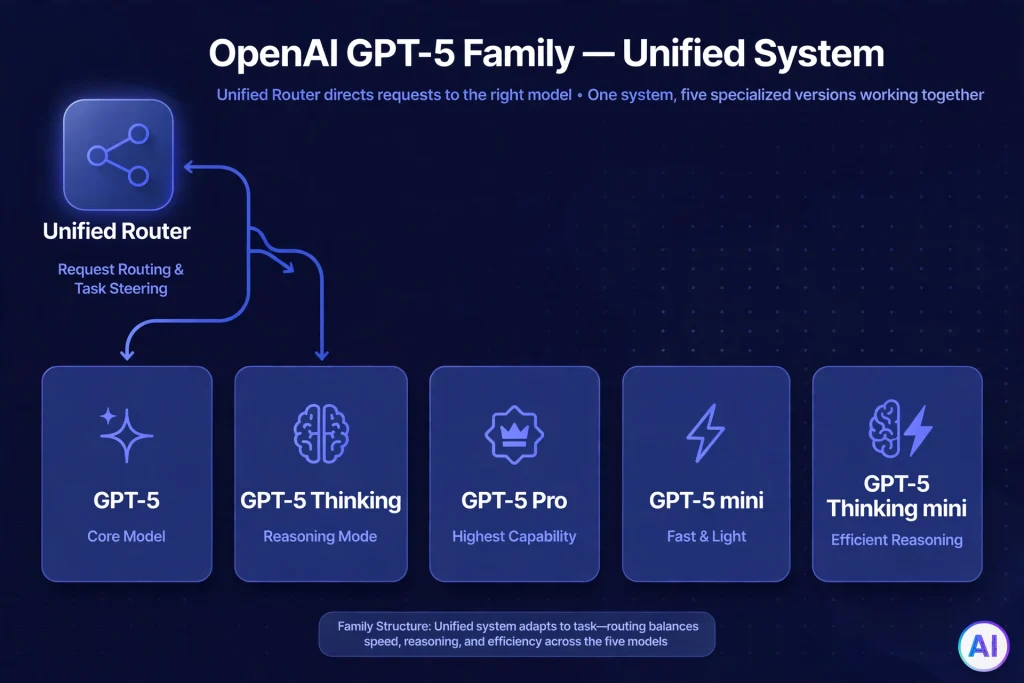
“GPT-5” was a family, and its members did not all share a date or an audience. That matters when someone quotes the ChatGPT-5 Release Date as if it applied to every version.
| Version | Role | Notes |
|---|---|---|
| GPT-5 (fast model) | Default answers for most questions | Became the default on August 7, 2025; later labelled GPT-5 Instant in OpenAI’s retirement notices |
| GPT-5 Thinking | Deeper reasoning for hard problems | Selectable by paid users; triggered by the router or by asking it to think harder |
| GPT-5 Pro | Extended reasoning with parallel compute | Pro subscribers; replaced o3-pro; superseded by GPT-5.1 Pro on November 19, 2025 |
| GPT-5 mini | Fallback after usage limits | Took over for free users who reached their cap |
| GPT-5 Thinking mini | Smaller reasoning fallback | Surfaced for paid users through the “show additional models” toggle |
In the API the pattern differs. OpenAI’s deprecation table lists gpt-5, gpt-5-mini and gpt-5-nano with snapshot names dated 2025-08-07, while gpt-5-pro carries a 2025-10-06 snapshot. That gap is a reminder not to assume a single date for every version, and it is one more reason the ChatGPT-5 Release Date should always be qualified with “in ChatGPT.” For a feature-by-feature walkthrough of the model itself, see our complete ChatGPT-5 guide.
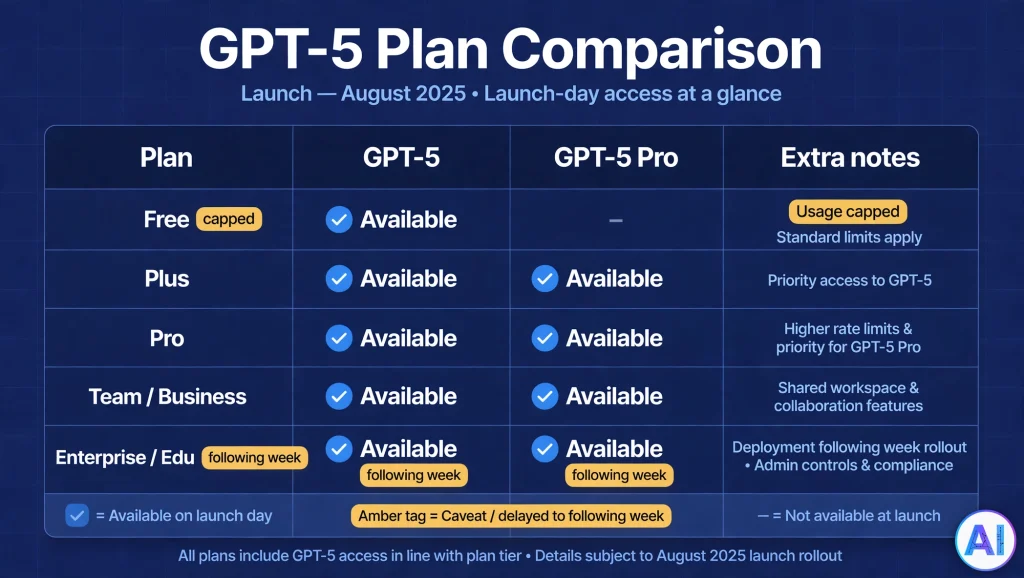
Who Could Access GPT-5 at the ChatGPT-5 Release Date?
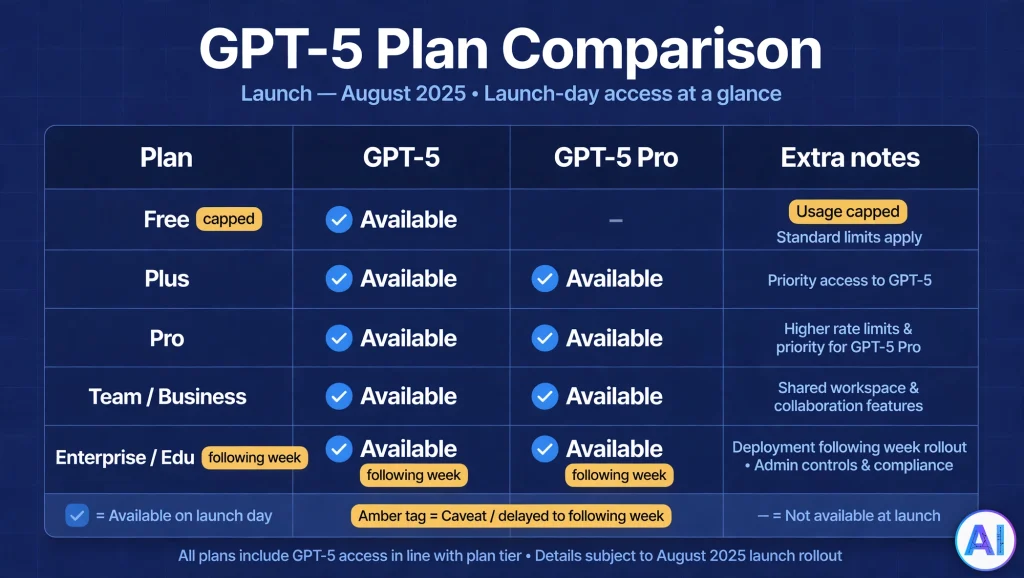
| Plan at launch | Access to GPT-5 | Extras |
|---|---|---|
| Free | Yes, with a usage cap | Dropped to GPT-5 mini after the cap; full reasoning could take days to appear |
| Plus | Yes, with higher usage than Free | Model picker for GPT-5 and GPT-5 Thinking |
| Pro | Unlimited GPT-5 | GPT-5 Pro access |
| Team (now Business) | Yes | Same picker as other paid tiers |
| Enterprise and Edu | The following week | Staggered start |
Was GPT-5 Available for Free Users?
Yes. CNBC described it as the first time free users could reach a reasoning model in ChatGPT. The catch was volume: OpenAI said the difference between free and paid access was mostly how much you could use, and free accounts moved to GPT-5 mini once they hit the limit. That detail matters when comparing the ChatGPT-5 Release Date experience across plans, because two people on launch day could see noticeably different behavior.
Plans themselves have changed since then. Team became Business, a Go tier now exists, and Pro is split into several price levels, all covered in our guide to ChatGPT subscriptions.
GPT-5 vs GPT-4o: What Changed?
GPT-4o had been ChatGPT’s default and favorite for over a year, so the swap was the most visible change on the ChatGPT-5 Release Date.
| Area | GPT-4o | GPT-5 at launch |
|---|---|---|
| Design | One multimodal model; separate reasoning models | Router plus fast and thinking models |
| Factual errors | Baseline | About 45% fewer, with search, in OpenAI’s test |
| Tone | Warmer, more agreeable | Cooler and less flattering at first; OpenAI later promised a warmer personality |
| Coding | Capable | Described by OpenAI as its strongest at the time |
| Fate in ChatGPT | Removed on launch day, restored for paid users August 8, 2025, retired February 13, 2026 | Retired February 13, 2026 |
The tone gap explains the backlash, which arrived within a week of the ChatGPT-5 Release Date. Many people preferred the older personality, which is why OpenAI brought GPT-4o back within a day. When OpenAI announced the final retirement on January 29, 2026, it said only 0.1% of users were still choosing GPT-4o daily.
What Happened After the ChatGPT-5 Release Date?
The first week was bumpy. On August 8, 2025, Altman acknowledged problems with the auto-switching router and the sudden removal of older models, promising doubled Plus limits and the return of GPT-4o. By August 12, the picker offered Auto, Fast and Thinking, and paid users could re-enable additional legacy models.
Then the numbers kept climbing. Three months after the ChatGPT-5 Release Date, GPT-5.1 arrived on November 12, 2025 with a warmer default tone, and GPT-5.1 Pro replaced GPT-5 Pro a week later. GPT-5.2 followed on December 11, 2025. Further point releases (5.4, 5.5 and 5.6) arrived through 2026, and OpenAI’s GPT-6 reached ChatGPT in October. Each release pushed the original GPT-5 further from the center of the product, even though the family name stayed.
When Were the Original GPT-5 Models Retired?
Retirement dates answer a different question from the ChatGPT-5 Release Date, so keep the two apart.
Retirement From ChatGPT
OpenAI had said, when GPT-5.1 launched, that GPT-5 models would stay in the legacy menu for three months. On January 29, 2026, it confirmed that GPT-5 Instant and Thinking would be retired on February 13, 2026, alongside GPT-4o, GPT-4.1, GPT-4.1 mini and o4-mini. The help center states that conversations and GPTs on retired models were moved to the closest current equivalents.
Not everything left on the same day:
- GPT-5 Pro stayed available to paid users through February 19, 2026.
- Enterprise workspaces kept GPT-5 access through the same date.
- GPT-5 Thinking mini was handled separately. A March 18, 2026 note said it would stop being selectable in 30 days. OpenAI gave a window rather than a calendar date, so I cannot give you an exact day.
Retirement From the API
The API runs on a different clock. OpenAI notified developers on June 11, 2026 that gpt-5, gpt-5-mini, gpt-5-nano and gpt-5-pro will be removed on December 11, 2026, with replacements named as gpt-5.6-sol, gpt-5.6-terra and gpt-5.6-luna. As of October 31, 2026, that leaves 41 days. In other words, the ChatGPT-5 Release Date and the end of ChatGPT access are separated by about six months, while end of API access is more than sixteen months out from launch.
Is GPT-5 Still Available in ChatGPT?
No. The original GPT-5 Instant and Thinking models are not selectable in ChatGPT, and OpenAI’s help center lists them among the models retired on February 13, 2026. If an old article tells you to pick “GPT-5” from the picker, it describes a menu that no longer exists. Anything that still says GPT-5 on your screen today is most likely a later GPT-5-series model or a conversation label, so check the exact name before assuming. A lot has been rebuilt in the picker since the ChatGPT-5 Release Date.
GPT-5 vs Later GPT-5-Series Models and Successors
Do not mix the ChatGPT-5 Release Date with the dates below. They are separate models with their own timelines.
| Model | Release | Where it stands |
|---|---|---|
| GPT-5.1 | Nov 12, 2025 | Retired from ChatGPT March 11, 2026; API shutdown listed for April 1, 2027 |
| GPT-5.2 | Dec 11, 2025 (secondary source) | Retired from ChatGPT June 12, 2026 |
| GPT-5.4 | Mar 5, 2026 (secondary source) | Removed from Codex with ChatGPT sign-in on August 31, 2026 |
| GPT-5.5 | Apr 23, 2026 (secondary source) | Retired from ChatGPT, ChatGPT Work and Codex October 14, 2026; API unaffected |
| GPT-5.6 | In ChatGPT July 9, 2026 | Replaced as the chat default by GPT-6; one third-party guide reports it is still selectable on paid plans |
| GPT-6 | In ChatGPT Oct 7–8, 2026 | GPT-6 Sol on paid plans, GPT-6 Luna on Free and Go |
A useful mental model: the numbers after the decimal point are refreshes of the GPT-5 line, not the original. Anyone writing about the ChatGPT-5 Release Date should name August 7, 2025 and only then mention these follow-ups.
How to Check Current ChatGPT Model Availability
Model menus change often, and they differ by plan, region and workspace settings. Whenever you read a claim built on the ChatGPT-5 Release Date, run this routine:
- Open the model picker in ChatGPT and look for a legacy models section. A March 2026 release note describes legacy access and thinking-effort controls living in the picker.
- Read the ChatGPT release notes in the OpenAI Help Center for the newest rollout and retirement entries.
- Check the model release notes page, which lists retirements such as the October 14, 2026 GPT-5.5 change.
- For developers, read the API deprecations page and query the models endpoint for the shutdown date field, which is null when none is announced.
- Ask a workspace admin if you are on Business, Enterprise or Edu, since admins can control which models appear.
OpenAI’s pages sometimes block automated readers, so confirm anything time-sensitive in your own browser before publishing or building on it.
Why the ChatGPT-5 Release Date Still Matters
A date that is more than a year old can still be useful, for three reasons.
First, accuracy. Benchmark claims, safety statements and price comparisons are only meaningful relative to when they were made, and the ChatGPT-5 Release Date anchors every GPT-5 launch-era number in this guide.
Second, migration. Developers who built on gpt-5 now have a hard shutdown date to plan around, and the original release date explains why their older prompts behave differently from newer models.
Third, search hygiene. Plenty of older pages still describe GPT-5 as upcoming. Knowing the real ChatGPT-5 Release Date helps you spot those stale pages quickly. For the product’s own origin story, see our explainer on when ChatGPT was released.
Frequently Asked Questions
What is the ChatGPT-5 Release Date?
The ChatGPT-5 Release Date is August 7, 2025, when OpenAI introduced GPT-5 and began rolling it out in ChatGPT.
Did GPT-5 launch on August 7, 2025?
Yes. OpenAI’s announcement and the start of the rollout both fall on that date, though not every user received it immediately.
When did GPT-5 become available in ChatGPT?
The ChatGPT-5 Release Date started the rollout: August 7, 2025 for Free, Plus, Pro and Team users, with Enterprise and Edu planned for the following week.
Was GPT-5 available to free users?
Yes. On the ChatGPT-5 Release Date, free users received GPT-5 with a usage cap, then moved to GPT-5 mini after reaching it.
What were the original GPT-5 versions?
Counting from the ChatGPT-5 Release Date, the lineup was GPT-5, GPT-5 Thinking, GPT-5 Pro, GPT-5 mini and GPT-5 Thinking mini, offered to different plans in different ways.
What was the difference between GPT-5 and GPT-5 Thinking?
GPT-5 handled most requests quickly, while GPT-5 Thinking spent more effort reasoning on hard problems. The router chose between them, and paid users could choose manually.
Is the original GPT-5 still available in ChatGPT?
No. GPT-5 Instant and Thinking were retired from ChatGPT on February 13, 2026.
Is GPT-5 API availability different from ChatGPT availability?
Yes. The API models remain callable until their scheduled December 11, 2026 shutdown, so the ChatGPT-5 Release Date and ChatGPT retirement do not describe API access.
What models came after the original GPT-5?
After the ChatGPT-5 Release Date came GPT-5.1, GPT-5.2, GPT-5.4, GPT-5.5 and GPT-5.6, followed by GPT-6 in ChatGPT in October 2026.
Conclusion
The ChatGPT-5 Release Date is August 7, 2025, and that single answer is accurate as long as you keep three things straight: it marks the announcement and rollout start, not instant universal access; the original GPT-5 models were retired from ChatGPT on February 13, 2026; and the API follows a separate schedule ending December 11, 2026. Everything newer, from GPT-5.1 through GPT-6, is a different release with its own date. Before you rely on any model name, check the live picker and OpenAI’s release notes, because this landscape moves faster than any single article can.
Sources and References
- OpenAI, “Introducing GPT-5,” August 7, 2025: https://openai.com/index/introducing-gpt-5/
- OpenAI, “Retiring GPT-4o, GPT-4.1, GPT-4.1 mini, and OpenAI o4-mini in ChatGPT,” January 29, 2026: https://openai.com/index/retiring-gpt-4o-and-older-models/
- OpenAI Help Center, “Retiring GPT-4o and other ChatGPT models” (read via search excerpt): https://help.openai.com/en/articles/20001051-retiring-gpt-4o-and-other-chatgpt-models
- OpenAI Help Center, “ChatGPT release notes” (read via search excerpt): https://help.openai.com/en/articles/6825453-chatgpt-release-notes
- OpenAI Help Center, “Model release notes” (read via search excerpt): https://help.openai.com/en/articles/9624314-model-release-notes
- OpenAI Developers, “Deprecations”: https://developers.openai.com/api/docs/deprecations
- OpenAI, “GPT-6 and Intelligent UI for everyone,” October 7, 2026 (read via search excerpt): https://openai.com/index/gpt-6-for-everyone/
- CNBC, “OpenAI launches new GPT-5 model for all ChatGPT users,” August 7, 2025: https://www.cnbc.com/2025/08/07/openai-launches-gpt-5-model-for-all-chatgpt-users.html
- VentureBeat, “OpenAI returns old models to ChatGPT as Sam Altman admits ‘bumpy’ GPT-5 rollout,” August 8, 2025: https://venturebeat.com/ai/openai-returns-old-models-to-chatgpt-as-sam-altman-admits-bumpy-gpt-5-rollout
- TechCrunch, “ChatGPT’s model picker is back, and it’s complicated,” August 12, 2025: https://techcrunch.com/2025/08/12/chatgpts-model-picker-is-back-and-its-complicated/
- Wikipedia, “GPT-5.2” (release date, secondary): https://en.wikipedia.org/wiki/GPT-5.2
- Wikipedia, “GPT-5.4” (release date, secondary): https://en.wikipedia.org/wiki/GPT-5.4
- Wikipedia, “GPT-5.5” (release date, secondary): https://en.wikipedia.org/wiki/GPT-5.5
- ChatGPT docs, “Models” (Codex model retirements): https://learn.chatgpt.com/docs/models
- Simon Willison, “The surprise deprecation of GPT-4o for ChatGPT consumers,” August 8, 2025 (picker toggle for additional models): https://simonwillison.net/2025/Aug/8/surprise-deprecation-of-gpt-4o/
- AI Toolbox, “ChatGPT Models Explained” (third-party report on current picker contents): https://www.ai-toolbox.co/chatgpt-models/chatgpt-models-explained-complete-comparison-2026