
Last checked against official sources on October 23, 2026. Ownership numbers change with every funding round, so the date matters.
Introduction: Who Owns ChatGPT?
Who owns ChatGPT? The short answer is OpenAI. ChatGPT is a product that OpenAI builds, runs, and sells access to, and the company behind it today is OpenAI Group PBC, a for-profit public benefit corporation. That company is controlled by a nonprofit called the OpenAI Foundation, which is where the story gets interesting.
If you were expecting a single name, a famous founder or a giant tech company, the real answer may surprise you. No individual owns ChatGPT. Sam Altman is the CEO, but he has said he holds no equity in OpenAI. Microsoft owns a large minority stake in OpenAI Group PBC, but it does not own ChatGPT, and it does not choose OpenAI’s board.
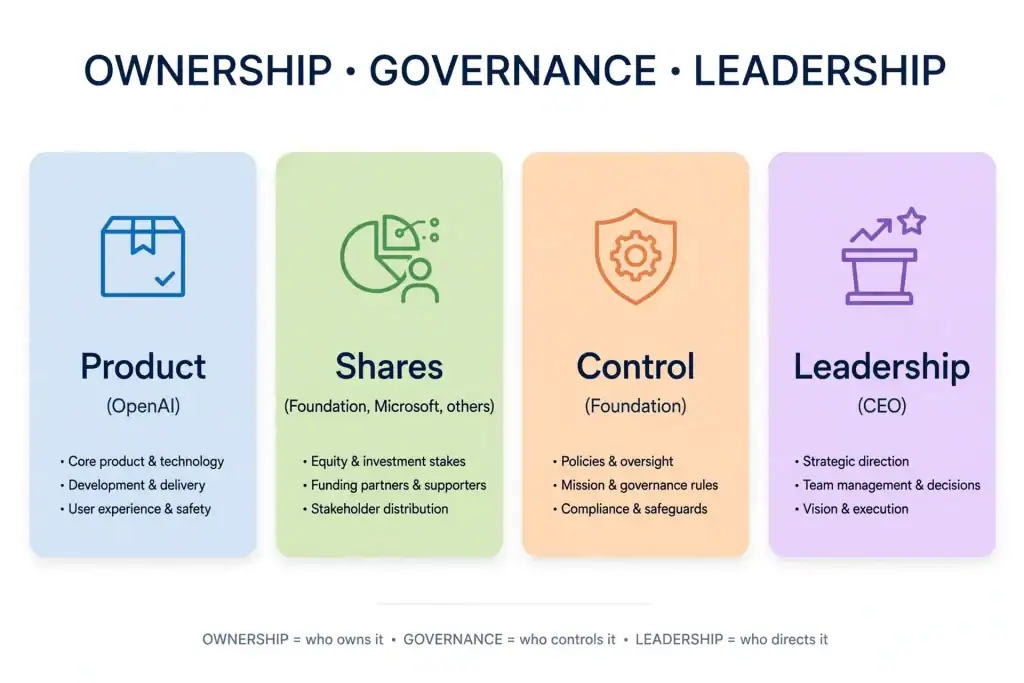
This guide to who owns ChatGPT walks through the whole picture in plain English. It explains what ChatGPT actually is, how OpenAI is organized, what Microsoft really holds, what Sam Altman does, who the other investors are, and whether you can buy shares. Along the way it keeps four ideas separate, because most of the confusion comes from mixing them up: owning a product, owning shares, controlling a company, and running it day to day.
Quick answer: OpenAI owns ChatGPT. OpenAI Group PBC is the for-profit company that runs it, and the nonprofit OpenAI Foundation controls that company. Microsoft holds a large minority stake (about 25% as of its June 2026 annual report) but does not control OpenAI. Sam Altman is the CEO and has said he owns no equity. OpenAI is still a private company, so you cannot buy its shares on a stock exchange.
Table of Contents
What Is ChatGPT?
ChatGPT is an AI chatbot. You type a question, a task, or a half-finished idea, and it replies with text, code, summaries, or analysis. Millions of people use it for everything from homework help to writing emails, and that popularity is exactly why so many people ask who owns ChatGPT in the first place.
It helps to be clear about one thing from the start: ChatGPT is a product, not a company. It does not have its own board, its own shareholders, or its own stock. It is a service offered by OpenAI, in the same way that a particular app or website is offered by the company that built it. (If you are also wondering whether a piece of writing came from it, see our ChatGPT detector guide.)
OpenAI was founded in December 2015 and created ChatGPT. When you sign up in the United States, OpenAI’s Terms of Use say your agreement is with OpenAI OpCo, LLC, a Delaware company. That detail matters when you ask who owns ChatGPT, because it shows how a modern tech company is built: a product, a contracting entity, a parent structure, and shareholders, all connected but not identical.
Who Owns ChatGPT?
OpenAI owns ChatGPT. Its terms say that OpenAI and its affiliates hold all rights, title, and interest in the services, and ChatGPT is one of those services. If a lawyer, a journalist, or a curious reader asks who owns ChatGPT as a product, that is the answer you can point to.
The trouble is that most people asking who owns ChatGPT are really asking a bigger question: who owns OpenAI, and who gets to make its decisions? That is a separate question with a longer answer. The product belongs to the company. The company has shareholders. A nonprofit controls it. Those are three different relationships, and each one has a different set of people attached to it.
Think of it like a restaurant chain. The menu items belong to the chain. The chain has investors who own pieces of it. And a separate group might hold the power to appoint the chain’s directors. Nobody would say the person who runs the kitchen owns the restaurant, and the same logic applies to Sam Altman and ChatGPT.
Who Owns OpenAI?
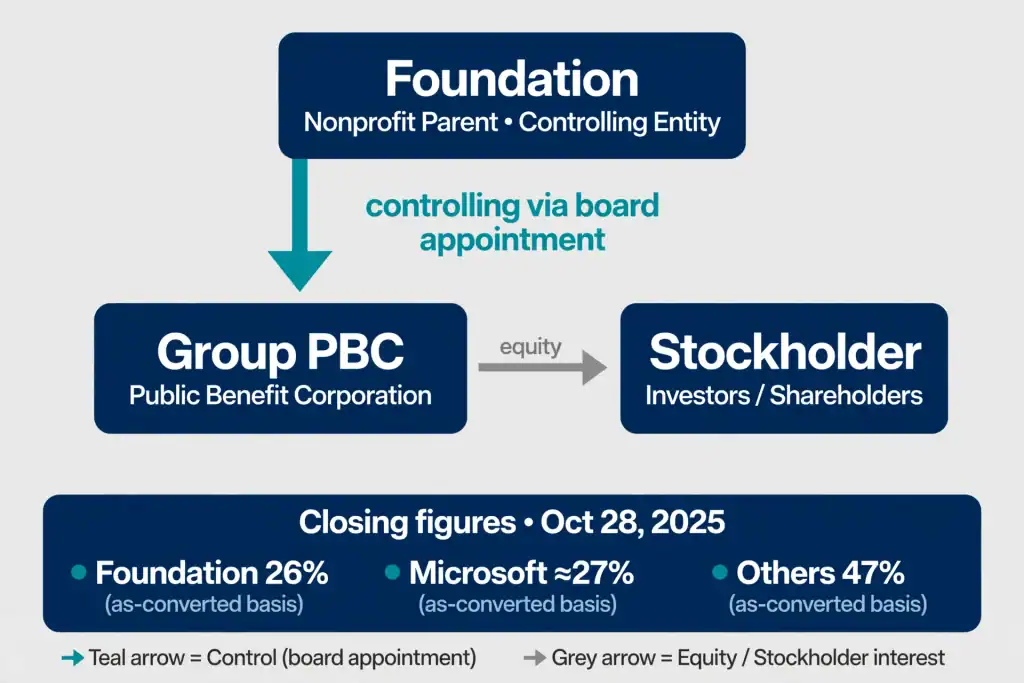
On October 28, 2025, OpenAI finished a restructuring that left it with two connected parts:
- OpenAI Foundation: the nonprofit. It controls the for-profit business.
- OpenAI Group PBC: the for-profit company that runs the business and the ChatGPT product.
According to OpenAI’s structure page, the Foundation held a 26% equity stake in OpenAI Group at closing, valued at about $130 billion. It also appoints every member of the Group’s board and can replace directors at any time. CNBC reported that current and former employees and other investors held about 47%, and Microsoft held roughly 27% on an as-converted, diluted basis.
Those three numbers add up to roughly the whole company, which makes them useful for understanding who owns OpenAI at that moment. But keep in mind that they are closing-day figures. OpenAI has raised more money since then, and every new round shrinks the percentage held by existing owners. We could not find a newer official figure for the Foundation, so read 26% as an October 2025 snapshot, not a live number.
Does Microsoft Own ChatGPT?
No. Microsoft is a major shareholder and partner, but it is not the owner of ChatGPT. This is probably the most common mistake in conversations about who owns ChatGPT, and it is easy to see why. Microsoft has invested billions of dollars, uses OpenAI’s models in its own products, and hosts much of OpenAI’s computing.
When the restructuring closed, Microsoft said its stake was worth about $135 billion, roughly 27% as-converted and diluted. In its annual report for the year ended June 30, 2026, Microsoft described its OpenAI investment as about 25% on an as-converted basis, which reflects later dilution. The two numbers are not a contradiction. They describe different dates, and the second one reflects new investors joining.
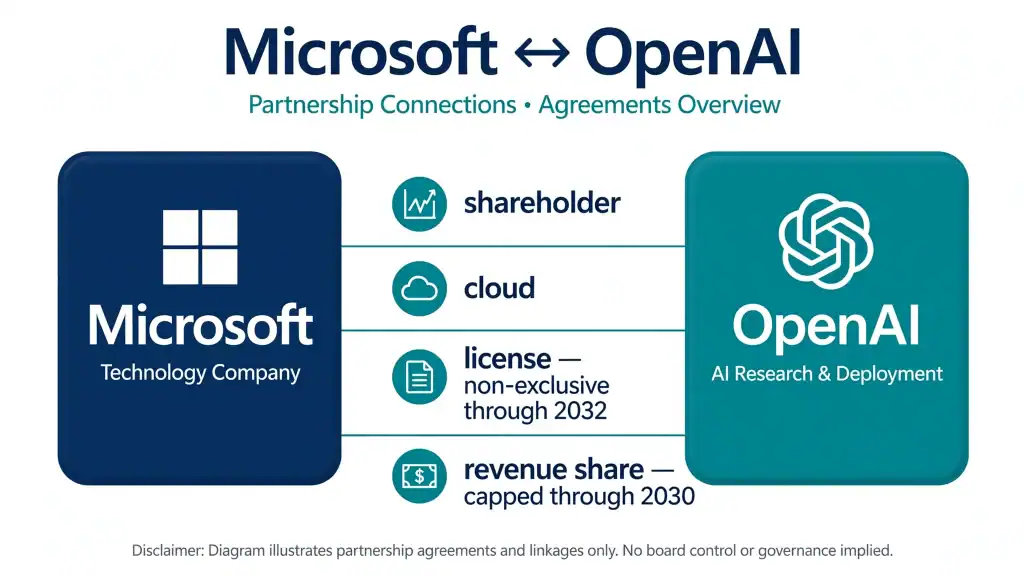
Four different roles often get blurred together here:
- Shareholder: Microsoft owns part of OpenAI Group PBC.
- Cloud provider: OpenAI buys computing power from Microsoft’s Azure, and the 2025 deal included a commitment to buy a large amount more.
- Technology partner: Microsoft licenses OpenAI’s models for its own products.
- Controller: Not Microsoft. The Foundation appoints the board.
The relationship changed again in 2026. In an April 27, 2026 amendment, Microsoft’s license to OpenAI’s models and products still runs through 2032, but it is now non-exclusive. Microsoft stopped paying a revenue share to OpenAI, while OpenAI’s capped payments to Microsoft continue through 2030. In plain terms, the partnership is looser than it used to be, and it was never a takeover in the first place.
What Is Sam Altman’s Role at OpenAI?
Sam Altman is OpenAI’s CEO and a co-founder. He also sits on the OpenAI Foundation’s board, which Bret Taylor chairs, according to OpenAI’s structure page. Because his face and name are so closely tied to the company, many readers assume he must be the answer when they ask who owns ChatGPT.
He is not. Altman’s job is leadership and governance, not ownership. He has said he owns no equity in OpenAI, and Fortune reported the same in August 2026. He invests in other companies, but those are not stakes in ChatGPT.
Here is a simple way to remember the difference. A CEO runs the business. A board governs it. A shareholder owns a piece of it. One person can be the CEO without being a shareholder, and that is exactly how it works at OpenAI today.
How Is OpenAI’s Nonprofit Structure Different From a Traditional Company?
In most companies, whoever owns the most shares controls the board. OpenAI deliberately splits those two things apart, and that split is the key to understanding who owns ChatGPT and who controls it.
The Foundation owns a minority of the shares, but it alone holds special voting and governance rights. Those rights let it choose the for-profit’s directors, and it can replace them whenever it wants. So the Foundation’s power comes from control rights, not from a majority stake. A shareholder with a bigger percentage, such as Microsoft at the time of the restructuring, does not get to override that.
The for-profit is also a public benefit corporation, which means it has the same mission as the Foundation, and commercial success and mission are meant to move together. OpenAI said the changes came after nearly a year of talks with the California and Delaware attorneys general. It also said the Foundation’s stake can grow if the company hits a valuation milestone, so even that number is not fixed.
The practical point is simple: investors can profit from OpenAI’s growth without gaining the power to steer its mission. Whether that design works in the long run is a fair debate, but it is the design behind who owns ChatGPT today.
| Concept | What it means | Who holds it at OpenAI |
|---|---|---|
| Product ownership | Who owns the ChatGPT service and brand | OpenAI |
| Share ownership | Who holds equity in OpenAI Group PBC | Foundation, Microsoft, employees, investors |
| Governance | Who appoints and replaces the board | OpenAI Foundation |
| Leadership | Who runs daily operations | CEO Sam Altman and management |
| Partnership | Commercial agreements | Microsoft, Amazon, and others |
How OpenAI’s Ownership Structure Changed Over Time
A lot of outdated articles still describe OpenAI as a “capped-profit” company or as a pure nonprofit. Both descriptions were true at some point, which is why the history matters. Here is a short timeline of how we got to the current answer on who owns ChatGPT:
| Date | What happened |
|---|---|
| December 2015 | OpenAI is founded as a nonprofit |
| 2019 | A for-profit arm is created under the nonprofit’s control |
| November 2023 | The board removes Sam Altman as CEO, then reinstates him days later |
| October 28, 2025 | Recapitalization: OpenAI Foundation and OpenAI Group PBC |
| March 31, 2026 | A $122 billion funding round closes at an $852 billion valuation |
| April 27, 2026 | Microsoft and OpenAI amend their partnership |
| June 8, 2026 | OpenAI announces a confidential IPO filing |
The 2023 episode is worth a sentence because it showed how governance works in practice. The board that removed Altman then reversed course after intense pressure from employees and partners, and the board itself was reshaped. That is one reason the 2025 restructuring put so much emphasis on formal governance rights for the Foundation.
Why the Question of Who Owns ChatGPT Matters
It is fair to ask why anyone should care who owns ChatGPT, as long as the chatbot works. There are a few practical reasons.
First, accountability. Whoever controls OpenAI sets the rules for ChatGPT, including its terms of use and usage policies. Knowing that the Foundation appoints the board, and that a CEO runs operations, tells you where decisions actually come from when you ask who owns ChatGPT and who answers for it.
Second, trust and conflict-of-interest questions. When a company is partly owned by large technology firms and also controlled by a mission-driven nonprofit, readers reasonably want to know which interest wins when they conflict. The structure is designed to give the Foundation the final say, and that is worth knowing even if you want to watch how it plays out.
Third, money. If OpenAI eventually goes public, shareholders and employees could see large changes in the value of their stakes, and the ownership picture would become more visible through public filings. Anyone following who owns ChatGPT today should expect the answer to become more detailed, and more precise, if that happens.
Common Myths About Who Owns ChatGPT
The setup is unusual, so a few myths about who owns ChatGPT keep spreading online:
- “Microsoft owns ChatGPT.” Microsoft is a large minority shareholder and a licensee. The Foundation, not Microsoft, appoints the board.
- “Sam Altman owns ChatGPT.” He is the CEO and says he holds no equity. Leading a company is not owning it.
- “A nonprofit means no shareholders.” The Foundation controls the business, but OpenAI Group PBC is a for-profit company with stockholders, and the Foundation is one of them.
- “ChatGPT is its own public company.” It is a product with no stock.
If you remember one thing about who owns ChatGPT, make it this: the answer depends on whether you mean the product, the shares, or the control. Most myths come from treating those three as one.
Who Are OpenAI’s Other Investors and Shareholders?
Beyond Microsoft and the Foundation, ownership is spread across employees, former employees, and outside investors. OpenAI has not published a full shareholder list with percentages, so be skeptical of any site that claims to have one. Anyone telling you exactly who owns ChatGPT down to the last percentage point is guessing.
What we can point to are funding announcements. On March 31, 2026, OpenAI closed a $122 billion round at an $852 billion valuation. TechCrunch reported that SoftBank co-led it with Andreessen Horowitz, D.E. Shaw Ventures, MGX, TPG, and T. Rowe Price, with Amazon, Nvidia, and Microsoft taking part. Bloomberg’s reporting, carried by Yahoo Finance, put Amazon at $50 billion and Nvidia and SoftBank at $30 billion each. Treat those as reported amounts, not confirmed ones, and remember they are money invested, not ownership percentages.
Ownership details can change whenever a company raises capital, issues new shares, or lets employees sell. That is why anyone researching who owns ChatGPT should note the date at the top of this article, and recheck the official sources before relying on any single number.
Is ChatGPT a Publicly Traded Company?
No. ChatGPT is a product, so it has no stock, which means there is no ticker to look up when you ask who owns ChatGPT shares. OpenAI Group PBC is also still private. On June 8, 2026, OpenAI said it had confidentially submitted a draft S-1 to the SEC. It also said it had not decided on timing and might stay private for a while.
A confidential filing is not a listing. As of this article’s date, we found no public ticker for OpenAI. Buying Microsoft stock gives you a share of Microsoft, which holds part of OpenAI. That is not the same as owning ChatGPT or OpenAI shares, and anyone selling you “ChatGPT stock” today deserves a second look.
Who Owns ChatGPT’s Technology and Intellectual Property?
Three layers are easy to confuse when people ask who owns ChatGPT’s technology:
- The service: OpenAI and its affiliates own the ChatGPT service under the terms.
- The company: OpenAI Group PBC, owned by its shareholders and controlled by the Foundation.
- Your output: Under OpenAI’s terms, as between you and OpenAI and as far as the law allows, you own the output you receive. The terms add that outputs may not be unique, so another user could get something similar.
On the question of who owns ChatGPT’s technology, Microsoft’s license to OpenAI’s models and products is a license, not ownership. It lets Microsoft use the technology in its own products through 2032, but it does not transfer the technology or the ChatGPT brand. This section describes OpenAI’s terms and is not legal advice. Copyright rules for AI-generated work differ by country and are still evolving, so anyone publishing AI-assisted work commercially should check the current terms and, where it matters, ask a lawyer.
Frequently Asked Questions
Who owns ChatGPT?
OpenAI owns and operates ChatGPT. The company behind it is OpenAI Group PBC, controlled by the nonprofit OpenAI Foundation.
Does Microsoft own ChatGPT?
No. Microsoft holds a minority stake in OpenAI Group PBC (about 25% as-converted in its fiscal 2026 annual report) and has licensing and cloud deals, but OpenAI owns ChatGPT.
Does Sam Altman own ChatGPT?
No. He is CEO and a Foundation board member, and he has said he holds no OpenAI equity.
Who owns OpenAI?
The Foundation, Microsoft, employees and former employees, and other investors. At the October 2025 closing, the split was about 26% Foundation, 27% Microsoft, and 47% others.
Is OpenAI a nonprofit or a for-profit company?
Both, in a connected structure. The nonprofit Foundation controls the for-profit OpenAI Group PBC, which runs the business.
Who controls OpenAI?
The OpenAI Foundation. It appoints the Group PBC board and can replace directors.
Who owns OpenAI’s shares?
OpenAI has not published a full list. Confirmed holders include the Foundation and Microsoft, plus employees and investors from funding rounds.
Who created ChatGPT?
OpenAI. The company was founded in 2015 by a group that included Sam Altman, Elon Musk, Greg Brockman, and Ilya Sutskever.
Can you buy shares in ChatGPT?
Not directly. ChatGPT has no shares, and OpenAI is not listed on a public exchange as of October 23, 2026. Any future IPO would be a separate event.
Has the answer to who owns ChatGPT changed recently?
The product owner has not changed, but the corporate structure has. The October 2025 restructuring created the OpenAI Foundation and OpenAI Group PBC, and later funding rounds and the April 2026 Microsoft amendment changed the details around them.
Conclusion
So, who owns ChatGPT? OpenAI does. That company is now OpenAI Group PBC, a for-profit public benefit corporation controlled by the nonprofit OpenAI Foundation, with shares held by the Foundation, Microsoft, employees, and other investors.
Microsoft is a major shareholder and partner, not the owner. Sam Altman leads the company and sits on the Foundation board, but he holds no equity. And ChatGPT itself is a product, not a public company, so there are no ChatGPT shares to buy. Keeping product, shares, control, and leadership separate is the easiest way to understand who owns ChatGPT without getting lost in headlines. Because the numbers change with each funding round, check the official sources below for updates.
Sources & References
- Our structure (OpenAI) — https://openai.com/our-structure/ — Foundation and Group PBC roles, the Foundation’s 26% stake at closing, its power to appoint and replace the Group’s board, and the Foundation board’s makeup including Sam Altman.
- Built to Benefit Everyone: OpenAI’s Updated Structure (OpenAI) — https://openai.com/index/built-to-benefit-everyone/ — recapitalization completion, Foundation control, PBC status, attorney general dialogue, and the Foundation’s potential additional ownership at a valuation milestone.
- OpenAI completes restructure, solidifying Microsoft as a major shareholder (CNBC, Oct. 28, 2025) — https://www.cnbc.com/2025/10/28/open-ai-for-profit-microsoft.html — closing split of 26% Foundation, about 27% Microsoft, 47% employees and investors.
- The next chapter of the Microsoft–OpenAI partnership (Microsoft Official Blog, Oct. 28, 2025) — https://blogs.microsoft.com/blog/2025/10/28/the-next-chapter-of-the-microsoft-openai-partnership/ — Microsoft’s IP rights through 2032 and the 2025 agreement, including OpenAI’s Azure commitment.
- The next phase of the Microsoft-OpenAI partnership (Microsoft Official Blog, Apr. 27, 2026) — https://blogs.microsoft.com/blog/2026/04/27/the-next-phase-of-the-microsoft-openai-partnership/ — non-exclusive license through 2032, revenue-share changes, and Azure as primary cloud.
- Microsoft Form 10-K, fiscal year ended June 30, 2026 (SEC) — https://www.sec.gov/Archives/edgar/data/0000789019/000119312526323660/msft-20260630.htm — Microsoft’s equity-method investment in OpenAI and its approximate as-converted percentage.
- OpenAI Terms of Use — https://www.openai.com/policies/terms-of-use/ — contracting entity, OpenAI’s rights in the services, and user ownership of output.
- OpenAI, not yet public, raises $3B from retail investors in $122B fund raise (TechCrunch, Mar. 31, 2026) — https://techcrunch.com/2026/03/31/openai-not-yet-public-raises-3b-from-retail-investors-in-monster-122b-fund-raise/ — March 2026 round size, valuation, and named investors.
- OpenAI raises $122 billion at $852 billion valuation (Yahoo Finance, Apr. 2, 2026) — https://finance.yahoo.com/sectors/technology/articles/openai-raises-122-billion-852-073000122.html — Bloomberg-attributed investor amounts.
- OpenAI Confirms Confidential IPO Filing, Keeps Timing Open (Yahoo Finance, June 8, 2026) — https://finance.yahoo.com/markets/stocks/articles/openai-confirms-confidential-ipo-filing-214558585.html — confidential S-1 and no set timing.
- Sam Altman reveals the investing advice Peter Thiel gave him (Fortune, Aug. 3, 2026) — https://fortune.com/2026/08/03/openai-ceo-sam-altman-investment-advice-from-peter-thiel-paul-graham-built-billionaire-wealth-no-equity/ — reporting that Altman owns no OpenAI equity.
- OpenAI (Wikipedia) — https://en.wikipedia.org/wiki/OpenAI — founding in December 2015, the 2019 for-profit arm, the November 2023 board episode, and founders (background context only).