
ChatGPT-5 was OpenAI’s August 2025 flagship AI system: a unified model designed to deliver quick answers for simple requests and deeper reasoning for complex work. It is no longer selectable in the standard ChatGPT interface, but ChatGPT-5 remains one of the most important models for understanding how OpenAI evolved reasoning, coding, writing, and tool use.
This complete ChatGPT-5 guide explains what the original GPT-5 could do, how it compared with GPT-4o, what GPT-5 Thinking and GPT-5 Pro added, and where the model stands today. It also separates the original GPT-5 from later GPT-5-series releases such as GPT-5.1 and GPT-5.5.
Table of Contents
What Was ChatGPT-5?
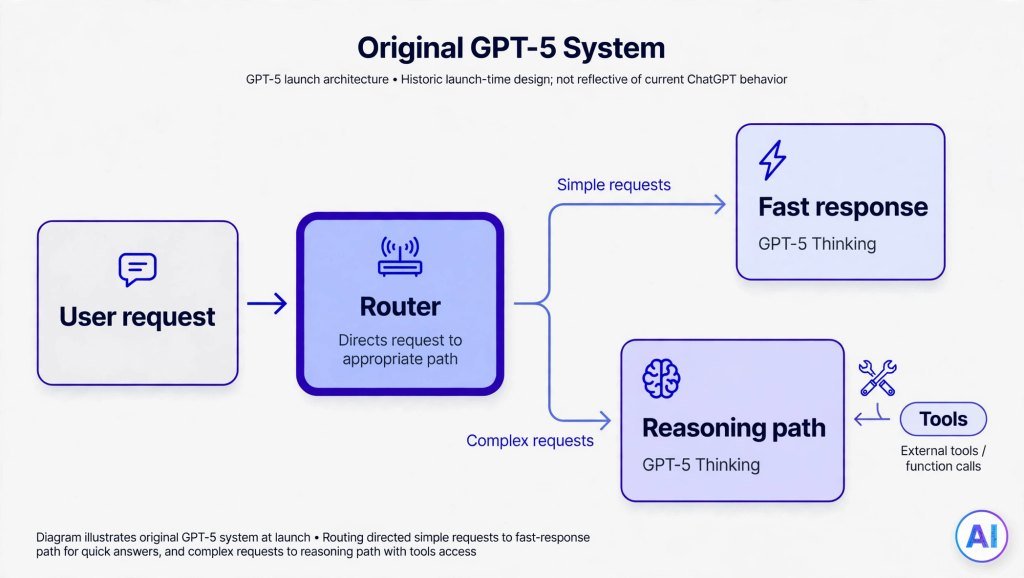
ChatGPT-5 was the ChatGPT experience built around OpenAI’s GPT-5 model family. At launch, it combined an efficient response model, GPT-5 Thinking for demanding tasks, and a real-time router that selected the appropriate mode based on complexity, tools, and user intent.
For example, ChatGPT-5 could quickly rewrite a short email, then switch to deeper reasoning when asked to debug code, solve a multi-step math problem, or analyze a complicated document. The goal was to remove the need for users to manually choose between a fast model and a reasoning model for every request.
OpenAI described GPT-5 as its “smartest, fastest, and most useful model” at its August 2025 launch. That statement was accurate for the launch period, but it should not be interpreted as a description of OpenAI’s current leading model.openai
If you are new to the technology, it helps to first understand how ChatGPT works and what GPT stands for. Those fundamentals make the differences between ChatGPT-5, GPT-5 Thinking, and later models easier to follow.
Why ChatGPT-5 Mattered
ChatGPT-5 mattered because it changed the way users interacted with ChatGPT. Earlier, people often had to decide whether a task needed a standard conversational model or a separate reasoning model. GPT-5 simplified that decision by bringing both capabilities into one auto-switching system.developers.openai
For casual users, this meant fewer technical choices and more natural conversations. For professionals, it meant a single assistant that could move from drafting an email to analyzing a spreadsheet, planning a project, or working through code without requiring a model change.
It also marked a shift toward agentic AI: systems that can follow longer instructions, use tools, adapt to changing context, and complete multi-step work. OpenAI highlighted GPT-5’s improvements in context recognition, structured thinking, problem-solving, and long chains of tool calls.openai+1
GPT-5 Features and Reasoning Architecture
The defining ChatGPT-5 feature was its unified architecture. Rather than treating quick chat and deep reasoning as separate products, GPT-5 used automatic routing to send each request to the most suitable mode.
Automatic reasoning and routing
GPT-5’s router evaluated the conversation type, task difficulty, tool requirements, and explicit user instructions. A prompt such as “think hard about this” could trigger more reasoning effort, while a routine question could receive a faster response.
This design was important because reasoning improves accuracy on complicated tasks but adds latency and cost. ChatGPT-5 applied deeper thinking selectively, balancing speed with problem-solving depth.
GPT-5 Thinking
GPT-5 Thinking was the deeper-reasoning mode within the ChatGPT-5 system. It was intended for mathematics, coding, science, planning, research-style questions, and multi-step tasks that benefited from tool use.
During its availability period, paid ChatGPT users could select GPT-5 Thinking manually from the model picker. They could also encourage more deliberate reasoning through prompts such as “think carefully” or “think hard about this.”
GPT-5 Pro
GPT-5 Pro was a more compute-intensive variant designed for the hardest problems. OpenAI said it used extended reasoning and parallel test-time compute to deliver more comprehensive responses than standard GPT-5 Thinking.
It was available to ChatGPT Pro subscribers and replaced o3-pro in OpenAI’s lineup at launch. GPT-5 Pro was not simply a faster version of ChatGPT-5; it prioritized depth, reliability, and thorough analysis over speed.
Developer controls
In the API, GPT-5 also introduced a “minimal” reasoning option and a “verbosity” parameter. These controls gave developers more influence over how much reasoning the model applied and how detailed its responses should be.openai
That mattered for product teams building customer support tools, coding assistants, research workflows, or automation systems. A developer could favor lower latency for routine requests while allowing more extensive reasoning for difficult tasks.openai
How GPT-5 Improved on GPT-4o
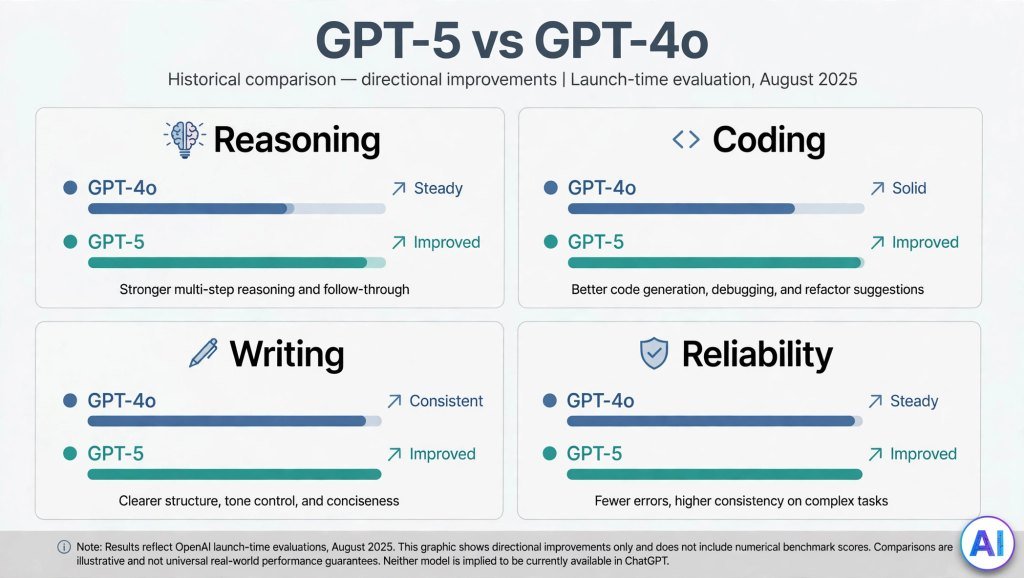
The GPT-5 vs GPT-4o comparison became popular because GPT-5 replaced GPT-4o as ChatGPT’s default model. OpenAI’s launch evaluation showed improvements in reasoning, coding, instruction following, multimodal understanding, and factual reliability.
| Area | GPT-4o | Original GPT-5 |
|---|---|---|
| Model approach | General-purpose multimodal model | Unified system with fast responses, Thinking mode, and automatic routing |
| Reasoning | Strong, but users often selected a separate reasoning model | Reasoning could be applied automatically or selected through GPT-5 Thinking |
| Coding | Capable general assistance | OpenAI described it as its strongest coding model at launch, with gains in front-end generation and large-repository debugging |
| Writing | Fluent and conversational | Better handling of structure, tone, literary form, and complex drafting, according to OpenAI’s launch evaluation |
| Factual reliability | More prone to factual errors in OpenAI’s tested conditions | About 45% fewer factual errors than GPT-4o with web search enabled on representative production prompts |
| Current ChatGPT status | Retired from ChatGPT on February 13, 2026 | Original GPT-5 Instant and Thinking also retired from ChatGPT on February 13, 2026 |
This table should be read historically. GPT-4o and the original ChatGPT-5 models have both been retired from ChatGPT, so neither is a current default option in the consumer app.
GPT-5 Coding, Writing, and Multimodal Work
Coding and debugging
Coding was one of ChatGPT-5’s strongest launch capabilities. OpenAI said GPT-5 was particularly better at generating complex front-end interfaces and debugging larger codebases, including creating responsive websites, apps, and games from a single prompt.
For developers, the value extended beyond writing new code. GPT-5 was designed to follow multi-step instructions, use tools, and adapt when context changed—skills that matter for debugging, refactoring, documentation, and agentic workflows.
OpenAI reported that GPT-5 scored 74.9% on SWE-bench Verified and 88% on Aider Polyglot. SWE-bench Verified measures performance on a fixed subset of validated real-world software-engineering tasks, while Aider Polyglot tests code editing across programming languages; the two scores measure different things and should not be treated as interchangeable.
In practical use, this meant GPT-5 could help turn an idea into a working interface, explain unfamiliar code, identify likely causes of an error, or suggest a refactor. Still, generated code needed review—especially for security, data handling, production deployments, and business-critical logic.openai
Writing and creative work
ChatGPT-5 was also positioned as a stronger writing collaborator than GPT-4o. OpenAI highlighted improvements in handling structural ambiguity, including maintaining demanding poetic forms and producing free verse with a natural flow.
For everyday users, this meant more useful assistance with reports, emails, outlines, editing, and long-form drafting. OpenAI also said GPT-5 was less excessively agreeable, used fewer unnecessary emojis, and asked more measured follow-up questions than GPT-4o.
The practical difference was steerability. Instead of producing overly generic text, GPT-5 was designed to respond more precisely to tone, format, audience, and constraints. That made it more useful for professionals who needed drafts that matched a specific brand voice or communication style.openai
Images, charts, and visual reasoning
GPT-5 was multimodal, meaning it could work beyond plain text. OpenAI reported strong results across visual, video-based, spatial, and scientific reasoning evaluations, including 84.2% on MMMU, a benchmark for multimodal understanding.
In ChatGPT, this supported tasks such as interpreting charts, summarizing photographed slides, or answering questions about diagrams. Benchmark performance did not guarantee correct interpretation of every image, so users still needed to verify important visual analysis.
Accuracy, Safety, and Limitations
ChatGPT-5 reduced several failure modes seen in earlier ChatGPT models, but it did not eliminate them. OpenAI reported that, with web search enabled on anonymized prompts representative of ChatGPT production traffic, GPT-5 responses were about 45% less likely to contain a factual error than GPT-4o responses. When thinking, GPT-5 was about 80% less likely to contain a factual error than o3 under the same tested conditions.
OpenAI also reported a reduction in “deception,” where a model claims to have completed a task it could not actually perform. In one multimodal test where images were removed from prompts, GPT-5 gave confident answers about nonexistent images 9% of the time, compared with 86.7% for o3.
These improvements were meaningful, but they were measured under specific evaluation conditions. Readers should still independently verify important facts, code, medical guidance, legal questions, and financial decisions. OpenAI positioned ChatGPT, including GPT-5 at launch, as a partner for understanding health information rather than a replacement for a medical professional.
Safety approach
GPT-5 introduced OpenAI’s “safe completions” approach. Instead of choosing only between full compliance and refusal, the model was trained to provide the most helpful safe response possible—such as answering at a high level, partially answering, explaining a refusal, or suggesting a safer alternative.
OpenAI also treated GPT-5 Thinking as high capability in the biological and chemical domain and applied additional safeguards, including threat modeling, classifiers, reasoning monitors, and enforcement processes.
GPT-5 Benchmark Results in Context
OpenAI’s launch announcement reported several state-of-the-art results for August 2025:
- 94.6% on AIME 2025 without tools, a mathematics competition benchmark.
- 74.9% on SWE-bench Verified, using a fixed subset of 477 verified software-engineering tasks.
- 88% on Aider Polyglot, a coding-editing evaluation.
- 84.2% on MMMU, a multimodal understanding benchmark.
- 46.2% on HealthBench Hard, an evaluation based on realistic health scenarios and physician-defined criteria.
- 88.4% on GPQA without tools for GPT-5 Pro, a benchmark containing difficult science questions.
These numbers show that ChatGPT-5 advanced over earlier models in the areas OpenAI tested. They do not guarantee that the model would solve every coding ticket, math problem, image-analysis task, or health question correctly.
Benchmarks are best used as directional evidence. A high score on a coding benchmark does not mean a model will understand your company’s private codebase, and a strong math result does not mean every calculation will be correct without review.
Is the Original GPT-5 Still Available in ChatGPT?
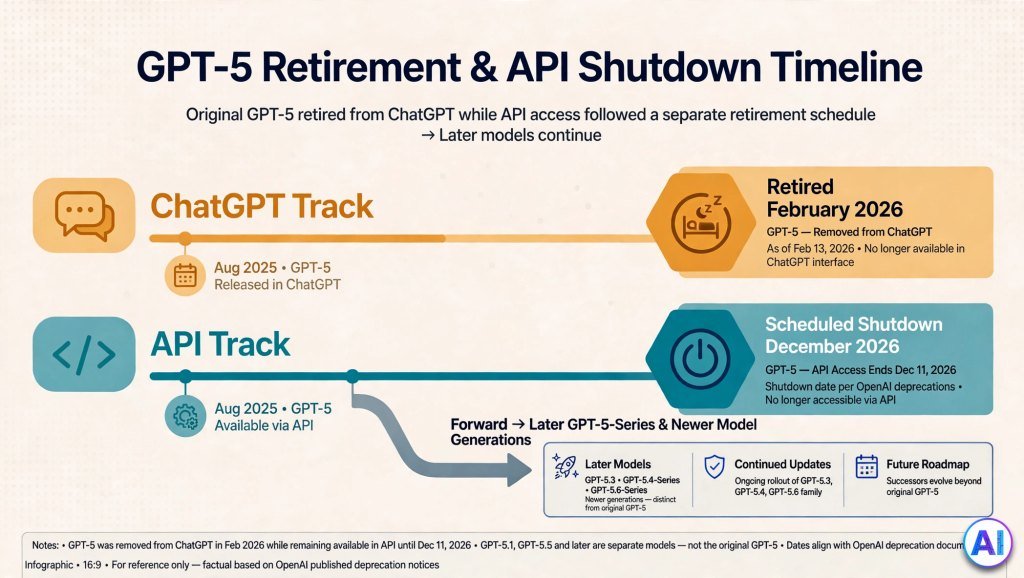
No. The original GPT-5 Instant and GPT-5 Thinking models were retired from ChatGPT on February 13, 2026. OpenAI’s retirement documentation lists them alongside GPT-4o, GPT-4.1, GPT-4.1 mini, and o4-mini as models no longer available for use in ChatGPT.
GPT-5 Pro remained available to paid users slightly longer, through February 19, 2026. Enterprise workspaces also retained GPT-5 model access through that date before the standard retirement process.
This is the key distinction many articles miss: ChatGPT-5 was available in ChatGPT in 2025, but the original GPT-5 is not a current selectable ChatGPT model as of October 30, 2026.
Is GPT-5 Still Available Through the API?
Partly—but not for much longer. OpenAI deprecated the original GPT-5 API models on June 11, 2026 and scheduled their removal for December 11, 2026.
| API model | Status as of October 30, 2026 | Scheduled shutdown | Listed replacement |
|---|---|---|---|
gpt-5 / gpt-5-2025-08-07 | Deprecated; scheduled for removal | December 11, 2026 | gpt-5.6-sol |
gpt-5-mini / gpt-5-mini-2025-08-07 | Deprecated; scheduled for removal | December 11, 2026 | gpt-5.6-terra |
gpt-5-nano / gpt-5-nano-2025-08-07 | Deprecated; scheduled for removal | December 11, 2026 | gpt-5.6-luna |
gpt-5-pro / gpt-5-pro-2025-10-06 | Deprecated; scheduled for removal | December 11, 2026 | gpt-5.6-sol with reasoning.mode: pro |
API availability is separate from ChatGPT availability. A model can remain callable by developers after it has been removed from the ChatGPT interface, and OpenAI’s documentation explicitly separates those lifecycles.
What Replaced GPT-5?
OpenAI did not replace the original ChatGPT-5 with one single successor. The company released a sequence of GPT-5-series variants, followed by newer model generations.
- GPT-5.1 arrived after the original GPT-5 and introduced Instant, Thinking, and Pro variants. Those GPT-5.1 models were retired from ChatGPT on March 11, 2026, though OpenAI’s API documentation still listed
gpt-5.1for API shutdown on April 1, 2027. - GPT-5.5 followed in April 2026, with OpenAI emphasizing agentic coding, computer use, knowledge work, and scientific research. It was retired from ChatGPT, ChatGPT Work, and Codex on October 14, 2026; OpenAI stated that this retirement did not affect API access.
- GPT-6 is rolling out in ChatGPT to eligible Pro, Plus, Enterprise, and Business users, according to OpenAI’s current GPT-5 help documentation.
- GPT-5.6-series API models, including
gpt-5.6-sol,gpt-5.6-terra, andgpt-5.6-luna, appear in OpenAI’s deprecation documentation as recommended replacements for the original GPT-5 API models.
For anyone researching ChatGPT-5 today, the useful takeaway is that “GPT-5” can refer to the original August 2025 model, the broader GPT-5 family, or later numbered variants. Those are not interchangeable. For broader context, see this ChatGPT release timeline and this guide to ChatGPT Pro plans.
Should You Still Use GPT-5?
For most ChatGPT users, the question is now settled: the original ChatGPT-5 is no longer selectable in the consumer app. If you are building with the OpenAI API, the original gpt-5 model remains on a documented deprecation path and is scheduled to stop working on December 11, 2026.
For new projects, OpenAI’s deprecation page recommends migrating to the listed replacement models rather than starting with a model that has an announced shutdown date. Developers should test prompts, tool calls, output formatting, latency, and cost behavior against the replacement before moving production traffic.
Conclusion
ChatGPT-5 was a major turning point for OpenAI because it combined fast responses, automatic routing, deeper reasoning, stronger coding, improved instruction following, and better factual reliability in one ChatGPT experience. Its launch capabilities made it a clear advance over GPT-4o in the areas OpenAI measured in August 2025.
However, ChatGPT-5 is now part of AI history rather than a current ChatGPT model. The original GPT-5 Instant and Thinking variants were retired from ChatGPT in February 2026, while the original GPT-5 API models are scheduled to shut down in December 2026.
If you are choosing a model today, treat ChatGPT-5 as an important predecessor: understand its best features and limitations, but verify the current model picker in ChatGPT and OpenAI’s live API deprecation page before relying on any specific model name.
FAQs
What is ChatGPT-5?
ChatGPT-5 was OpenAI’s ChatGPT experience built around the GPT-5 model family, launched on August 7, 2025. It combined fast answers, GPT-5 Thinking for harder problems, and automatic routing between the two.
What were the main GPT-5 features?
Its main features were a unified model system, automatic reasoning and routing, improved instruction following, stronger coding and debugging, better writing support, multimodal understanding, tool use, and reduced hallucinations relative to earlier models under OpenAI’s tested conditions.
How did GPT-5 improve reasoning and coding?
GPT-5 could apply deeper reasoning when a task warranted it, while GPT-5 Thinking handled more demanding problems. For coding, OpenAI reported improvements in front-end generation, debugging larger repositories, and agentic tool use.
How did GPT-5 compare with GPT-4o?
GPT-5 replaced GPT-4o as ChatGPT’s default model at launch and offered stronger reasoning, coding, multimodal understanding, and factual reliability in OpenAI’s reported evaluations. Both models have since been retired from ChatGPT.
Is the original GPT-5 still available in ChatGPT?
No. GPT-5 Instant and GPT-5 Thinking were retired from ChatGPT on February 13, 2026. GPT-5 Pro remained available to paid users through February 19, 2026.
Is GPT-5 still available through the API?
The original GPT-5 API models were deprecated on June 11, 2026 and are scheduled to be removed on December 11, 2026. OpenAI lists gpt-5.6-sol as the recommended replacement for gpt-5.
What is the difference between GPT-5 and GPT-5 Pro?
GPT-5 was the main unified system, while GPT-5 Pro was a more compute-intensive variant that used extended reasoning for especially complex tasks. OpenAI reported that external experts preferred GPT-5 Pro over GPT-5 Thinking on 67.8% of more than 1,000 economically valuable reasoning prompts.
What models followed GPT-5?
Later GPT-5-series releases included GPT-5.1 and GPT-5.5, followed by newer generations including GPT-6 and GPT-5.6-series API models. These are separate models, not merely renamed versions of the original GPT-5.
Sources and References
- OpenAI, “Introducing GPT-5,” August 7, 2025 — https://openai.com/index/introducing-gpt-5/
- OpenAI, “GPT-5 is here” — https://openai.com/gpt-5/openai
- OpenAI, “GPT-5 and the new era of work,” August 7, 2025 — https://openai.com/index/gpt-5-new-era-of-work/help.openai
- OpenAI Help Center, “Retiring GPT-4o and other ChatGPT models” — https://help.openai.com/en/articles/20001051-retiring-gpt-4o-and-other-chatgpt-models
- OpenAI Developers, “Deprecations” — https://developers.openai.com/api/docs/deprecations.md
- OpenAI Help Center, “Model Release Notes” — https://help.openai.com/en/articles/9624314-model-release-notes
- OpenAI Help Center, “ChatGPT Release Notes” — https://help.openai.com/en/articles/6825453help.openai
- OpenAI, “Introducing GPT-5.5,” April 23, 2026 — https://openai.com/index/introducing-gpt-5-5/
- OpenAI Help Center, “GPT-5 in ChatGPT” — https://help.openai.com/en/articles/11909943-gpt-5-in-chatgpt